
[Paper Review] New forms of attraction: Attractor saddles for the black hole index
This paper introduces a new attractor mechanism in $χ=2$ supergravity where smooth, finite-temperature, supersymmetric black hole solutions—called attractor saddles—emerge as saddles in the gravitational path integral. These solutions exhibit scalar and gauge field attraction to moduli- and temperature-independent values at the poles, while the free energy depends only on black hole charges, matching the string theory index and resolving the long-standing tension between the supersymmetric index and extremal black hole entropy.
The count of microstates for supersymmetric black holes is typically obtained from a supersymmetric index in weakly-coupled string theory. We find the saddles in the gravitational path integral corresponding to this index in a general theory of $N=2$ supergravity in asymptotically flat space. This saddle exhibits a new attractor mechanism which explains the agreement between the string theory index and the macroscopic entropy. These saddles are smooth, complex Euclidean spinning black holes that are supersymmetric but not extremal, i.e., they are formally finite-temperature solutions. With this new mechanism, the scalars and the electromagnetic fields get attracted to temperature- and moduli-independent values at the north and south poles of the rotating black hole, although they vary along the Euclidean horizon in a non-universal way. Further, although the area and the spin of the black hole depend non-trivially on the temperature and on the moduli, the free energy is essentially a function only of the black hole charges (apart from a trivial dependence on the temperature and the moduli through the BPS mass), and agrees with the string theory index.
Motivation & Objective
- To resolve the tension between the supersymmetric index in weakly-coupled string theory and the macroscopic entropy of supersymmetric black holes.
- To identify gravitational path integral saddles in asymptotically flat $χ=2$ supergravity that reproduce the string theory index.
- To explain how the free energy of these saddles depends only on black hole charges, despite non-trivial dependence on temperature and moduli.
- To provide a unified framework where the supersymmetric index and black hole entropy agree via smooth, non-extremal, supersymmetric Euclidean solutions.
Proposed method
- Identify smooth, complex Euclidean spinning black hole solutions in $χ=2$ supergravity that are supersymmetric but not extremal.
- Analyze the gravitational path integral with asymptotically flat boundary conditions, focusing on saddle-point contributions.
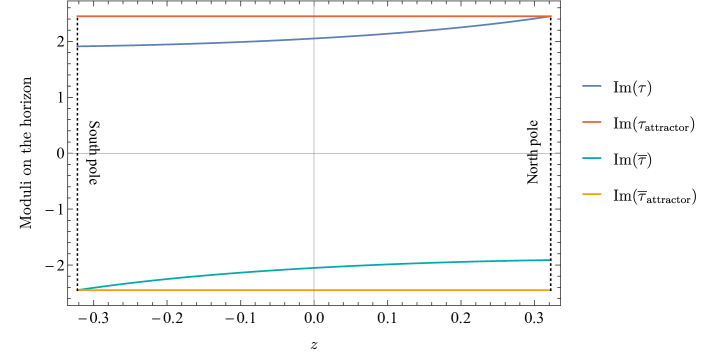
- Demonstrate that scalar fields and gauge fields are attracted to values independent of moduli and temperature at the north and south poles.
- Show that the on-shell action (free energy) depends only on black hole charges, with trivial dependence on temperature and moduli via the BPS mass.
- Use the attractor mechanism to explain the independence of the index from moduli and temperature.
- Construct solutions via a Taub-NUT bubble geometry to realize the new attractor mechanism in Euclidean signature.
Experimental results
Research questions
- RQ1How can the supersymmetric index in string theory be reproduced in a gravitational path integral framework with asymptotically flat boundary conditions?
- RQ2What is the nature of the attractor mechanism in non-extremal, finite-temperature, supersymmetric black hole solutions?
- RQ3Why does the free energy of the saddle-point solution depend only on black hole charges, despite non-trivial dependence on temperature and moduli?
- RQ4How do scalar and gauge fields behave in these new attractor saddles, and why are their values independent of asymptotic moduli and temperature?
- RQ5Can the agreement between the string theory index and black hole entropy be explained in a single, consistent formalism using smooth, non-extremal solutions?
Key findings
- The paper identifies smooth, finite-temperature, supersymmetric black hole solutions in $χ=2$ supergravity that serve as saddles in the gravitational path integral.
- These solutions exhibit a new attractor mechanism where scalars and gauge fields are fixed to moduli- and temperature-independent values at the poles, despite varying along the Euclidean horizon.
- The free energy of the saddle is a function only of black hole charges, with trivial dependence on temperature and moduli through the BPS mass, matching the string theory index.
- The on-shell action of these saddles reproduces the statistical entropy from the supersymmetric index, resolving the long-standing mismatch.
- The solutions are non-extremal but still supersymmetric, with a smooth Euclidean geometry that avoids the cusp problems of previous finite-temperature Euclidean black hole constructions.
- The attractor mechanism is realized via a Taub-NUT bubble construction, providing a geometric realization of the new attractor behavior in asymptotically flat space.
Better researchstarts right now
From reading papers to final review, dramatically reduce your research time.
No credit card · Free plan available
This review was created by AI and reviewed by human editors.