
[Paper Review] Orbital Hall effect and topology on a two-dimensional triangular lattice: from bulk to edge
This study investigates the orbital Hall effect and topological phases in a multi-orbital tight-binding model on a triangular lattice, modeling transition metal dichalcogenide monolayers. By tuning orbital hybridization and symmetry-breaking mechanisms, it identifies four distinct topological phases, demonstrating that the orbital Hall effect emerges in the absence of spin Hall conductivity in higher-order topological insulators, with orbital angular momentum carried by edge states that lack topological protection against disorder.
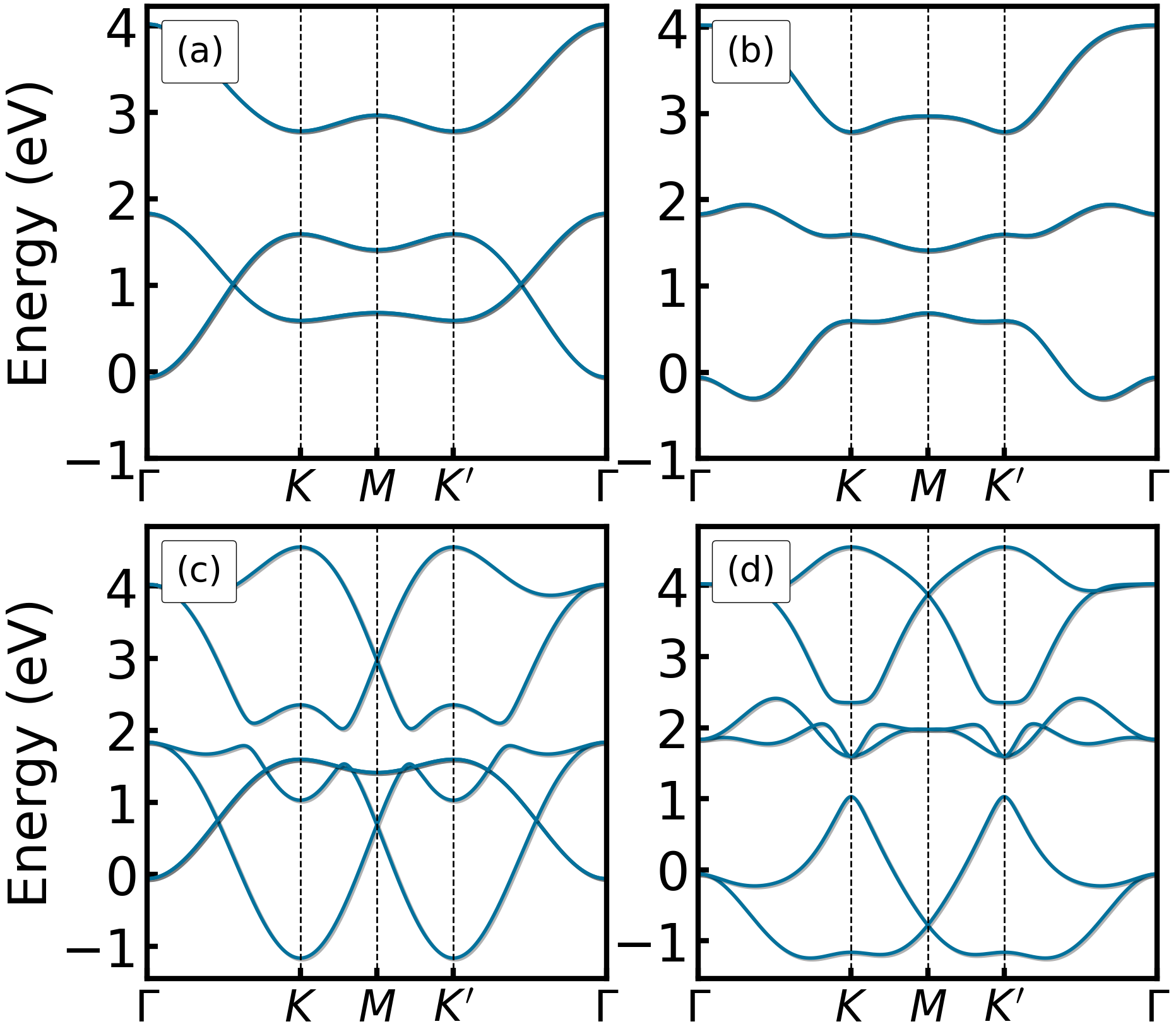
We investigate a generalized multi-orbital tight-binding model on a triangular lattice, a system prevalent in a wide range of two-dimensional materials, and particularly relevant for simulating transition metal dichalcogenide monolayers. We show that the interplay between spin-orbit coupling and different symmetry-breaking mechanisms leads to the emergence of four distinct topological phases [Eck, P., extit{et al.}, Phys. Rev. B, 107 (11), 115130 (2023)]. Remarkably, this interplay also triggers the orbital Hall effect with distinguished characteristics. Furthermore, by employing the Landauer-Büttiker formula, we establish that in the orbital Hall insulating phase, the orbital angular momentum is carried by edge states present in nanoribbons with specific terminations. We also show that, as expected, they do not have topological protection against the disorder of the edge states belonging to a first-order topological insulator.
Motivation & Objective
- To understand the interplay between spin-orbit coupling and symmetry-breaking mechanisms in inducing topological phases on a triangular lattice.
- To investigate the emergence of the orbital Hall effect in multi-orbital systems, particularly in transition metal dichalcogenide monolayers.
- To determine the role of edge states in carrying orbital angular momentum in nanoribbons with specific terminations.
- To assess the robustness of orbital and spin Hall currents against scalar disorder using quantum transport formalisms.
- To clarify the connection between higher-order topological insulating phases and the orbital Hall effect in centrosymmetric systems.
Proposed method
- Employed a generalized multi-orbital tight-binding model on a triangular lattice with $d_{z^2}$, $d_{xy}$, and $d_{x^2-y^2}$ orbitals to simulate transition metal dichalcogenide monolayers.
- Systematically modified hopping terms to control orbital hybridization and break symmetries, enabling exploration of distinct topological phases.
- Applied the Kubo formalism to calculate bulk orbital and spin conductivities and the Landauer-Büttiker formula to analyze edge transport in nanoribbons.
- Incorporated Anderson disorder via site-random on-site potential with uniform distribution $(-U/2, U/2)$ to test robustness of Hall currents.
- Used band structure analysis and Berry curvature mapping to identify topological invariants and phase transitions.
- Compared results across different ribbon terminations (e.g., flat vs. zigzag) to assess symmetry-dependent transport behavior.
Experimental results
Research questions
- RQ1How does the interplay between spin-orbit coupling and symmetry-breaking mechanisms lead to distinct topological phases in a 2D triangular lattice?
- RQ2In which topological phases does the orbital Hall effect emerge, and how does it differ from the spin Hall effect in terms of quantization and transport characteristics?
- RQ3Can orbital angular momentum be transported via edge states in nanoribbons, and what determines their existence and robustness?
- RQ4Are the edge states carrying orbital angular momentum topologically protected against disorder, and how does this compare to first-order topological insulators?
- RQ5What is the relationship between higher-order topological insulating phases and the emergence of the orbital Hall effect in centrosymmetric systems?
Key findings
- Four distinct topological phases were identified through tuning orbital hybridization and symmetry-breaking, with two being first-order topological insulators and two being higher-order topological insulators.
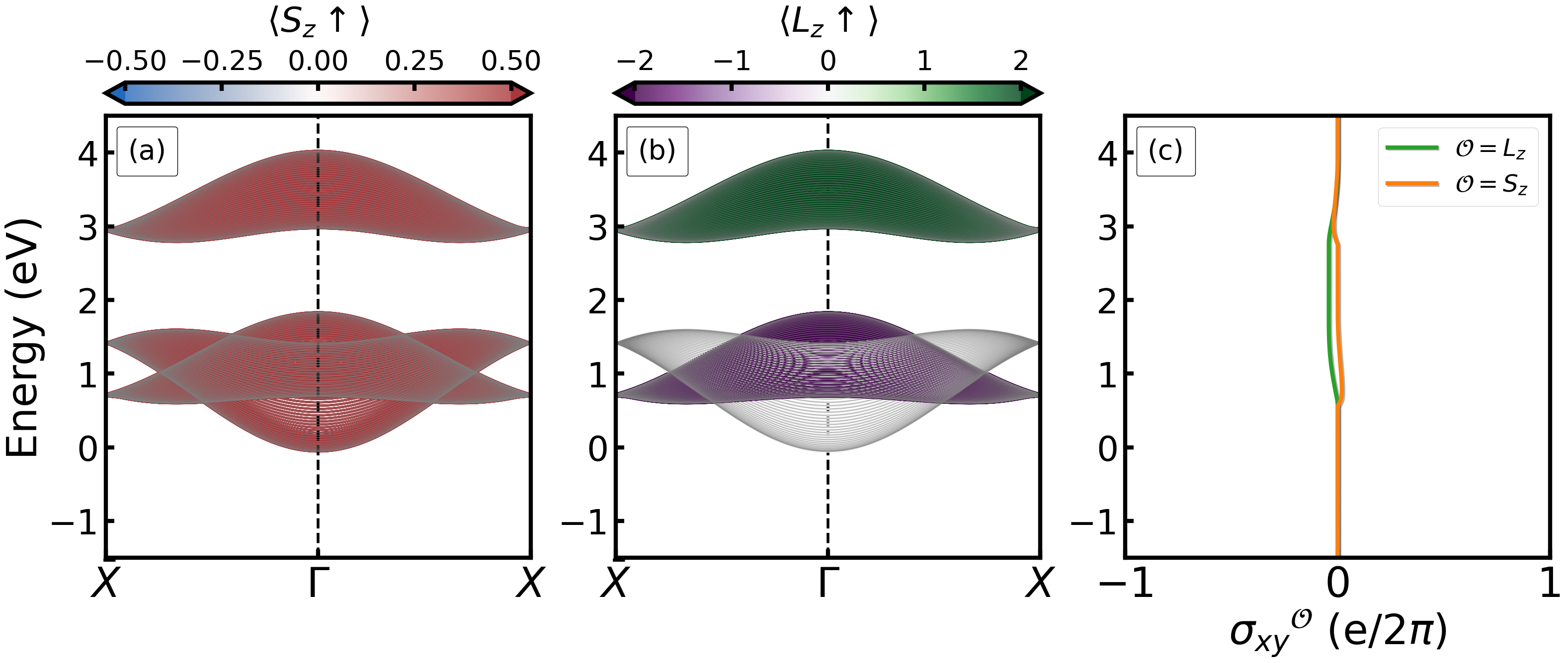
- The orbital Hall effect emerges in the absence of spin Hall conductivity in the higher-order topological insulating phase, with a non-quantized orbital Hall plateau.
- In the orbital Hall insulating phase, orbital angular momentum is carried by edge states in nanoribbons with flat terminations, as confirmed by Landauer-Büttiker transport calculations.
- Unlike first-order topological insulators, the edge states responsible for orbital angular momentum transport are not topologically protected against scalar disorder, as evidenced by a decreasing orbital Hall current with increasing disorder strength.
- The spin Hall current remains quantized and robust under disorder in first-order topological phases, while the orbital Hall current shows a monotonic decrease, indicating lack of topological protection.
- The orbital Hall effect persists in mesoscopic MoS₂ monolayer devices under disorder, but its plateau value is suppressed, confirming the absence of topological protection for orbital edge states.
Read this paper
Open the full text in the Nubint reader and ask about any passage as you read.
Read this paper on NubintThis review was generated by AI from the original paper. Please check the paper before citing it.