
[Paper Review] Payroll Tax Incidence: Evidence from Unemployment Insurance
This paper examines payroll tax incidence using state-level unemployment insurance (UI) tax increases in the U.S., exploiting employer-specific and time-varying tax variation. It finds that firms pass through minimal tax burdens to workers, instead reducing hiring and employment growth—especially for young and low-earning workers—indicating significant labor demand effects and limited wage pass-through.
Economic models assume that payroll tax burdens fall fully on workers, but where does tax incidence fall when taxes are firm-specific and time-varying? Unemployment insurance in the United States has the key feature of varying both across employers and over time, creating the potential for labor demand responses if tax costs cannot be fully passed on to worker wages. Using state policy changes and matched employer-employee job spells from the LEHD, I study how employment and earnings respond to payroll tax increases for highly exposed employers. I find significant drops in employment growth driven by lower hiring, and minimal evidence of pass-through to earnings. The negative employment effects are strongest for young and low-earning workers.
Motivation & Objective
- To estimate the incidence of employer-specific, time-varying payroll taxes on workers’ earnings and employment outcomes.
- To assess whether firms pass on UI tax increases to workers through wage changes or instead reduce hiring and employment growth.
- To examine heterogeneous effects across worker demographics, firm size, and exposure levels to tax changes.
- To evaluate the role of labor market frictions, such as downward wage rigidity and cash constraints, in shaping tax incidence.
- To contribute U.S.-specific evidence on payroll tax incidence, filling a gap in the literature due to limited federal payroll tax variation.
Proposed method
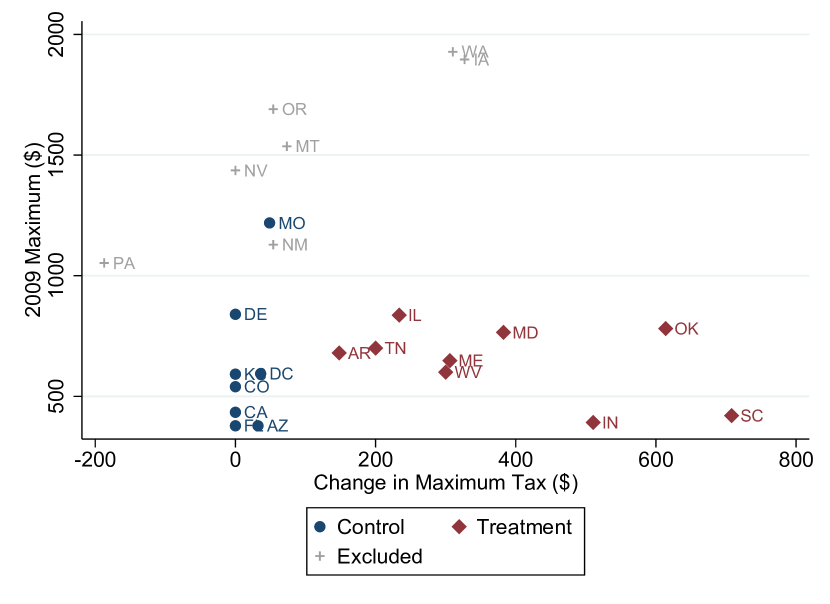
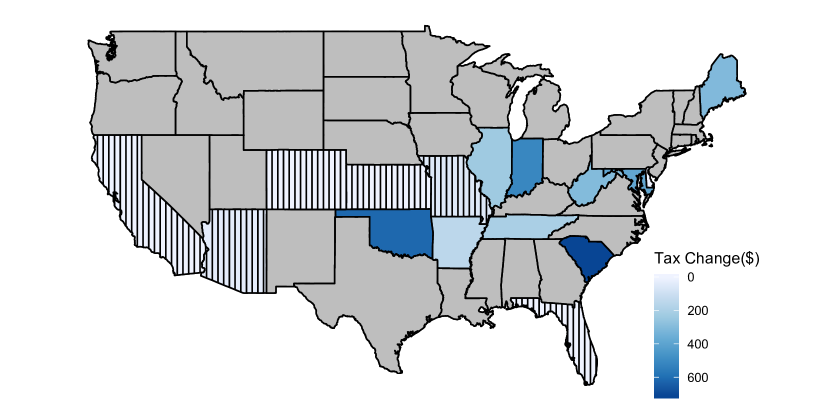
- Uses a difference-in-differences (DiD) design comparing employers in states with UI tax increases (treatment) versus those without (control).
- Employs administrative data from the U.S. Census Bureau’s Longitudinal Employer-Household Dynamics (LEHD) program, linking employer-employee job spells.
- Defines 'highly exposed' employers as those with prior layoff histories, subject to larger UI tax increases.
- Estimates event study models with time-varying tax change indicators to track dynamic responses in earnings and employment growth.
- Applies a triple-difference (DDD) design to compare high- and low-exposure employers within the same state, controlling for state-level economic conditions.
- Uses regression models with fixed effects for workers, firms, states, and time quarters, including controls for minimum wage and lagged earnings.
Experimental results
Research questions
- RQ1To what extent do UI payroll tax increases lead to pass-through of costs to workers through changes in earnings?
- RQ2How do firms respond to firm-specific, time-varying payroll tax increases—through changes in hiring, separations, or wages?
- RQ3Are the employment and earnings effects of UI tax increases heterogeneous across worker groups, such as age, earnings level, or firm size?
- RQ4What is the implied labor demand elasticity in response to UI tax increases, and how does it compare to other studies?
- RQ5How do cash constraints and firm characteristics moderate the response to payroll tax changes?
Key findings
- For each $100 increase in UI payroll taxes per worker, employment growth declined by 0.43 percentage points over the year, driven primarily by reduced hiring.
- The largest employment effects emerged in the second and third years after the tax increase, suggesting delayed and persistent negative impacts on economic recovery.
- Earnings growth for existing workers declined by 0.63% in the first quarter after the tax increase, but this effect was short-lived and implied a maximum pass-through rate of 90%, indicating incomplete wage pass-through.
- The negative employment effects were strongest for workers under age 25 and low-earning workers, with the latter also experiencing larger drops in earnings growth.
- Single-establishment firms reduced hiring more than multi-establishment firms, suggesting that cash constraints amplify the response to tax increases.
- Labor demand elasticity estimates ranged from -1.1 (Q1) to -2.4 (end of year), consistent with but on the lower end of elasticities found in similar studies on payroll taxes.
Better researchstarts right now
From reading papers to final review, dramatically reduce your research time.
No credit card · Free plan available
This review was created by AI and reviewed by human editors.