
[Paper Review] Physics of the Majorana-superconducting qubit hybrids
This paper presents a theoretical framework for Majorana-superconducting qubit hybrids, demonstrating how imperfectly coupled Majorana zero modes (MZMs) enhance superconducting qubit functionality through interplay between Cooper pair tunneling and single-electron tunneling. It derives analytical expressions for the ground state energy across all parameter regimes and reveals rich operational phases, enabling noise suppression, novel qubit control, and unambiguous MZM detection via tunable Josephson physics.
Manipulation of decoupled Majorana zero modes (MZMs) could enable topologically-protected quantum computing. However, the practical realization of a large number of perfectly decoupled MZMs needed to perform nontrivial quantum computation has proven to be challenging so far. Fortunately, even a small number of imperfect MZMs can be used to qualitatively extend the behavior of standard superconducting qubits, allowing for new approaches for noise suppression, qubit manipulation and read-out. Such hybrid devices take advantage of interplay of Cooper pair tunneling, coherent single electron tunneling, and Majorana hybridization. Here we provide a qualitative understanding of this system, give analytical results for its ground state energy spanning full parameter range, and describe potential sensing applications enabled by the interplay between Majorana and Cooper pair tunneling.
Motivation & Objective
- To provide a qualitative and analytical understanding of hybrid systems combining Majorana zero modes (MZMs) and superconducting qubits, overcoming limitations of purely numerical approaches.
- To develop an analytical method for computing the ground state energy of the hybrid system across the full parameter range, including crossover regimes.
- To explore how MZM hybridization enables new functionalities such as enhanced noise suppression, alternative qubit manipulation, and improved read-out protocols.
- To identify practical sensing and detection applications enabled by the interplay between MZM tunneling and Cooper pair tunneling in the hybrid device.
- To establish a physical picture based on coherent charge dynamics that avoids reliance on complex wavefunction boundary condition treatments.
Proposed method
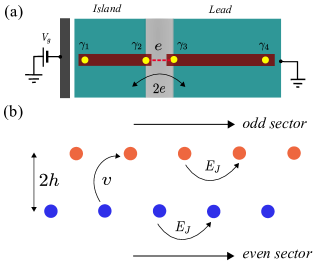
- Formulates a Hamiltonian model for a floating superconducting island coupled to a superconducting lead via Josephson junctions and to two nanowires hosting MZMs, with tunneling terms for Cooper pairs (Josephson coupling $E_J$) and single electrons (Majorana tunneling $v$).
- Introduces a two-sector Hilbert space based on fermion parity (odd and even), with Pauli operators $\sigma_z = i\gamma_1\gamma_2$, $\sigma_x = i\gamma_2\gamma_3$, and $\sigma_y = i\gamma_3\gamma_1$ to describe the system’s non-Abelian degrees of freedom.
- Derives exact analytical expressions for the ground state energy using a combination of effective potential methods and parabolic cylinder functions, particularly in the limit of small $\alpha$ and $l$.
- Applies a generalized WKB-like approach to compute tunnel splitting in the crossover regime between different quantum phases, using symmetric and antisymmetric combinations of wavefunctions.
- Uses the WKB approximation and properties of parabolic cylinder functions $D_{-\eta}(x)$ to derive compact expressions for the tunnel splitting $\Delta^{(3)}$, valid in the $v \gg E_C$ regime.
- Validates the analytical results through asymptotic expansions and matching with known limits, such as the $\alpha \ll 1$, $l \ll 1$ regime, yielding closed-form expressions for $\mathscr{M}_0(\varphi)$ and $\mathscr{M}_1(\varphi)$.
Experimental results
Research questions
- RQ1How does the interplay between Cooper pair tunneling and single-electron tunneling from MZMs modify the energy spectrum of a superconducting qubit?
- RQ2What are the distinct operational regimes of a hybrid MZM-superconducting qubit system, and how do they interconvert via parameter tuning?
- RQ3Can analytical expressions for the ground state energy be derived across the full parameter range, including crossover regions between different quantum phases?
- RQ4How does the hybrid system enable new mechanisms for noise suppression and qubit control beyond standard superconducting qubits?
- RQ5Can the hybrid device serve as a sensitive probe for detecting Majorana zero modes through tunable Josephson physics?
Key findings
- The ground state energy of the hybrid system exhibits rich phase behavior across different parameter regimes, with analytical expressions derived for $\mathscr{M}_0(\varphi)$ and $\mathscr{M}_1(\varphi)$ in the small $\alpha$ and $l$ limit.
- In the limit $\alpha \ll 1$, $l \ll 1$, the ground state energy is given by $\mathscr{M}_0(\varphi) = -\sqrt{v/E_C}\left[2(\sqrt{2}-1) - |\varphi| + \frac{|\varphi|^2}{4} - \frac{l^2}{4\sqrt{2}} - \frac{l^2}{2\sqrt{2}}\log\left(\frac{8(\sqrt{2}-1)}{l}\right)\right]$, capturing the crossover physics.
- The tunnel splitting in the crossover regime is analytically expressed as $\frac{\Delta^{(3)}}{E_C} = 8\mathcal{A}^2\sqrt{v/E_C} D_{-\eta}(0)\sqrt{\eta} D_{-\eta-1}(0)$, with the leading-order contribution dominated by exponential factors in the wavefunction.
- The system supports a tunable Josephson coupling that depends on the MZM hybridization energy $h$ and the single-electron tunneling amplitude $v$, enabling new control protocols.
- The hybrid device exhibits a non-trivial current-phase relationship due to the interplay of MZM and Cooper pair tunneling, which can be exploited for unambiguous MZM detection.
- The analytical framework avoids reliance on complex boundary condition treatments by focusing on coherent charge dynamics, offering a simpler physical picture of the system’s behavior.

Better researchstarts right now
From reading papers to final review, dramatically reduce your research time.
No credit card · Free plan available
This review was created by AI and reviewed by human editors.