
[Paper Review] QFaaS: A Serverless Function-as-a-Service Framework for Quantum Computing
QFaaS is a serverless Function-as-a-Service framework for quantum computing that unifies support for multiple quantum SDKs (Qiskit, Q#, Cirq, Braket) and execution targets (simulators and cloud providers like IBM Quantum and Amazon Braket). It enables hybrid quantum-classical application development through containerization, DevOps integration, and a standardized function lifecycle, significantly reducing the burden on developers during the transition to quantum-native software engineering in the Noisy Intermediate-Scale Quantum era.
Recent breakthroughs in quantum hardware are creating opportunities for its use in many applications. However, quantum software engineering is still in its infancy with many challenges, especially dealing with the diversity of quantum programming languages and hardware platforms. To alleviate these challenges, we propose QFaaS, a novel Quantum Function-as-a-Service framework, which leverages the advantages of the serverless model and the state-of-the-art software engineering approaches to advance practical quantum computing. Our framework provides essential components of a quantum serverless platform to simplify the software development and adapt to the quantum cloud computing paradigm, such as combining hybrid quantum-classical computation, containerizing functions, and integrating DevOps features. We design QFaaS as a unified quantum computing framework by supporting well-known quantum languages and software development kits (Qiskit, Q#, Cirq, and Braket), executing the quantum tasks on multiple simulators and quantum cloud providers (IBM Quantum and Amazon Braket). This paper proposes architectural design, principal components, the life cycle of hybrid quantum-classical function, operation workflow, and implementation of QFaaS. We present two practical use cases and perform the evaluations on quantum computers and simulators to demonstrate our framework's ability to ease the burden on traditional engineers to expedite the ongoing quantum software transition.
Motivation & Objective
- To address the challenges in quantum software engineering, including the steep learning curve, toolchain heterogeneity, and lack of standardized development lifecycles.
- To simplify the development and deployment of hybrid quantum-classical applications by abstracting low-level quantum infrastructure and execution details.
- To accelerate the adoption of quantum computing in industry by enabling traditional software engineers to build and scale quantum functions with minimal quantum mechanics expertise.
- To unify access to diverse quantum programming languages and hardware platforms through a standardized, serverless abstraction layer.
- To support the transition to quantum-native software engineering by integrating DevOps practices and containerization into quantum application workflows.
Proposed method
- Designing a modular, microservices-based architecture that supports multiple quantum SDKs (Qiskit, Q#, Cirq, Braket) through language-agnostic function interfaces.
- Implementing a serverless execution model where quantum functions are packaged as containers and triggered via event-driven workflows.
- Integrating DevOps capabilities such as CI/CD pipelines, logging, monitoring, and version control for quantum functions.
- Supporting hybrid quantum-classical computation by orchestrating classical control logic with quantum circuit execution on simulators or physical devices.
- Enabling seamless deployment across multiple quantum backends, including IBM Quantum and Amazon Braket, via a unified API abstraction layer.
- Using containerization (e.g., Docker) to encapsulate quantum functions and ensure portability and reproducibility across environments.
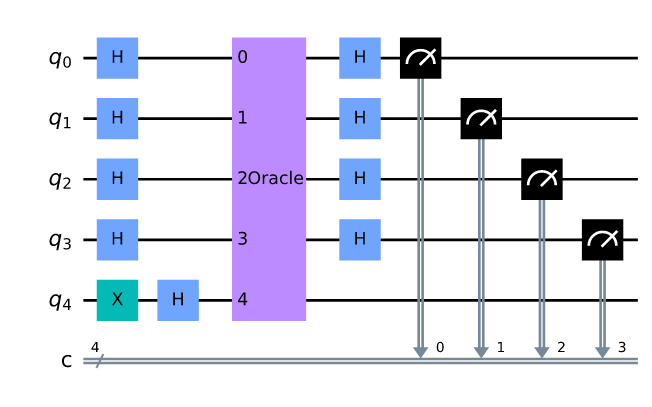
Experimental results
Research questions
- RQ1How can a unified, serverless framework reduce the complexity of developing and deploying quantum applications across heterogeneous quantum SDKs and hardware platforms?
- RQ2To what extent can DevOps and containerization practices be adapted to quantum software engineering to improve reliability, scalability, and maintainability?
- RQ3Can a function-as-a-service abstraction effectively support hybrid quantum-classical workloads with minimal performance overhead?
- RQ4How does the QFaaS framework enable traditional software engineers to build quantum applications without deep expertise in quantum mechanics?
- RQ5What is the feasibility and performance of executing quantum functions on real quantum hardware and simulators through a standardized, cloud-based interface?
Key findings
- QFaaS successfully supports the execution of hybrid quantum-classical functions across multiple quantum SDKs, including Qiskit, Q#, Cirq, and Braket, enabling interoperability across diverse development environments.
- The framework demonstrates end-to-end support for quantum function lifecycle management, including deployment, invocation, monitoring, and versioning, through a standardized interface.
- Evaluation on IBM Quantum and Amazon Braket platforms confirms the framework’s ability to execute quantum tasks reliably on both real devices and simulators.
- The integration of DevOps and containerization practices in QFaaS reduces the operational burden on developers and improves reproducibility and scalability of quantum applications.
- The framework enables non-quantum experts to develop and deploy quantum functions with minimal quantum mechanics knowledge, accelerating the transition to quantum-native software engineering.
- QFaaS is open-sourced and available on GitHub, fostering community collaboration and future extensibility to additional quantum providers and SDKs.
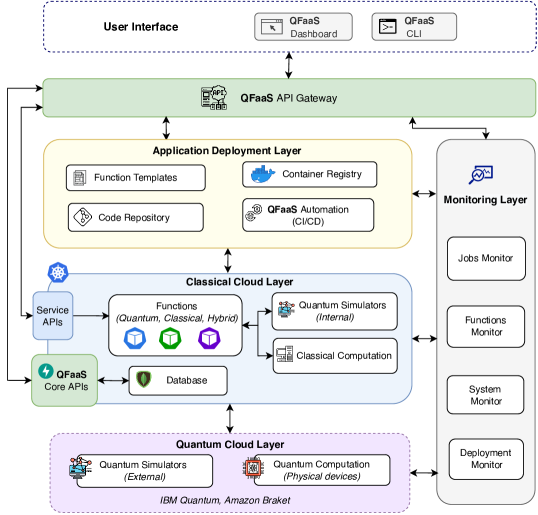
Read this paper
Open the full text in the Nubint reader and ask about any passage as you read.
Read this paper on NubintThis review was generated by AI from the original paper. Please check the paper before citing it.