
[论文解读] Quantum Alternating Operator Ansatz (QAOA) beyond low depth with gradually changing unitaries
本文提出一种离散绝热定理框架,用于分析参数渐变的量子交替算符试探态(QAOA)在浅层电路之外的行为。它解释了为何在大角度下性能下降,原因在于酉算符本征值环绕导致本征态连通性发生变化,揭示了浅层电路可能优于深层电路,且各类问题的性能图均表现出普遍性的定性特征。
The Quantum Approximate Optimization Algorithm and its generalization to Quantum Alternating Operator Ansatz (QAOA) is a promising approach for applying quantum computers to challenging problems such as combinatorial optimization and computational chemistry. In this paper, we study the underlying mechanisms governing the behavior of QAOA circuits beyond shallow depth in the practically relevant setting of gradually varying unitaries. We use the discrete adiabatic theorem, which complements and generalizes the insights obtained from the continuous-time adiabatic theorem primarily considered in prior work. Our analysis explains some general properties that are conspicuously depicted in the recently introduced QAOA performance diagrams. For parameter sequences derived from continuous schedules (e.g. linear ramps), these diagrams capture the algorithm's performance over different parameter sizes and circuit depths. Surprisingly, they have been observed to be qualitatively similar across different performance metrics and application domains. Our analysis explains this behavior as well as entails some unexpected results, such as connections between the eigenstates of the cost and mixer QAOA Hamiltonians changing based on parameter size and the possibility of reducing circuit depth without sacrificing performance.
研究动机与目标
- 理解在参数渐变条件下,QAOA在浅层深度之外的行为。
- 解释近期在优化与量子化学问题中观察到的QAOA性能图中普遍存在的定性特征。
- 研究大参数规模下性能下降的机制,特别是本征态连通性变化的作用。
- 提供一个将连续绝热定理推广至离散、基于酉算符的QAOA演化理论框架。
- 通过识别可在不牺牲性能的前提下减少电路深度的条件,实现更优的参数调度设计。
提出的方法
- 将离散绝热定理应用于建模QAOA演化为一系列渐变的酉算符,而非连续哈密顿量演化。
- 利用全息理论及复单位圆上本征值环绕的数学结构,解释非绝热跃迁。
- 通过离散化兰道-齐默曼公式表征非绝热跃迁,估算小能隙处的失败概率。
- 借助微扰理论分析参数增大时的本征态连通性变化,尤其在临界角度附近。
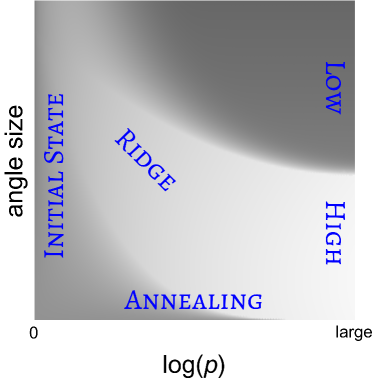
- 通过将参数空间映射为行为定性不同的区域(如:绝热区、脊线区、高区、低区)来推导性能图。
- 利用数值与解析工具验证深层QAOA电路中本征态演化与性能趋势的预测。
实验结果
研究问题
- RQ1为何QAOA性能图在不同问题与性能度量下,即使在深层电路中也表现出定性相似的结构?
- RQ2为何在QAOA性能图右上区域大参数规模下观察到性能突然下降?
- RQ3在深层QAOA电路中,由于酉算符本征值环绕,代价哈密顿量与混合哈密顿量之间的本征态连通性如何变化?
- RQ4浅层QAOA电路是否可能因非绝热效应而优于深层电路,其条件是什么?
- RQ5在不降低性能的前提下,可在多大程度上通过增大参数规模来减少电路深度,且‘脊线’区域的性能极限由什么决定?
主要发现
- QAOA性能图右上区域的性能下降是由酉演化中的本征值环绕引起的,其导致本征态连通性重构,使最终态与代价哈密顿量的高激发态发生耦合。
- 由于非绝热效应,浅层电路在大参数下可能优于深层电路,挑战了‘更深电路总是更好’的假设。
- 离散绝热定理解释了QAOA性能图中普遍存在的定性行为,包括在中间参数处存在‘脊线’区域且性能较高的现象。
- 脊线区域的性能从根本上受限于本征值环绕导致的最小能隙,尤其当整体最小能隙出现在f=1时,这在量子化学问题中常见。
- 通常可通过增加角度大小Δ而适度减少电路深度p,仅造成微小性能损失,提供一种实用的优化策略。
- 该框架可实现QAOA调度的新设计策略,例如使用大步长避免本征态交换,使用小步长沿能隙追踪本征态,从而可能实现绝热的捷径。
更好的研究,从现在开始
从阅读论文到最终审阅,大幅缩短您的研究时间。
无需绑定信用卡
本解读由 AI 生成,并经人工编辑审核。