
[Paper Review] Quantum Simulation of Lattice QCD with Improved Hamiltonians
This paper introduces improved Hamiltonians for quantum simulations of lattice QCD using the similarity renormalization group (SRG) to reduce errors from gauge field truncation. In 1+1D, the method enables accurate simulation of low chromo-electric field truncations, and in 3+1D, it facilitates a successful quantum simulation of two-flavor QCD on IBM’s Perth processor, demonstrating enhanced accuracy without increasing qubit count beyond standard truncation limits.
Quantum simulations of lattice gauge theories are anticipated to directly probe the real time dynamics of QCD, but scale unfavorably with the required truncation of the gauge fields. Improved Hamiltonians are derived to correct for the effects of gauge field truncations on the SU(3) Kogut-Susskind Hamiltonian. It is shown in $1+1D$ that this enables low chromo-electric field truncations to quantitatively reproduce features of the untruncated theory over a range of couplings and quark masses. In $3+1D$, an improved Hamiltonian is derived for lattice QCD with staggered massless fermions. It is shown in the strong coupling limit that the spectrum qualitatively reproduces aspects of two flavor QCD and simulations of a small system are performed on IBM's { t Perth} quantum processor.
Motivation & Objective
- To address the scaling problem in quantum simulations of lattice gauge theories due to gauge field truncation.
- To develop improved Hamiltonians that mitigate errors from low electric field truncations without increasing qubit requirements.
- To extend the method from 1+1D to 3+1D for two-flavor QCD with staggered fermions.
- To demonstrate the feasibility of simulating real-time dynamics in QCD on near-term quantum processors using the improved Hamiltonian framework.
- To validate the approach through tensor network simulations and experimental implementation on IBM’s quantum hardware.
Proposed method
- The similarity renormalization group (SRG) is applied to derive effective Hamiltonians that decouple high-energy gauge field states, reducing truncation-induced errors.
- The method is first applied to the SU(3) Kogut-Susskind Hamiltonian in 1+1D with a single flavor of staggered fermions, yielding an improved effective Hamiltonian.
- In 3+1D, the improved Hamiltonian is derived for two-flavor lattice QCD with staggered fermions, incorporating the effects of plaquette terms.
- The resulting Hamiltonians are mapped to qubit Hamiltonians using Jordan-Wigner fermion-to-qubit mapping, enabling quantum circuit implementation.
- A single Trotter step is implemented on IBM’s Perth quantum processor with a self-mitigating circuit to reduce noise effects.
- Tensor network simulations are used to validate the improved Hamiltonians in 1+1D across varying system sizes and parameters.
Experimental results
Research questions
- RQ1Can improved Hamiltonians derived via SRG reduce truncation errors in lattice QCD simulations without increasing qubit count?
- RQ2How well do these improved Hamiltonians reproduce the spectrum and dynamics of untruncated QCD in 1+1D?
- RQ3Can the SRG-based improvement be extended to 3+1D with two-flavor QCD and staggered fermions?
- RQ4Can real-time dynamics of QCD be simulated on near-term quantum hardware using the improved Hamiltonian framework?
- RQ5What is the performance limit of a single Trotter step in simulating time evolution on current noisy intermediate-scale quantum (NISQ) devices?
Key findings
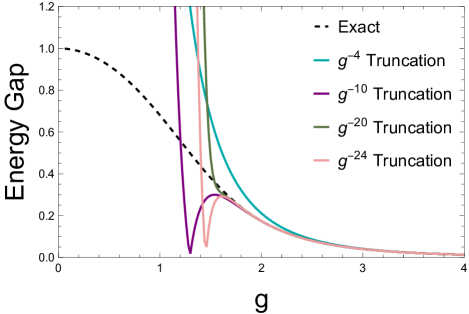
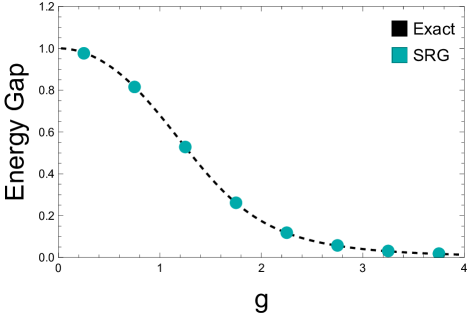
- In 1+1D, the improved Hamiltonian enables low chromo-electric field truncations to quantitatively reproduce features of the untruncated theory across a range of couplings and quark masses.
- Tensor network simulations confirm that the improved Hamiltonian maintains accuracy as system size increases, outperforming standard truncation methods.
- In 3+1D, the derived improved Hamiltonian for two-flavor QCD qualitatively reproduces key aspects of the spectrum in the strong coupling limit.
- A single Trotter step simulation on IBM’s Perth processor successfully captures early-time dynamics of the trivial vacuum state, with good agreement to exact results for t < 1.
- The simulation results show that error increases beyond t = 1 due to Trotter error, highlighting the need for deeper circuits or error mitigation.
- The use of Jordan-Wigner encoding enables efficient qubit mapping, but future work may benefit from more efficient encodings like Bravyi-Kitaev to reduce circuit depth.
Better researchstarts right now
From reading papers to final review, dramatically reduce your research time.
No credit card · Free plan available
This review was created by AI and reviewed by human editors.