
[论文解读] Refining resource estimation for the quantum computation of vibrational molecular spectra through Trotter error analysis
本论文通过在容错量子相位估计算法中分析Trotter误差,对使用容错量子计算机模拟振动分子光谱的量子资源估计进行了优化。研究聚焦于基于L-模哈密顿量表示和VSCF映射方法的乙炔样多炔类分子,提供了详细的、定量的资源估算——包括量子比特数、门数和Trotter误差,为识别振动结构模拟中潜在的量子优势提供了路线图。
Accurate simulations of vibrational molecular spectra are expensive on conventional computers. Compared to the electronic structure problem, the vibrational structure problem with quantum computers is less investigated. In this work we accurately estimate quantum resources, such as number of logical qubits and quantum gates, required for vibrational structure calculations on a programmable quantum computer. Our approach is based on quantum phase estimation and focuses on fault-tolerant quantum devices. In addition to asymptotic estimates for generic chemical compounds, we present a more detailed analysis of the quantum resources needed for the simulation of the Hamiltonian arising in the vibrational structure calculation of acetylene-like polyynes of interest. Leveraging nested commutators, we provide an in-depth quantitative analysis of trotter errors compared to the prior investigations. Ultimately, this work serves as a guide for analyzing the potential quantum advantage within vibrational structure simulations.
研究动机与目标
- 解决与电子结构问题相比,振动结构模拟中缺乏详细量子资源估算的问题。
- 为在容错量子设备上模拟振动光谱,提供量子比特数、量子门数和Trotter误差的精确、定量估算。
- 聚焦于工业上相关的分子,特别是乙炔样多炔类分子,采用L-模哈密顿量表示和VSCF方法。
- 通过引入嵌套换位子分析,改进先前工作,以更深入理解振动模拟中Trotter误差的特性。
- 建立一个框架,用于在电子结构模拟之前,识别振动结构计算中潜在的量子优势。
提出的方法
- 采用基于振动自洽场(VSCF)方法推导的振动哈密顿量L-模表示,实现超越简谐近似的精确分子建模。
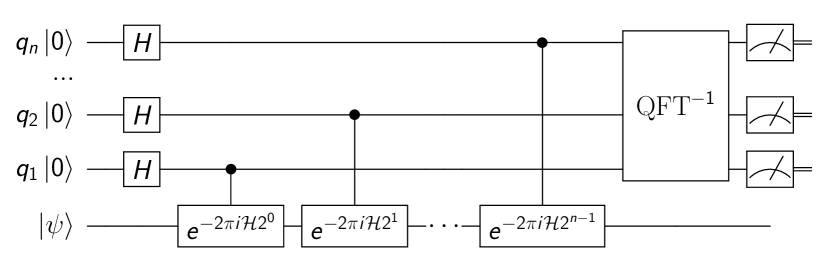
- 应用采用Trotter-Suzuki分解的量子相位估计算法(QPE),在量子计算机上模拟振动哈密顿量的时间演化。
- 采用嵌套换位子技术,对Trotter误差进行解析计算与边界估计,实现对不同模拟参数下误差的精确量化。
- 使用Jordan-Wigner或类似变换,将多体振动哈密顿量映射到量子比特上,并基于基组大小和模态截断,显式统计Pauli项数量。
- 对多炔类分子(P1–P3)进行渐近分析和特定案例分析,改变模态数量,评估量子比特数和门数的缩放特性。
- 采用基于阈值的误差模型,将振动能量精度设定为10⁻⁵ cm⁻¹,与光谱学精度要求一致。

实验结果
研究问题
- RQ1使用容错量子计算机模拟振动分子光谱,其精确的量子资源需求——包括量子比特数和量子门数——是多少?
- RQ2在振动结构模拟中,Trotter误差如何随系统大小和模拟参数变化?能否通过嵌套换位子技术对误差进行定量边界估计?
- RQ3对于哪些分子体系,特别是多炔类分子,其振动结构模拟可能在电子结构模拟之前实现量子优势?
- RQ4哈密顿量表示方法的选择(L-模与四次力场)如何影响资源效率和误差缩放?
- RQ5增加模态数量(基函数)对Pauli项数量和整体门数有何影响?
主要发现
- 对于具有8个模态的乙炔(C₂H₂),模拟需要56个量子比特和约693,419个Pauli项,表明容错实现下门数显著。
- 随着模态数量的增加,Pauli项数量迅速增长:以P₂为例,模态数从4个增至8个时,Pauli项数从15,657增至4,386,132,反映出强烈的缩放挑战。
- 通过嵌套换位子技术进行的Trotter误差分析表明,误差累积高度依赖于振动哈密顿量中的非简谐性和耦合强度。
- 研究表明,多炔类分子的振动结构模拟可能在电子结构模拟之前实现量子优势,特别是在追求10⁻⁵ cm⁻¹精度时。
- 与类似分子的电子结构模拟相比,资源估算显著更高:P₁在6个模态时需155,279个Pauli项,而C₂H₂在STO-3G基组下电子结构模拟仅需2,951个。
- 基于VSCF的L-模表示方法比简谐近似能实现更精确的哈密顿量参数化,从而减少资源估算中的误差来源。
更好的研究,从现在开始
从阅读论文到最终审阅,大幅缩短您的研究时间。
无需绑定信用卡
本解读由 AI 生成,并经人工编辑审核。