
[Paper Review] Renewable Energy Expansion under Taxes and Subsidies: A Transmission Operator's Perspective
This paper proposes a bi-level optimization model where a welfare-maximizing transmission system operator (TSO) plans transmission expansion, anticipating generation capacity investments by price-taking generators under carbon taxes and renewable incentives. Results show that combining high transmission investment budgets and renewable incentives significantly increases renewable share and system welfare, while carbon taxes alone have a more predictable but less impactful effect.
This paper investigates the role of a transmission system operator within a carbon footprint reduction strategy incorporating carbon taxes and renewable energy generation subsidies in the decentralised energy market. This is achieved via an optimisation bi-level model in which a welfare-maximizing transmission system operator makes investments in transmission lines at the upper level while considering power market dynamics at the lower level. To account for the deregulated energy market structure, this paper assumes that the generation companies at the lower level make capacity investments as price-takers in perfect competition. Considering alternative transmission infrastructure expansion budgets, carbon emission taxes and monetary incentives for renewable energy generation capacity expansion, the impact of alternative compositions of these factors is analysed against three output factors: the share of renewable energy in the generation mix, total generation amount, and social welfare. The proposed modelling assessment is applied to an illustrative three-node instance and a case study considering a simplified representation of the energy system of the Nordic and Baltic countries. The results highlight that, under certain circumstances, renewable energy generation subsidies may lead to an increase of renewable energy in the generation mix followed by a simultaneous fall in the total generation amount. Nevertheless, when applied together, these three measures demonstrated a positive impact on all output factors within Nordics' and Baltics' energy systems. The experiments additionally suggest that considering the high value of the carbon tax does not have an impact on the output factors while the composition of high values of renewable energy generation subsidies and budget for transmission infrastructure expansion has the strongest effect.
Motivation & Objective
- To analyze how transmission expansion, carbon taxes, and renewable generation incentives jointly influence the generation mix in liberalized electricity markets.
- To assess the efficiency of individual and combined policy instruments in promoting renewable energy integration.
- To model the strategic interaction between a welfare-maximizing TSO and profit-maximizing generators under perfect competition.
- To evaluate the impact of these policies on renewable share, system welfare, and total generation capacity using a bi-level optimization framework.
- To provide policy-relevant insights for the Nordic and Baltic energy systems under realistic simplifications for computational tractability.
Proposed method
- Formulates a bi-level optimization model with the TSO at the upper level making transmission investment decisions to maximize social welfare.
- Models generators at the lower level as price-takers in a perfect competition setting, making capacity investment decisions based on market-clearing outcomes.
- Integrates three policy instruments: transmission expansion budget (TEB), carbon tax, and renewable generation incentives (incentive).
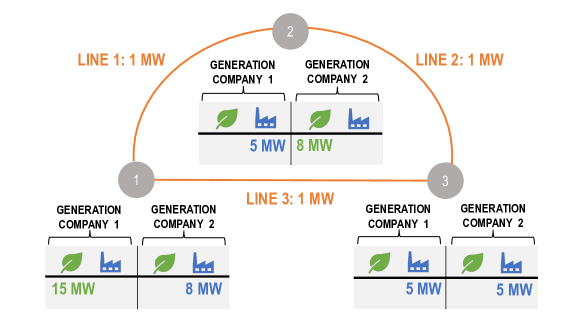
- Applies the model to a three-node illustrative case and a simplified Nordic-Baltic energy system, using discrete enumeration of upper-level decisions due to solver limitations.
- Employs a decomposition approach to solve the bi-level problem by enumerating feasible transmission investment portfolios and selecting the one maximizing welfare.
- Simplifies the system by applying Kirchhoff’s voltage law, omitting TSO revenue streams, and shortening the planning horizon to ensure computational feasibility.
Experimental results
Research questions
- RQ1How does increasing the transmission expansion budget affect renewable generation share and system welfare when generators are price-takers?
- RQ2What is the individual and combined impact of carbon taxes and renewable incentives on the share of variable renewable energy (VRE) in the generation mix?
- RQ3To what extent do transmission investments amplify or diminish the effectiveness of renewable incentives and carbon pricing?
- RQ4How do different combinations of policy instrument levels (low vs. high) influence the overall system outcomes in terms of VRE share, welfare, and total generation?
- RQ5What role does the TSO play in coordinating renewable energy integration when market signals are imperfect or insufficient?
Key findings
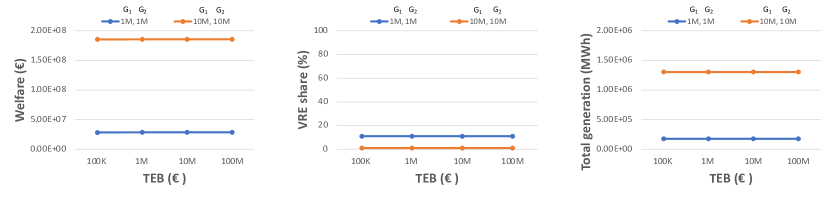
- Individually, carbon taxes, transmission expansion budgets, and renewable incentives show limited efficiency in increasing renewable share or system welfare.
- The combination of high transmission expansion budgets and high renewable incentives leads to the largest increase in renewable generation share and system welfare, regardless of the generation expansion budget level.
- Carbon taxes alone produce a clear and direct increase in VRE share once the marginal cost of conventional generation becomes less competitive.
- The impact of increasing transmission and incentive levels from 'low' to 'high' varies significantly depending on the generation expansion budget, indicating a strong interaction effect.
- The TSO’s strategic investment decisions are pivotal in enabling a successful renewable transition, especially when paired with strong policy signals.
- Despite simplifications, the model’s policy insights remain robust, particularly regarding the synergistic effect of coordinated transmission and renewable incentives.
Better researchstarts right now
From reading papers to final review, dramatically reduce your research time.
No credit card · Free plan available
This review was created by AI and reviewed by human editors.