
[Paper Review] Trading T gates for dirty qubits in state preparation and unitary synthesis
This paper presents a quantum algorithm that trades T-gates for dirty ancillary qubits in the synthesis of arbitrary quantum states and unitaries, achieving a near-optimal T-count trade-off. By leveraging $Λ$ dirty qubits, it reduces T-gate cost to $Θ(N/\lambda + \lambda \log^2(N/\epsilon))$, offering a quadratic improvement over prior ancilla-free methods in the best case, with optimality proven up to logarithmic factors.
Efficient synthesis of arbitrary quantum states and unitaries from a universal fault-tolerant gate-set e.g. Clifford+T is a key subroutine in quantum computation. As large quantum algorithms feature many qubits that encode coherent quantum information but remain idle for parts of the computation, these should be used if it minimizes overall gate counts, especially that of the expensive T-gates. We present a quantum algorithm for preparing any dimension-$N$ pure quantum state specified by a list of $N$ classical numbers, that realizes a trade-off between space and T-gates. Our scheme uses $\mathcal{O}(\log{(N/ε)})$ clean qubits and a tunable number of $\sim(λ\log{(\frac{\log{N}}ε)})$ dirty qubits, to reduce the T-gate cost to $\mathcal{O}(\frac{N}λ+λ\log{\frac{N}ε}\log{\frac{\log{N}}ε})$. This trade-off is optimal up to logarithmic factors, proven through an unconditional gate counting lower bound, and is, in the best case, a quadratic improvement in T-count over prior ancillary-free approaches. We prove similar statements for unitary synthesis by reduction to state preparation. Underlying our constructions is a T-efficient circuit implementation of a quantum oracle for arbitrary classical data.
Motivation & Objective
- To minimize T-gate count in quantum state preparation and unitary synthesis, which are major cost factors in fault-tolerant quantum computation.
- To exploit a tunable number of dirty ancillary qubits—qubits that are initialized in a mixed or unknown state—rather than requiring clean ancillas.
- To establish a trade-off between T-gate count and ancilla qubit usage that is optimal up to logarithmic factors.
- To extend the approach to unitary synthesis by reduction to state preparation, maintaining low T-count.
- To prove a lower bound on gate counts that confirms the optimality of the proposed trade-off.
Proposed method
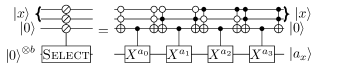
- The method uses a hierarchical decomposition of state preparation via controlled phase rotations, where each rotation is implemented using a Fourier state and a controlled adder circuit.
- It approximates target phases $ a_x / 2^b $ using a Fourier state $ |\mathcal{F}\rangle $ prepared to error $ \epsilon $, reducing the need for direct T-gate-intensive phase rotations.
- The controlled adder circuit, costing $ \mathcal{O}(b) $ T gates, applies the phase rotation $ e^{i2\pi x / 2^b} $ via entanglement with the Fourier state.
- The total error is bounded by $ \delta \leq \frac{2\pi n}{2^b} + \epsilon $, with $ b = \Theta(\log(N/\delta)) $, allowing precise control of approximation error.
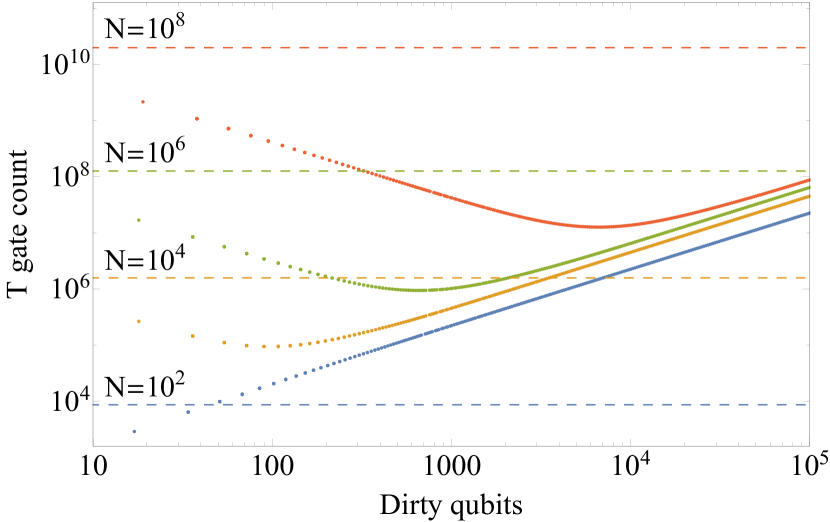
- The T-gate cost is decomposed into $ \mathcal{O}(N/\lambda + \lambda \log^2(N/\epsilon)) $, where $ \lambda $ controls the number of dirty qubits used.
- The approach is extended to unitary synthesis by reducing the problem to state preparation of the unitary's columns, preserving the T-count trade-off.
Experimental results
Research questions
- RQ1Can the T-gate count in arbitrary quantum state preparation be reduced by utilizing dirty ancillary qubits instead of clean ones?
- RQ2What is the optimal trade-off between T-gate count and the number of ancillary qubits, including dirty ones, in state and unitary synthesis?
- RQ3Is the proposed T-count trade-off optimal up to logarithmic factors, and can this be proven via an unconditional lower bound?
- RQ4How does the use of a Fourier state and controlled adder circuit compare in T-cost to direct phase rotation synthesis?
- RQ5Can the same trade-off be extended to unitary synthesis, and what is the resulting T-count scaling?
Key findings
- The proposed method achieves a T-gate cost of $ \mathcal{O}(N/\lambda + \lambda \log^2(N/\epsilon)) $ for preparing an N-dimensional quantum state, with $ \lambda $ dirty qubits used.
- The method provides a quadratic improvement in T-count over ancilla-free approaches in the best case, reducing T-count from $ \mathcal{O}(N \log(N/\epsilon)) $ to $ \tilde{\mathcal{O}}(\sqrt{N}) $ when $ \lambda = \mathcal{O}(\sqrt{N}) $.
- The trade-off between T-gate count and ancilla usage is proven optimal up to logarithmic factors via an unconditional gate-counting lower bound.
- For unitary synthesis of an $ N \times N $ matrix with $ K $ fully specified columns, the T-cost scales as $ \mathcal{O}(KN/\lambda + \lambda K \log^2(N/\epsilon)) $, maintaining the same trade-off.
- The use of a Fourier state and controlled adder reduces the need for direct T-gate-intensive phase rotations, enabling efficient approximation with error $ \delta \leq \frac{2\pi n}{2^b} + \epsilon $.
- The method outperforms naive ancilla usage for $ \lambda = \mathcal{O}(\sqrt{N}) $, even when considering the cost of preparing $ |\textsc{T}\rangle $ magic states.
Better researchstarts right now
From paper design to paper writing, dramatically reduce your research time.
No credit card · Free plan available
This review was created by AI and reviewed by human editors.