
[Paper Review] Variational Quantum Linear Solver
The paper introduces a hybrid quantum-classical variational algorithm (VQLS) to solve linear systems on near-term quantum devices, with an operational termination condition and evidence of scalable performance.
Previously proposed quantum algorithms for solving linear systems of equations cannot be implemented in the near term due to the required circuit depth. Here, we propose a hybrid quantum-classical algorithm, called Variational Quantum Linear Solver (VQLS), for solving linear systems on near-term quantum computers. VQLS seeks to variationally prepare $|x angle$ such that $A|x angle\propto|b angle$. We derive an operationally meaningful termination condition for VQLS that allows one to guarantee that a desired solution precision $ε$ is achieved. Specifically, we prove that $C \geq ε^2 / κ^2$, where $C$ is the VQLS cost function and $κ$ is the condition number of $A$. We present efficient quantum circuits to estimate $C$, while providing evidence for the classical hardness of its estimation. Using Rigetti's quantum computer, we successfully implement VQLS up to a problem size of $1024 imes1024$. Finally, we numerically solve non-trivial problems of size up to $2^{50} imes2^{50}$. For the specific examples that we consider, we heuristically find that the time complexity of VQLS scales efficiently in $ε$, $κ$, and the system size $N$.
Motivation & Objective
- Motivate solving linear systems on NISQ devices where circuit depth is limited.
- Propose a variational hybrid quantum-classical framework to approximate solutions of A x = b.
- Define cost functions whose values certify proximity to the true solution and guide termination.
- Provide efficient quantum circuits to estimate the cost and demonstrate practical scaling insights.
Proposed method
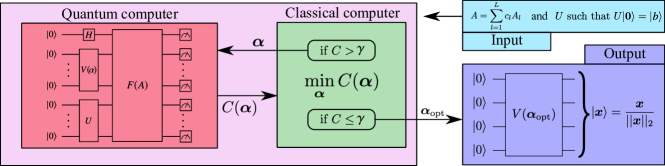
- Represent A as a linear combination of unitaries A = sum_l c_l A_l with efficiently implementable A_l.
- Use a trainable variational circuit V(alpha) to prepare x(alpha) = V(alpha)|0>.
- Define cost functions C_G and C_L (and their unnormalized versions) that quantify how far A|x> is from |b>, enabling termination when C <= gamma.
- Estimate cost function values via Hadamard tests and the Hadamard-Overlap Test circuit to avoid controlling expensive subcircuits.
- Provide fixed-structure (layered) hardware-efficient ansatz and alternatives like QAOA-style or variable-structure ansätze.
- Discuss a probabilistic error cancellation (PEC) mitigation approach to certify termination under noise.
Experimental results
Research questions
- RQ1Can VQLS prepare a state |x> proportional to the solution of A|x> = |b> on near-term quantum hardware?
- RQ2What cost functions quantitatively bound the solution error ε in terms of κ and C?
- RQ3Are the cost-estimation tasks classically hard, justifying quantum advantage for VQLS?
- RQ4How do different ansatz structures affect trainability and scaling with system size n?
- RQ5What is the observed scaling of time-to-solution with κ, ε, and N in practical tests?
Key findings
- A termination condition is established: C ≥ ε^2 / κ^2 ensures desired precision ε.
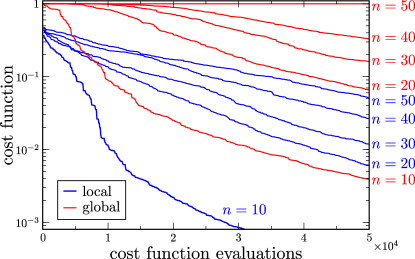
- Local cost functions (C_L) train better than global ones (C_G) for large n, enabling scaling to 2^50 dimensions.
- Experiments on Rigetti hardware solve a 1024×1024 problem; simulations show scaling with κ, ε, and N that is at worst linear in κ, logarithmic in 1/ε, and polylogarithmic in N for tested examples.
- Cost-function evaluation is shown to be DQC1-hard to estimate classically, underscoring quantum advantage in VQLS.
- VQLS exhibits optimal parameter resilience to global depolarizing noise (OPR) for normalized costs; PEC can certify termination under noise with polynomial overhead.
Better researchstarts right now
From reading papers to final review, dramatically reduce your research time.
No credit card · Free plan available
This review was created by AI and reviewed by human editors.