
[Paper Review] Wigner Analysis of Particle Dynamics and Decoherence in Wide Nonharmonic Potentials
This paper develops an analytical Wigner function formalism for particle dynamics in wide, nonharmonic potentials with decoherence, using frame transformations and two key approximations—constant-angle and linearized-decoherence—enabling accurate modeling of macroscopic quantum superpositions in nonlinear, open quantum systems. The method recovers Gaussian wavepacket dynamics in the limit of negligible nonlinearity and decoherence.
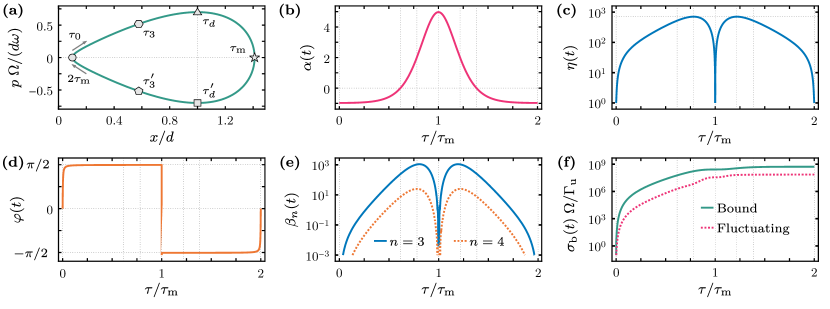
We derive an analytical expression of a Wigner function that approximately describes the time evolution of the one-dimensional motion of a particle in a nonharmonic potential. Our method involves two exact frame transformations, accounting for both the classical dynamics of the centroid of the initial state and the rotation and squeezing about that trajectory. Subsequently, we employ two crucial approximations, namely the constant-angle and linearized-decoherence approximations. These approximations are effective in the regime of wide potentials and small fluctuations, namely potentials that enable spatial expansions orders of magnitude larger than the one of the initial state but that remain smaller compared to the relevant dynamical length scale (e.g., distance between turning points). Our analytical result elucidates the interplay between classical and quantum physics and the impact of decoherence during nonlinear dynamics. This analytical result is instrumental to design, optimize and understand proposals using nonlinear dynamics to generate macroscopic quantum states of massive particles.
Motivation & Objective
- To model the time evolution of the Wigner function for a particle in a wide, nonharmonic potential with decoherence.
- To address the regime of large-scale quantum dynamics where phase-space expansion is orders of magnitude larger than the initial state.
- To develop an analytical framework that captures the interplay between classical dynamics, quantum nonlinearity, and decoherence.
- To provide a tool for designing and optimizing protocols that generate macroscopic quantum superposition states in massive particles.
- To extend semiclassical methods to open quantum systems with weak coupling to a high-temperature bath and white-noise potential fluctuations.
Proposed method
- Apply two exact frame transformations: one for the classical centroid trajectory and another for rotation and squeezing around it.
- Introduce the constant-angle approximation to simplify integration over nonlinear dynamics in the rotating frame.
- Implement the linearized-decoherence approximation to model weak coupling to a high-temperature bath and white-noise potential fluctuations.
- Derive an analytical expression for the time-evolved Wigner function in the transformed frame, then map back to the original frame.
- Use the Airy function formalism to describe the interference pattern at the classical turning point in a double-well potential.
- Recover Gaussian wavepacket dynamics as a limiting case when nonlinearity and decoherence are negligible.
Experimental results
Research questions
- RQ1How can the Wigner function be analytically approximated for a particle in a wide, nonharmonic potential with decoherence?
- RQ2What approximations are valid in the regime of large coherent expansions and small fluctuations?
- RQ3How does decoherence affect the fringe spacing in interference patterns during nonlinear dynamics?
- RQ4In what limit does the method recover standard Gaussian wavepacket dynamics?
- RQ5Can the analytical framework predict the scaling of interference fringe separation with system parameters like mass, potential depth, and control parameters?
Key findings
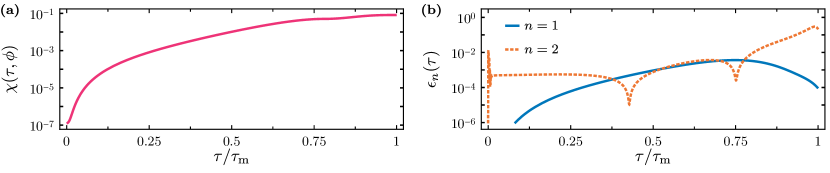
- The analytical Wigner function provides an excellent approximation for particle dynamics in wide, nonharmonic potentials with weak decoherence, valid when the potential length scale is much larger than the initial state size.
- The fringe separation in the interference pattern at the turning point scales as $ x_{ extrm{f}} \sim \left(\frac{\Omega}{\omega}\right)^{2/3} \left(\frac{1}{d}\right)^{1/3} f(x_{\textrm{s}}/d) $, where $ f $ depends only on the normalized initial displacement $ x_{\textrm{s}}/d $.
- The method recovers the Gaussian wavepacket dynamics of Heller and co-workers in the limit of negligible nonlinearity and decoherence.
- The constant-angle and linearized-decoherence approximations are effective in the regime of wide potentials and small fluctuations, enabling analytical tractability.
- The interference pattern is described by a product of Airy functions, with the probability distribution derived via an integral transformation involving the Wigner function in the centroid frame.
- The analytical result enables design and optimization of protocols for generating macroscopic quantum superpositions in massive particles using nonlinear dynamics.
Better researchstarts right now
From reading papers to final review, dramatically reduce your research time.
No credit card · Free plan available
This review was created by AI and reviewed by human editors.