
[论文解读] A Generative Adversarial Network for Climate Tipping Point Discovery (TIP-GAN)
本文提出TIP-GAN,一种生成对抗网络,通过训练生成器在临界阈值附近生成模型配置,并利用判别器借助代理气候模型检测临界点状态,以识别气候临界点。该方法成功将采样聚焦于大西洋经向翻转环流(AMOC)崩溃阈值附近的不确定性区域,当使用三个生成器时,98.7%的生成样本落在不确定性区域内;训练后的判别器在无需依赖真实标签的情况下,预测临界点的F1分数超过99%。
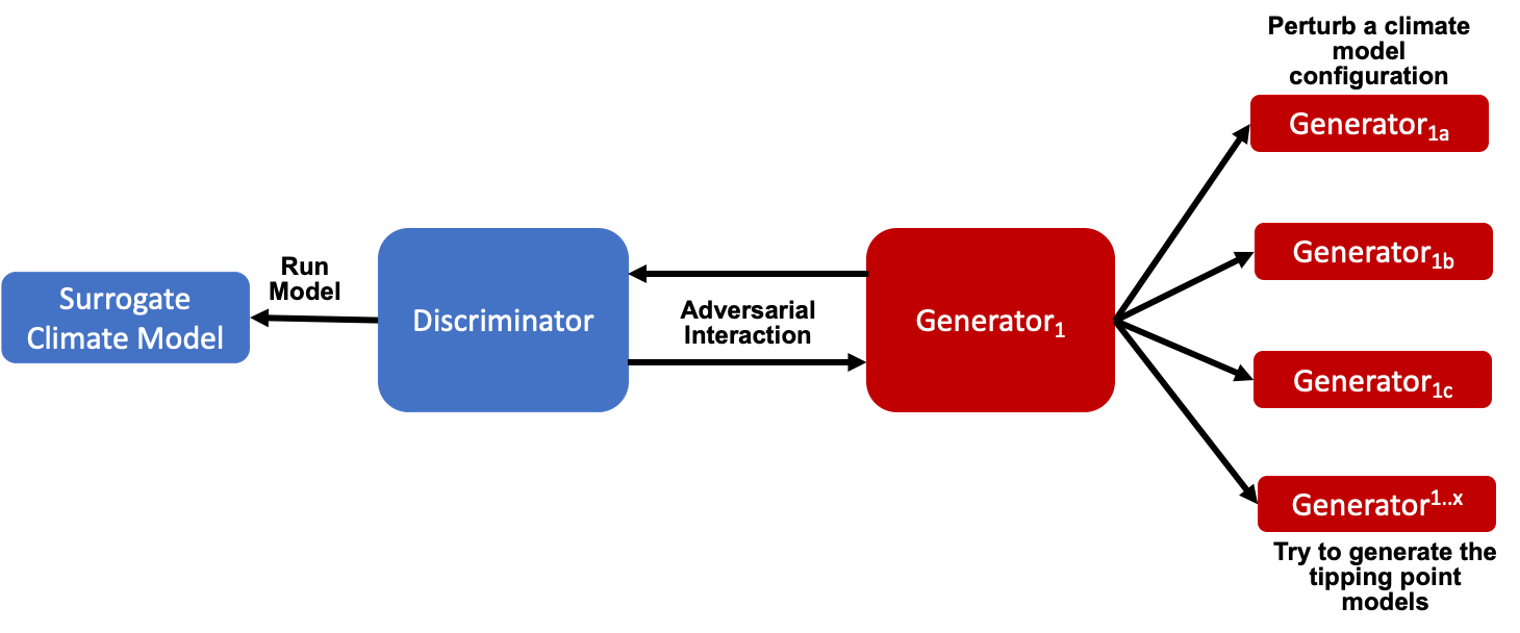
We propose a new Tipping Point Generative Adversarial Network (TIP-GAN) for better characterizing potential climate tipping points in Earth system models. We describe an adversarial game to explore the parameter space of these models, detect upcoming tipping points, and discover the drivers of tipping points. In this setup, a set of generators learn to construct model configurations that will invoke a climate tipping point. The discriminator learns to identify which generators are generating each model configuration and whether a given configuration will lead to a tipping point. The discriminator is trained using an oracle (a surrogate climate model) to test if a generated model configuration leads to a tipping point or not. We demonstrate the application of this GAN to invoke the collapse of the Atlantic Meridional Overturning Circulation (AMOC). We share experimental results of modifying the loss functions and the number of generators to exploit the area of uncertainty in model state space near a climate tipping point. In addition, we show that our trained discriminator can predict AMOC collapse with a high degree of accuracy without the use of the oracle. This approach could generalize to other tipping points, and could augment climate modeling research by directing users interested in studying tipping points to parameter sets likely to induce said tipping points in their computationally intensive climate models.
研究动机与目标
- 为解决在高维、计算成本高昂的地球系统模型中识别气候临界点的挑战。
- 通过引导研究人员聚焦于可能引发临界点的参数集合,减少对暴力模拟的依赖。
- 开发一种基于生成对抗网络的框架,可推广至其他临界点及科学发现问题。
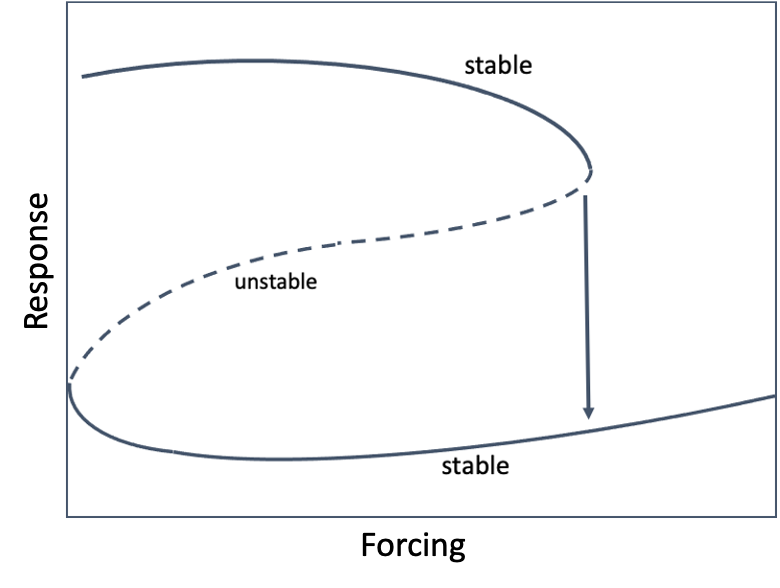
- 探索如何通过对抗训练系统性地发现分岔点附近的态空间不确定性。
提出的方法
- 训练一个包含多个生成器和一个判别器的生成对抗网络,其中判别器使用代理气候模型(真实标签)评估生成的配置是否导致AMOC崩溃。
- 通过引入包含不确定性的自定义损失函数,修改生成器的目标函数,以鼓励探索态空间中分离子流形附近的区域。
- 判别器被训练以分类生成的配置为导致临界点(崩溃)或稳定状态,使用真实标签的输出作为真实标签。
- 使用多个生成器以提升覆盖范围,并聚焦于临界点阈值附近的高不确定性区域。
- 该方法利用对抗训练,不断优化生成器输出,使其集中于稳定与不稳定状态之间的边界。
- 训练完成后,判别器在无真实标签参与的情况下于测试数据上进行评估,以检验其对临界点的预测能力。
实验结果
研究问题
- RQ1GAN框架能否有效识别并集中采样于地球系统模型中气候临界点附近的高不确定性区域?
- RQ2增加生成器数量如何影响生成样本在临界点阈值区域的聚焦程度?
- RQ3训练后的判别器在不依赖代理模型(真实标签)的情况下,能在多大程度上预测AMOC崩溃?
- RQ4包含不确定性的损失函数能否提升动力系统中分岔边界发现的性能?
- RQ5TIP-GAN方法在其他气候临界点或科学发现问题中具有多大程度的可推广性?
主要发现
- 当使用三个生成器时,98.7%的TIP-GAN生成样本落在AMOC临界点附近的不确定性区域内,而训练数据集中仅为34.9%。
- 判别器在测试集上的F1分数达到0.998,用于分类不确定性区域内的配置,表明其在无真实标签参与下的预测准确度极高。
- 增加生成器数量显著提升了样本在不确定性区域的集中度,不确定性区域样本占比分别为:N=1时67.4%,N=2时91.4%,N=3时98.7%。
- 判别器在稳定配置上的表现近乎完美,对非不确定性区域的精确率、召回率和F1分数均为100%。
- 该方法成功学习到分离子流形的上下边界,对应于临界点状态的稳定流形。
- 结果表明,TIP-GAN可引导气候模型研究者聚焦于高影响力参数集合,从而显著减少所需模拟次数。
更好的研究,从现在开始
从阅读论文到最终审阅,大幅缩短您的研究时间。
无需绑定信用卡
本解读由 AI 生成,并经人工编辑审核。