
[论文解读] AGN Selection and Demographics: A New Age with JWST/MIRI
本研究利用SMILES巡天的JWST/MIRI测光数据,在34平方角分的GOODS-S场中识别出217个AGN候选体,揭示其中80%为新发现,尤其在大质量星系中的隐匿AGN中更为显著,展示了MIRI在完成宇宙时空中AGN普查方面的变革性能力。
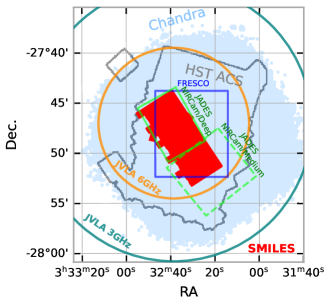
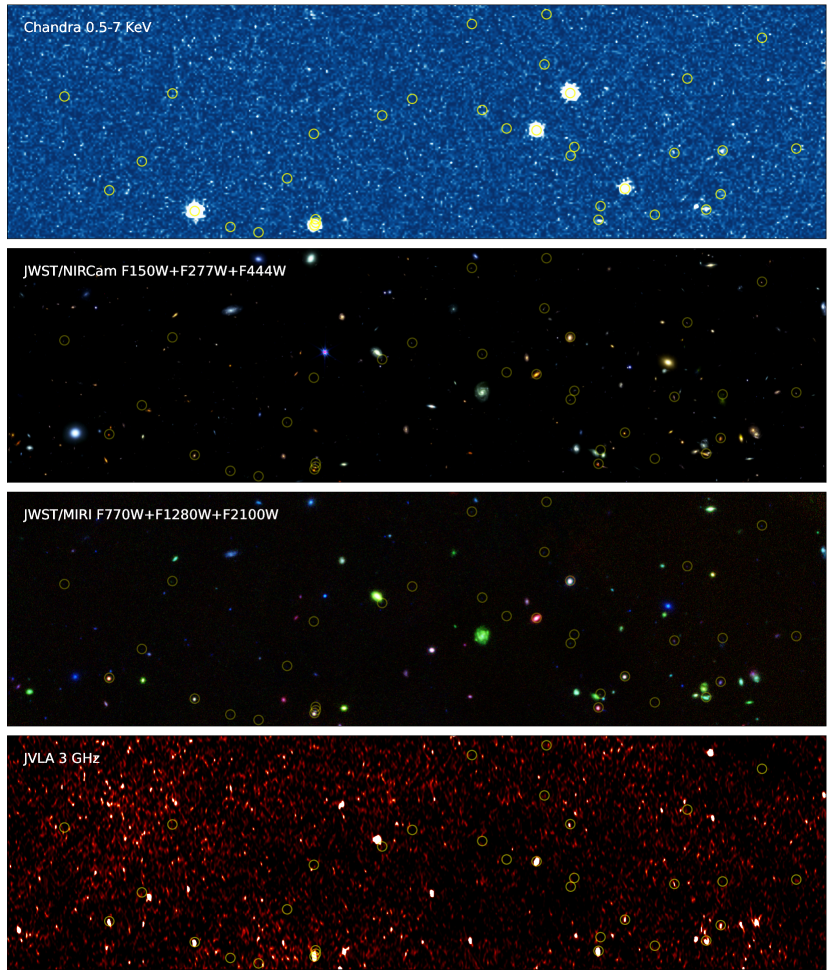
Understanding the co-evolution of supermassive black holes (SMBHs) and their host systems requires a comprehensive census of active galactic nuclei (AGN) behavior across a wide range of redshift, luminosity, obscuration level and galaxy properties. We report significant progress with JWST towards this goal from the Systematic Mid-infrared Instrument Legacy Extragalactic Survey (SMILES). Based on comprehensive SED analysis of 3273 MIRI-detected sources, we identify 217 AGN candidates over a survey area of $\sim$34 arcmin$^2$, including a primary sample of 111 AGNs in normal massive galaxies ($M_{*}>10^{9.5}~M_\odot$) at $z\sim$0--4, an extended sample of 86 AGN {\it candidates} in low-mass galaxies ($M_{*}<10^{9.5}~M_\odot$) and a high-$z$ sample of 20 AGN {\it candidates} at $z\sim$4--8.4. Notably, about 80\% of our MIRI-selected AGN candidates are new discoveries despite the extensive pre-JWST AGN searches. Even among the massive galaxies where the previous AGN search is believed to be thorough, 34\% of the MIRI AGN identifications are new, highlighting the impact of obscuration on previous selections. By combining our results with the efforts at other wavelengths, we build the most complete AGN sample to date and examine the relative performance of different selection techniques. We find the obscured AGN fraction increases from $L_{ m AGN, bol}\sim10^{10}~L_\odot$ to $10^{11}~L_\odot$ and then drops towards higher luminosity. Additionally, the obscured AGN fraction gradually increases from $z\sim0$ to $z\sim4$ with most high-$z$ AGNs obscured. We discuss how AGN obscuration, intrinsic SED variations, galaxy contamination, survey depth and selection techniques complicate the construction of a complete AGN sample.
研究动机与目标
- 为克服以往AGN巡天的局限性,特别是由于尘埃消光导致隐匿AGN代表性不足的问题。
- 评估不同波段AGN选别方法的完整性和可靠性,尤其在中红外波段,因为隐匿AGN在此波段主导其光度。
- 利用SED拟合,表征红移z ~ 0–8.4范围内大质量与低质量星系中AGN的群体特征。
- 评估多波段选别技术的性能,并识别AGN探测中的系统性偏差。
- 确定隐匿AGN比例随光度和红移的演化规律,为SMBH-星系共同演化模型提供依据。
提出的方法
- 对3,273个MIRI探测到的源进行综合SED拟合,结合MIRI测光(5.6–26 μm)与短波段的NIRCam和HST数据。
- 应用基于SED的分类方法,依据特征性的中红外尘埃发射特征和光谱能量分布形态识别AGN候选体。
- 定义三个样本:111个位于大质量星系(M* > 10⁹.⁵ M☉)中的AGN,86个位于低质量星系(M* < 10⁹.⁵ M☉)中的AGN,以及20个高红移AGN(z ~ 4–8.4)。
- 将MIRI识别的AGN与已有的X射线、光学和射电星表对比,评估完整性和识别遗漏源。
- 通过比较具有和不具有X射线或光学特征的AGN,量化隐匿AGN比例,同时考虑巡天深度和灵敏度。
- 使用统计分析估算以往巡天遗漏的AGN比例,特别是由于遮蔽和低X射线光度所致。
实验结果
研究问题
- RQ1在z ~ 0–4的大质量星系中,由于遮蔽作用,以往多波段巡天遗漏了多少比例的AGN?
- RQ2隐匿AGN比例如何随AGN光度和红移演化,特别是在z > 4时?
- RQ3与Spitzer和Chandra巡天相比,MIRI观测在相同场区中在多大程度上提升了AGN普查的完整性?
- RQ4在z ~ 2时,低质量星系对整体AGN群体的贡献如何,与大质量星系相比有何差异?
- RQ5为何约80%的MIRI选中的AGN在X射线巡天中未被探测到,这对其本征性质意味着什么?
主要发现
- MIRI选中的AGN数密度达到约6.6 arcmin⁻²,超过混淆极限的Spitzer/MIPS 24 μm巡天两倍以上,且超出Chandra X射线巡天2.4倍。
- 在大质量星系(M* > 10⁹.⁵ M☉)中,34%的AGN此前未被识别,表明遮蔽作用显著偏倚了以往的AGN巡天。
- 在z ~ 2时首次发现,JWST/MIRI探测到的低质量星系(log(M*/M☉) < 9.5)中的AGN数量与大质量星系相当,揭示了一个此前被隐藏的群体。
- 隐匿AGN比例随光度上升至L_AGN,bol ~ 10¹¹ L☉时达到峰值,随后在更高光度下下降,表明遮蔽机制存在复杂演化。
- 在z > 4时,约一半的AGN群体可能高度遮蔽,高红移AGN表现出强烈的中红外发射,但X射线探测微弱或缺失。
- 已知AGN候选体中约28%被SED分析遗漏,凸显了AGN SED的极端多样性以及任何单一选别方法的局限性。
更好的研究,从现在开始
从阅读论文到最终审阅,大幅缩短您的研究时间。
无需绑定信用卡
本解读由 AI 生成,并经人工编辑审核。