
[论文解读] An Inexact Feasible Interior Point Method for Linear Optimization with High Adaptability to Quantum Computers
本文提出了一种用于线性优化的不精确可行内点法(IF-IPM),通过一种新颖的正交子空间系统(OSS)生成不精确但可行的牛顿步长,实现了与量子线性系统算法(QLSAs)的高效集成。该方法实现了 $\tilde{\cal O}(n^{2.5}L\tilde{\nu}^2\tilde{\nu}^5)$ 的时间复杂度,优于先前的量子内点法,并与经典内点法的复杂度相当;同时,通过迭代精确化方法缓解了条件数增长和求解器误差的影响。
The use of quantum computing to accelerate complex optimization problems is a burgeoning research field. This paper applies Quantum Linear System Algorithms (QLSAs) to Newton systems within Interior Point Methods (IPMs) to take advantage of quantum speedup in solving Linear Optimization (LO) problems. Due to their inexact nature, QLSAs can be applied only to inexact variants of IPMs. Existing IPMs with inexact Newton directions are infeasible methods due to the inexact nature of their computations. This paper proposes an Inexact-Feasible IPM (IF-IPM) for LO problems, using a novel linear system to generate inexact but feasible steps. We show that this method has $\Ocal(\sqrt{n}L)$ iteration complexity, analogous to the best exact IPMs, where $n$ is the number of variables and $L$ is the binary length of the input data. Moreover, we examine how QLSAs can efficiently solve the proposed system in an iterative refinement (IR) scheme to find the exact solution without excessive calls to QLSAs. We show that the proposed IR-IF-IPM can also be helpful to mitigate the impact of the condition number when a classical iterative method, such as a Conjugate Gradient method or a quantum solver is used at iterations of IPMs. After applying the proposed IF-IPM to the self-dual embedding formulation, we investigate the proposed IF-IPM's efficiency using the QISKIT simulator of QLSA.
研究动机与目标
- 设计一种可行的IPM变体,即使在使用不精确牛顿步长时也能保持迭代的可行性,从而克服现有不精确不可行IPM的局限性。
- 设计一种新的线性系统(正交子空间系统,OSS),用于为IPM生成不精确但可行的搜索方向。
- 通过确保牛顿系统条件良好且适合迭代精确化,实现与量子线性系统算法(QLSAs)的高效集成。
- 实现 $\tilde{\cal O}(\tilde{\nu}L)$ 的迭代复杂度,与最优经典IPM相当,同时在不精确求解下保持可行性。
- 通过在量子和经典环境下均采用迭代精确化方案,减轻条件数增长和QLSA误差的影响。
提出的方法
- 提出正交子空间系统(OSS)作为新型牛顿系统,通过将搜索方向投影到正交子空间中,确保不精确解仍保持可行性。
- 将OSS系统表述为对称且稀疏的线性系统,即使在不精确求解下也能保持原始-对偶可行性。
- 将OSS系统集成到可行IPM框架中,确保所有迭代点均位于可行域内部。
- 应用量子线性系统算法(QLSAs)求解OSS系统,实现量子加速的IPM,利用量子加速优势求解线性系统。
- 实施一种迭代精确化(IR)方案,通过使用低精度解重新初始化QIPM,以应对条件数增长和QLSA误差。
- 将IF-IPM与经典迭代求解器(如共轭梯度法)结合,以增强鲁棒性并降低对高精度量子或经典求解器的依赖。
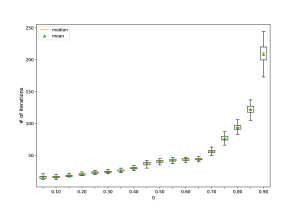
实验结果
研究问题
- RQ1能否设计一种不精确IPM,使其在不精确牛顿步长下仍能保持迭代的可行性,而不同于现有不精确不可行IPM?
- RQ2所提出的正交子空间系统(OSS)是否相比标准方法(如法方程或增广系统)具有更优的条件数?
- RQ3QLSAs能否在可行IPM框架中被有效应用,而不损害收敛性或可行性?
- RQ4迭代精确化是否能显著减轻量子加速IPM中条件数增长和QLSA误差的影响?
- RQ5当与QLSAs或经典迭代求解器结合时,所提出的IF-IPM的理论时间复杂度是多少?与现有量子和经典IPM相比如何?
主要发现
- 所提出的IF-IPM实现了 $\tilde{\cal O}(\tilde{\nu}L)$ 的迭代复杂度,与最优经典IPM相当,即使在使用不精确解的情况下也成立。
- 正交子空间系统(OSS)的条件数以 $\tilde{\nu}^{-1}$ 的速率增长,慢于法方程和增广系统的 $\tilde{\nu}^{-1}$ 速率,因此在不精确求解下更具稳定性。
- 实验结果证实,OSS系统在良好条件、病态条件及退化问题下均保持了可行性,并展现出优于法方程和增广系统的条件数特性。
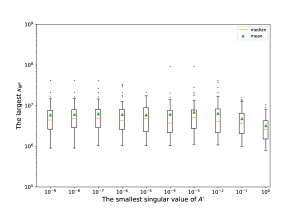
- 迭代精确化能有效缓解牛顿系统条件数的增长,使得可使用低精度QLSAs或经典求解器而不损失收敛性。
- 所提出的IR-IF-QIPM实现了 $\tilde{\cal O}_{n,\tilde{\nu}_Q,\tilde{\nu},\tilde{\nu}^0,L}(n^{2.5}L\tilde{\nu}_Q^2\tilde{\nu}^5)$ 的时间复杂度,优于IR-II-QIPM,是目前收敛量子IPM中最佳的复杂度表现。
- 结合经典共轭梯度求解器的IR-IF-IPM实现了 $\tilde{\cal O}_{\tilde{\nu}^0,L}(n^{2.5}L\tilde{\nu}_Q\tilde{\nu}^2)$ 的复杂度,相较于经典IPM在 $n$ 和条件数依赖性方面表现更优。
更好的研究,从现在开始
从阅读论文到最终审阅,大幅缩短您的研究时间。
无需绑定信用卡
本解读由 AI 生成,并经人工编辑审核。