
[论文解读] Atomique: A Quantum Compiler for Reconfigurable Neutral Atom Arrays
本文提出FPQA-C,一种用于可重构中性原子量子架构——现场可编程量子比特阵列(FPQA)的可扩展量子编译框架。该架构通过动态原子移动技术,有效降低长程量子门的开销。通过结合分层量子比特阵列与量子比特-原子映射器,以及高并行性路由器,FPQA-C相较领先方案(包括超导与固定原子阵列)将两量子比特(2Q)门数量减少最多5.3倍,电路深度减少最多3.6倍。
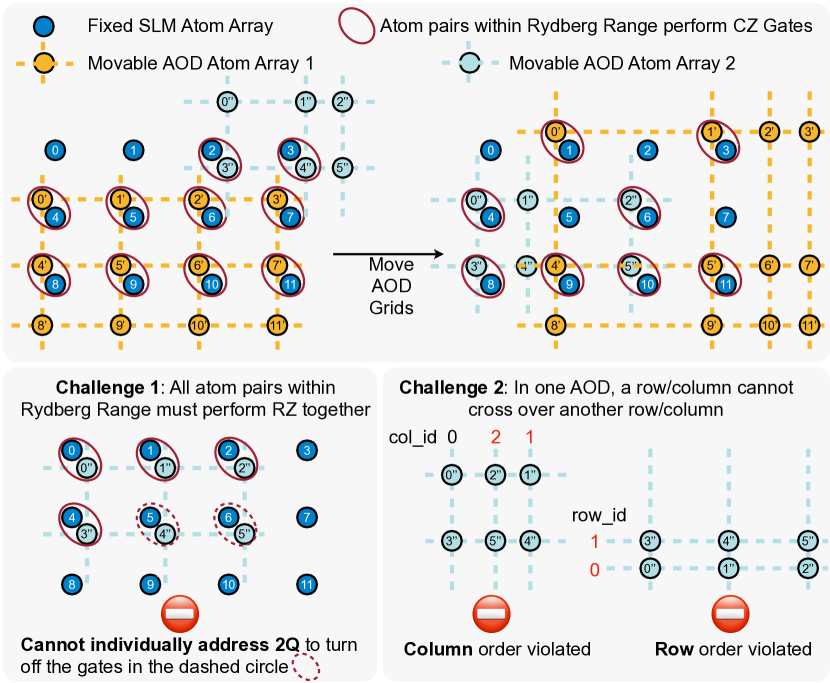
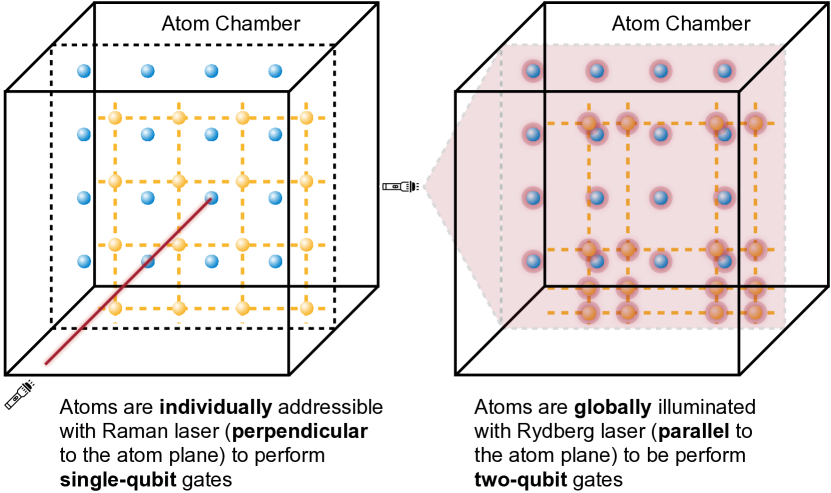
The neutral atom array has gained prominence in quantum computing for its scalability and operation fidelity. Previous works focus on fixed atom arrays (FAAs) that require extensive SWAP operations for long-range interactions. This work explores a novel architecture reconfigurable atom arrays (RAAs), also known as field programmable qubit arrays (FPQAs), which allows for coherent atom movements during circuit execution under some constraints. Such atom movements, which are unique to this architecture, could reduce the cost of long-range interactions significantly if the atom movements could be scheduled strategically. In this work, we introduce Atomique, a compilation framework designed for qubit mapping, atom movement, and gate scheduling for RAA. Atomique contains a qubit-array mapper to decide the coarse-grained mapping of the qubits to arrays, leveraging MAX k-Cut on a constructed gate frequency graph to minimize SWAP overhead. Subsequently, a qubit-atom mapper determines the fine-grained mapping of qubits to specific atoms in the array and considers load balance to prevent hardware constraint violations. We further propose a router that identifies parallel gates, schedules them simultaneously, and reduces depth. We evaluate Atomique across 20+ diverse benchmarks, including generic circuits (arbitrary, QASMBench, SupermarQ), quantum simulation, and QAOA circuits. Atomique consistently outperforms IBM Superconducting, FAA with long-range gates, and FAA with rectangular and triangular topologies, achieving significant reductions in depth and the number of two-qubit gates.
研究动机与目标
- 通过在FPQA中实现动态原子重构,解决固定原子阵列(FAA)中高SWAP门开销的挑战。
- 通过新型编译框架克服FPQA中的硬件限制,如原子运动不可重叠与不可并行化的边集。
- 在确保容错性(通过误差预算与码距分析)的前提下,最小化FPQA中的电路深度与2Q门数量。
- 开发一种可扩展的启发式编译堆栈,支持FPQA上NISQ与容错量子计算工作负载。
- 通过在严格硬件约束下协同调度原子移动与门操作,实现在2Q门执行中的高并行性。
提出的方法
- 将量子比特阵列映射建模为门频率图上的MAX k-Cut问题,以最大化阵列间2Q门数量并最小化SWAP操作。
- 设计一种量子比特-原子映射器,将量子比特分配至特定原子,同时平衡负载并避免违反硬件约束。
- 实现一种高并行性路由器,通过迭代识别并调度可并行化的2Q门,同时协调原子移动。
- 将FPQA硬件建模为具有条件边集的动态多部耦合图,以捕捉基于原子位置的所有可能的量子比特相互作用。
- 在电路仿真中集成原子转移与移动的误差模型,估算表面码纠错下的逻辑错误率与资源需求。
- 通过经验拟合推导出逻辑错误率的标定公式:$ p_l = \alpha \cdot (p^*)^d $,其中 $ \alpha_{FPQA} = 0.0265 $,$ p^*_{FPQA} = 0.0112 $,表明与采用量子比特驻留技术的FAA相比,其误差阈值更高。
实验结果
研究问题
- RQ1与固定原子阵列相比,FPQA中动态原子重构是否能显著降低2Q门开销?
- RQ2在原子运动不可重叠与不可并行化边集等严格硬件约束下,编译框架如何高效调度原子移动与2Q门执行?
- RQ3FPQA-C在涵盖QAOA、量子模拟与QASMBench等多种量子工作负载中,对电路深度与2Q门数量的改善程度如何?
- RQ4FPQA的逻辑错误率如何随码距变化?在相同误差预算下,其与采用量子比特驻留技术的FAA相比表现如何?
- RQ5SLM与AOD之间原子转移对电路可靠性有何影响?该问题在编译堆栈中如何缓解?
主要发现
- 在20多个基准测试中,FPQA-C相较IBM超导处理器将2Q门数量减少最多5.3倍。
- 相较IBM超导处理器,电路深度减少最多3.6倍;与采用矩形、三角形及长程门拓扑的FAA相比,分别减少3.2倍、3.1倍与2.2倍。
- FPQA的逻辑错误率标定为 $ p_l = 0.0265 \cdot (0.0112)^d $,其误差阈值更高且误差预因子更低,优于采用量子比特驻留技术的FAA($ \alpha_{FAA} = 0.0299 $,$ p^*_{FAA} = 0.0101 $)。
- FPQA-C通过协同调度原子移动与门操作,在2Q门执行中实现高并行性,同时通过精心设计的路由避免了不必要的里德伯极化相互作用。
- 该框架通过基于MAX k-Cut的量子比特阵列映射,最大化阵列间2Q门数量,显著降低对SWAP门的依赖,从而大幅减少开销。
- 资源估算表明,由于移动与转移过程中的错误传播减少,FPQA实现相同误差预算所需物理量子比特更少、码距离更低,优于FAA。
更好的研究,从现在开始
从阅读论文到最终审阅,大幅缩短您的研究时间。
无需绑定信用卡
本解读由 AI 生成,并经人工编辑审核。