
[论文解读] Bound isoscalar axial-vector $bc\bar u\bar d$ tetraquark $T_{bc}$ from lattice QCD using two-meson and diquark-antidiquark variational basis
该格点QCD研究利用变分法,结合两介子和二股子-反二股子插值算符,在四个MILC组态上研究了存在一种束缚的同位旋标量轴矢量四价子态 $T_{bc} = bc\bar{u}\bar{d}$,其量子数为 $J^P = 1^+$。研究发现,在物理π介子质量下,散射长度为 $+0.57$ fm,结合能为 $-43^{+6}_{-7}$ MeV,表明 $T_{bc}$ 存在一个稳定的束缚态。
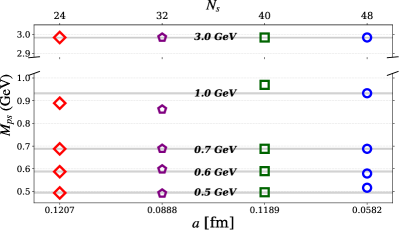
We report a lattice QCD study of the heavy-light meson-meson interactions with an explicitly exotic flavor content $bc\bar u\bar d$, isospin $I\!=\!0$, and axialvector $J^P=1^+$ quantum numbers in search of possible tetraquark bound states. The calculation is performed at four values of lattice spacing, ranging $\sim$0.058 to $\sim$0.12 fm, and at five different values of valence light quark mass $m_{u/d}$, corresponding to pseudoscalar meson mass $M_{ps}$ of about 0.5, 0.6, 0.7, 1.0, and 3.0 GeV. The energy eigenvalues in the finite-volume are determined through a variational procedure applied to correlation matrices built out of two-meson interpolating operators as well as diquark-antidiquark operators. The continuum limit estimates for $D\bar B^*$ elastic $S$-wave scattering amplitude are extracted from the lowest finite-volume eigenenergies, corresponding to the ground states, using amplitude parametrizations supplemented by a lattice spacing dependence. Light quark mass $m_{u/d}$ dependence of the $D\bar B^*$ scattering length ($a_0$) suggests that at the physical pion mass $a_0^{phys} = +0.57(^{+4}_{-5})(17)$ fm, which clearly points to an attractive interaction between the $D$ and $\bar B^*$ mesons that is strong enough to host a real bound state $T_{bc}$, with a binding energy of $-43(_{-7}^{+6})(_{-24}^{+14})$ MeV with respect to the $D\bar B^*$ threshold. We also find that the strength of the binding decreases with increasing $m_{u/d}$ and the system becomes unbound at a critical light quark mass $m^{*}_{u/d}$ corresponding to $M^{*}_{ps} = 2.73(21)(19)$ GeV.
研究动机与目标
- 研究格点QCD中是否存在一个量子数为 $J^P = 1^+$、$I = 0$ 的束缚 $T_{bc} = bc\bar{u}\bar{d}$ 四价子态。
- 确定在具有奇特味荷的系统中,$D B^*$ 相互作用是否足够吸引以形成真正的束缚态。
- 评估底-粲四价子中分子态与紧凑二股子-反二股子构型之间的相互作用。
- 将有限体积格点谱外推至物理点,提取散射长度和结合能。
- 确定 $T_{bc}$ 状态变为无束缚态的临界轻夸克质量,以探测该态的稳定性。
提出的方法
- 采用四个包含动力学 $u/d$、$s$ 和 $c$ 夸克的MILC格点组态,使用HISQ行动,格点间距为 0.058 至 0.12 fm。
- 对价键 $u/d$ 和 $c$ 夸克使用重叠费米子,对底夸克使用非相对论QCD,并进行 $\mathcal{O}(\alpha_s v^4)$ 改进。
- 通过两介子插值算符和局部二股子-反二股子算符构建相关矩阵,用于变分分析。
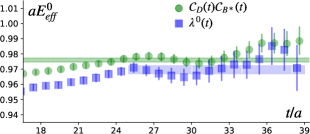
- 通过在多个源-阱分离距离下对相关矩阵进行变分程序,提取有限体积能级。
- 使用参数化的 $DB^*$ 散射振幅对能谱进行全局拟合,包含离散化和 $m_{u/d}$ 依赖性修正。
- 通过联合拟合模型将结果外推至零格点间距和物理 $m_{u/d}$,得到散射长度和结合能。
实验结果
研究问题
- RQ1在 $I=0$、$J^P=1^+$ 通道中,$D B^*$ 相互作用是否支持 $T_{bc}$ 四价子的束缚态?
- RQ2在物理π介子质量下,$T_{bc}$ 状态相对于 $D B^*$ 阈值的结合能是多少?
- RQ3随着轻夸克质量的增加,$T_{bc}$ 的结合强度如何变化?在何种临界 $m_{u/d}$ 下该态会变为无束缚态?
- RQ4基于算符重叠分析,$T_{bc}$ 态在多大程度上表现出分子态或紧凑二股子-反二股子特性?
- RQ5在不同体积和格点间距的格点组态中,提取的能级和散射参数的鲁棒性如何?
主要发现
- 在物理π介子质量下,$DB^*$ 的散射长度为 $a_0^{\text{phys}} = +0.57^{+4}_{-5}(17)$ fm,表明存在强吸引力。
- 发现 $T_{bc}$ 态为束缚态,其相对于 $D B^*$ 阈值的结合能为 $-43^{+6}_{-7}(-24)^{+14}$ MeV。
- 结合能随轻夸克质量增加而减小,当轻夸克质量达到临界值 $m_{u/d}^*$ 时,该态变为无束缚态,对应 $M_{\text{ps}}^* = 2.73(21)(14)$ GeV。
- 在所有组态中,基态能级均低于 $D B^*$ 阈值,且能量劈裂和算符重叠一致,证实了其稳定性。
- 算符重叠分析表明,基态主要由两介子和二股子-反二股子组分共同主导,表明其具有混合的分子-紧凑结构。
- 结果在不同体积和格点间距的组态中均具鲁棒性,能级和拟合结果一致,尤其在较大体积的 $L_1$ 和 $S_1$ 组态中表现更佳。
更好的研究,从现在开始
从阅读论文到最终审阅,大幅缩短您的研究时间。
无需绑定信用卡
本解读由 AI 生成,并经人工编辑审核。