
[论文解读] Causal Inference under Network Interference Using a Mixture of Randomized Experiments
该论文提出了一种混合随机化设计,结合伯努利随机化与基于聚类的随机化,以在存在单位间相互影响的网络干扰条件下实现平均处理效应的无偏估计。该研究建立了方差上界 $O(d^2 n^{-1} p^{-1})$ 和匹配的下界 $Θ(d^{1.5} n^{-1} p^{-1})$,并对稀疏网络给出了改进的方差界,同时提出了一种对未知干扰权重保持不变的随机化设计。
In randomized experiments, the classic Stable Unit Treatment Value Assumption (SUTVA) posits that the outcome for one experimental unit is unaffected by the treatment assignments of other units. However, this assumption is frequently violated in settings such as online marketplaces and social networks, where interference between units is common. We address the estimation of the total treatment effect in a network interference model by employing a mixed randomization design that combines two widely used experimental methods: Bernoulli randomization, where treatment is assigned independently to each unit, and cluster-based randomization, where treatment is assigned at the aggregate level. The mixed randomization design simultaneously incorporates both methods, thereby mitigating the bias present in cluster-based designs. We propose an unbiased estimator for the total treatment effect under this mixed design and show that its variance is bounded by $O(d^2 n^{-1} p^{-1} (1-p)^{-1})$, where $d$ is the maximum degree of the network, $n$ is the network size, and $p$ is the treatment probability. Additionally, we establish a lower bound of $Ω(d^{1.5} n^{-1} p^{-1} (1-p)^{-1})$ for the variance of any mixed design. Moreover, when the interference weights on the network's edges are unknown, we propose a weight-invariant design that achieves a variance bound of $O(d^3 n^{-1} p^{-1} (1-p)^{-1})$, which is aligned with the estimator introduced by Cortez-Rodriguez et al. (2023) under similar conditions.
研究动机与目标
- 解决网络实验环境中单位相互干扰导致稳定单位处理值假设(SUTVA)被违反的问题。
- 开发一种统一的实验设计,结合伯努利随机化与基于聚类的随机化,以更好地捕捉干扰效应。
- 在该混合设计下,提供平均处理效应(ATE)的无偏估计量。
- 推导在各种网络结构和干扰假设下 ATE 估计量的紧致方差界。
- 建立估计方差的理论极限,包括下界以及稀疏网络下的改进上界。
提出的方法
- 提出一种混合随机化设计,其中每个单位以固定概率独立地被分配至伯努利随机化或基于聚类的随机化。
- 使用图表示 $G(V,E)$,其中边表示干扰,有向边权重 $v_{ij}$ 表示单位 $j$ 对单位 $i$ 的干扰程度。
- 提出一种 ATE 的无偏估计量,通过干扰权重同时考虑直接和间接处理效应。
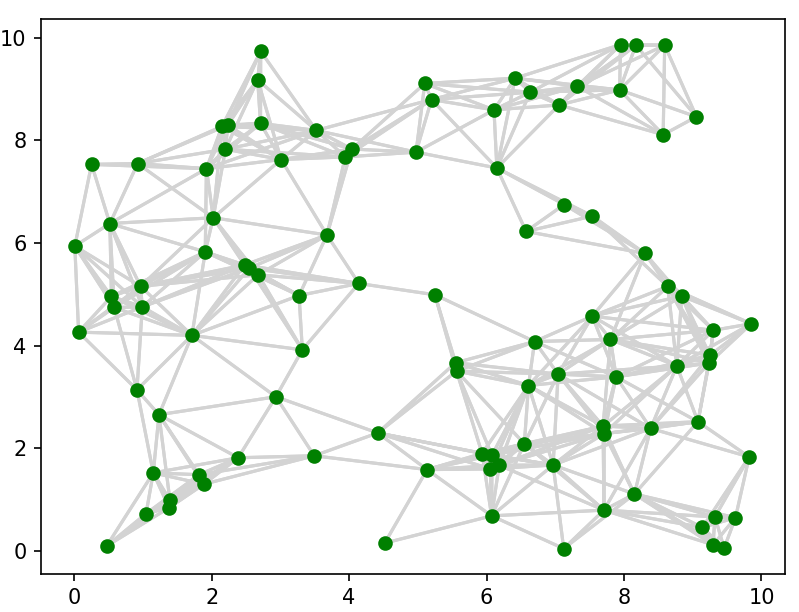
- 应用图分解算法,利用最大匹配将网络划分为簇,确保每条边恰好被覆盖一次。
- 利用集中不等式和组合论证推导方差界,利用最大度数 $d$ 和处理概率 $p$。
- 提出一种权重不变设计,在干扰权重未知时仍能保持方差界,实现 $O(d^3 n^{-1} p^{-1})$ 的方差。
实验结果
研究问题
- RQ1结合伯努利与基于聚类的随机化的混合设计,能否在存在网络干扰时产生 ATE 的无偏估计量?
- RQ2此类混合设计下 ATE 估计量的理论方差界是什么?其随网络规模 $n$、最大度数 $d$ 和处理概率 $p$ 的变化规律如何?
- RQ3是否存在网络干扰下任何混合设计的方差的固有下界?
- RQ4对于具有增长常数 $κ \leq d$ 的稀疏网络,方差界如何改进?
- RQ5能否构造一种设计,使得在干扰权重未知时仍能保持低方差?
主要发现
- 所提出的 ATE 估计量在混合随机化设计下保持无偏,即使存在网络干扰。
- 估计量的方差上界为 $O(d^2 n^{-1} p^{-1})$,其中 $d$ 为最大度数,$n$ 为网络规模,$p$ 为处理概率。
- 建立了匹配的下界 $Ω(d^{1.5} n^{-1} p^{-1})$,表明上界几乎紧致。
- 对于具有增长常数 $κ \leq d$ 的稀疏网络,方差界改进为 $O(\kappa^7 d \, n^{-1} p^{-1})$,反映出在稀疏设置下性能更优。
- 提出了一种权重不变设计,在干扰权重未知时实现 $O(d^3 n^{-1} p^{-1})$ 的方差界,确保鲁棒性。
- 图分解算法确保任意最大度数为 $d$ 的图可被划分为至多 $2d$ 个匹配,从而实现高效的簇构建与理论分析。
更好的研究,从现在开始
从阅读论文到最终审阅,大幅缩短您的研究时间。
无需绑定信用卡
本解读由 AI 生成,并经人工编辑审核。