
[论文解读] Charge Transfer and Zhang-Rice Singlet Bands in the Nickelate Superconductor $\mathrm{La_3Ni_2O_7}$ under Pressure
作者在压力下研究 La3Ni2O7 的 11-band Hubbard 模型,使用 determinant quantum Monte Carlo 和 cellular dynamical mean-field theory,揭示两个自旋对称态带具有不同的空穴分布,并提出一个低能量四带 t-J 模型来描述物理。
Recently, a bulk nickelate superconductor $\mathrm{La_3Ni_2O_7}$ is discovered at pressures with a remarkable high transition temperature $T_c \sim 80K$. Here, we study a Hubbard model with tight-binding parameters derived from extit{ab initio} calculations of $\mathrm{La_3Ni_2O_7}$, by employing large scale determinant quantum Monte Carlo and cellular dynamical mean-field theory. Our result suggests that the superexchange couplings in this system are comparable to that of cuprates. The system is a charge transfer insulator as hole concentration becomes four per site at large Hubbard $U$. Upon hole doping, two low-energy spin-singlet bands emerge in the system exhibiting distinct correlation properties: while the one composed of the out-of-plane Ni-$d_{3z^2-r^2}$ and O-$p_z$ orbitals demonstrates strong antiferromagnetic correlations and narrow effective bandwidth, the in-plane singlet band consisting of the Ni-$d_{x^2-y^2}$ and O-$p_x / p_y$ orbitals is in general more itinerant. Over a broad range of hole doping, the doped holes occupy primarily the $d_{x^2-y^2}$ and $p_x / p_y$ orbitals, whereas the $d_{3z^2-r^2}$ and $p_z$ orbitals retain underdoped. We propose an effective $ t-J$ model to capture the relevant physics and discuss the implications of our result for comprehending the $\mathrm{La_3Ni_2O_7}$ superconductivity.
研究动机与目标
- 通过研究 La3Ni2O7 在压力下的磁性交换和空穴分布来理解高温超导性。
- 确定 超交换耦合并评估其与铜氧体的相似性。
- 表征轨道分辨的空穴分布及在半填充时的绝缘性本质。
- 识别低能量自旋-配对的单态带及其相关性属性。
- 提出一个用于 La3Ni2O7 在压力下的有效低能量四带 t-J 模型。
提出的方法
- 使用包括 Ni 3d 和 O 2p 轨道的 11-band Hubbard 模型,参数来自 ab initio 下折叠。
- 利用 determinant quantum Monte Carlo (DQMC) 计算自旋相关和空穴浓度。
- 应用 cellular dynamical mean-field theory (CDMFT) 获取自能和谱信息。
- 分析自旋相关性以提取层间和层内超交换耦合的相对强度。
- 计算局部态密度并跟踪 Zhang-Rice-样带的出现。
- 提出一个有效的四带 t-J 模型以捕捉主导的磁交换与低能量物理。
实验结果
研究问题
- RQ1在压力下 La3Ni2O7 的主导磁交换耦合是什么?它们与铜氧体相比有何异同?
- RQ2空穴在 Ni d 与 O p 轨道之间的分布在半填充及偏离半填充时是怎样的?低能带的性质如何?
- RQ3是否出现 ZRS-样带?它们在平面内轨道和垂直方向轨道之间有何差异?
- RQ4一个有效的低能量 t-J 模型是否能捕捉到在压力下系统的关键物理?
主要发现
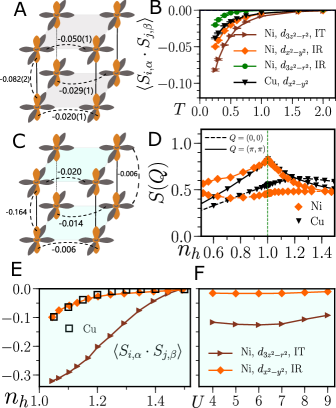
- 在半填充时,层间 d3z^2−r^2–d3z^2−r^2 反铁磁交换占主导,平面内 d_x^2−y^2–d_x^2−y^2 交换虽显著但较弱。
- 空洞掺杂后出现两条自旋-单态带,具有不同的相关性:一条窄且强相关的出平面带(d3z^2−r^2, pz),以及一条更具迁移性的平面内带(dx^2−y^2, px/py)单态带。
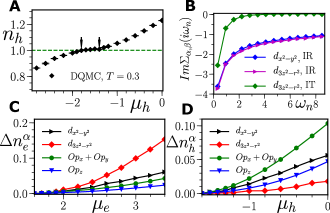
- 空穴掺杂集中在平面轨道(dx^2−y^2 和 px/py),而出平面轨道(d3z^2−r^2 与 pz)保持欠掺,这表明强烈的轨道分化。
- 系统在半填充时表现为电荷转移绝缘体(每个位点四个空穴),空穴主要进入 O 2p 轨道,与 Zaanen-Sawatzky-Allen 电荷转移物理一致。
- 平面内的 ZRS-样带比出平面单态带更具迁移性,暗示两条带在潜在的超导性中具有不同的传输和相关作用。
- 提出一个有效的四带 t-J 模型以捕捉 La3Ni2O7 在压力下的主导磁交换与低能物理。
更好的研究,从现在开始
从论文设计到论文写作,大幅缩短您的研究时间。
无需绑定信用卡
本解读由 AI 生成,并经人工编辑审核。