
[论文解读] Critical role of vertical radiative cooling contrast in triggering episodic deluges in small-domain hothouse climates
本研究表明,在小尺度温室气候中,周期性暴雨主要由强烈的垂直辐射冷却对比所触发,而非先前提出的低对流层辐射加热。该机制依赖于高层对流层的辐射冷却强度约为低对流层加热的两倍,从而周期性地建立并释放对流抑制,暴雨发生的时间由辐射冷却和再蒸发冷却的时间尺度决定。
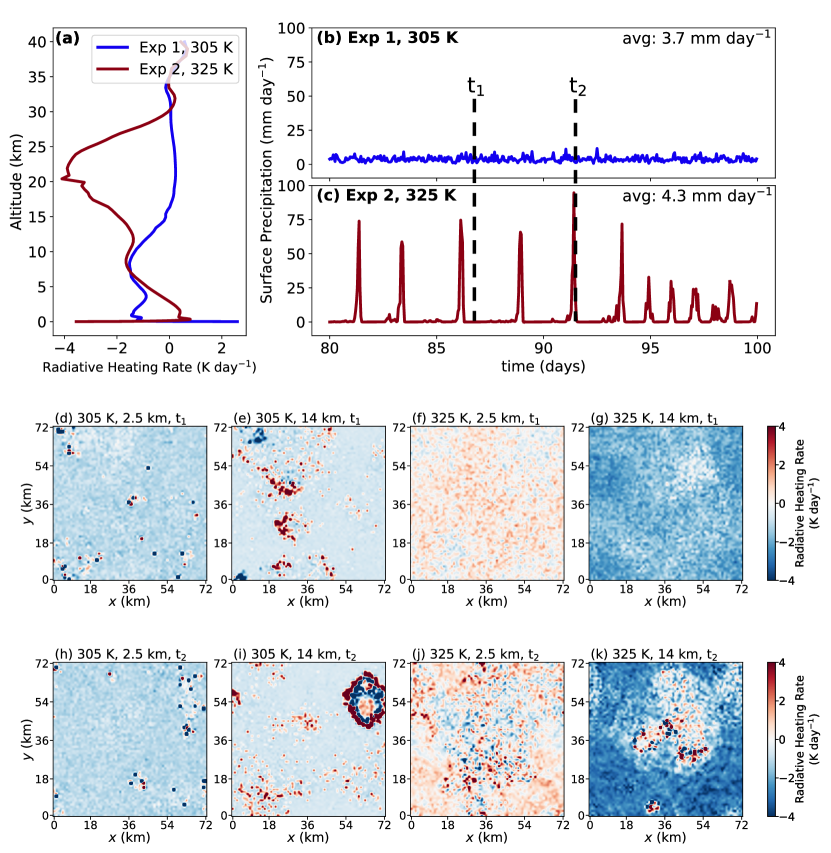
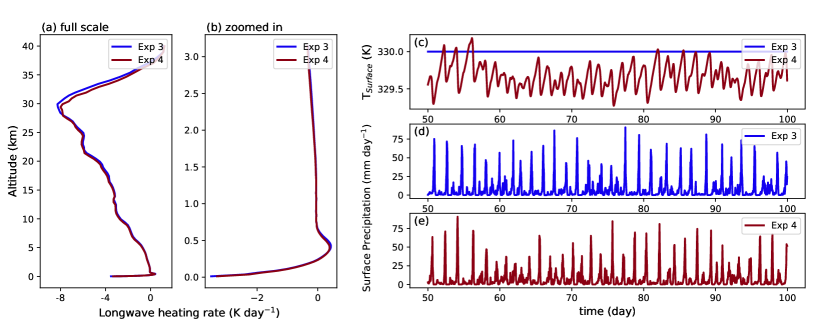
Seeley and Wordsworth (2021) showed that in small-domain cloud-resolving simulations the pattern of precipitation transforms in extremely hot climates ($\ge$ 320 K) from quasi-steady to organized episodic deluges, with outbursts of heavy rain alternating with several dry days. They proposed a mechanism for this transition involving increased water vapor absorption of solar radiation leading to net lower-tropospheric radiative heating. This heating inhibits lower-tropospheric convection and decouples the boundary layer from the upper troposphere during the dry phase, allowing lower-tropospheric moist static energy to build until it discharges, resulting in a deluge. We perform cloud-resolving simulations in polar night and show that the same transition occurs, implying that some revision of their mechanism is necessary. We show that episodic deluges can occur even if the lower-tropospheric radiative heating rate is negative, as long as the magnitude of the upper-tropospheric radiative cooling is about twice as large. We find that in the episodic deluge regime the mean precipitation can be inferred from the atmospheric column energy budget and the period can be predicted from the time for radiation and reevaporation to cool the lower atmosphere.
研究动机与目标
- 研究小尺度、高温气候中从准稳态向周期性暴雨降水模式转变的物理机制。
- 检验如先前所建议的那样,低对流层辐射加热是否为周期性暴雨形成所必需。
- 考察垂直辐射冷却对比与对流抑制(CIN)在组织周期性对流中的作用。
- 确定暴雨的发生时机与振幅是否可由大气能量平衡及辐射冷却时间尺度预测。
提出的方法
- 在小区域(72 km × 72 km)的极夜条件下,使用大气模式系统(SAM)进行云分辨模拟,以隔离辐射效应的影响。
- 改变地表温度以模拟温室气候(≥320 K),并分析对流层内辐射加热/冷却的垂直分布。
- 追踪对流抑制(CIN)与对流可用位能(CAPE)的演变,以评估对流触发的条件。
- 量化辐射冷却与再蒸发过程使低对流层充分冷却所需的时间,将其与暴雨重现期关联。
- 分析辐射加热速率的水平均匀性,以评估其在同步化网格点对流中的作用。
- 利用大气柱能量平衡推断周期性暴雨模式下的平均降水。
实验结果
研究问题
- RQ1在温室气候中,周期性暴雨的发生是否必须依赖于低对流层辐射加热?
- RQ2垂直辐射冷却梯度在触发周期性对流中起什么作用?
- RQ3当低对流层加热为负时,只要高层对流层冷却足够强,周期性暴雨是否仍可能发生?
- RQ4暴雨发生时机在多大程度上取决于辐射冷却与再蒸发冷却时间尺度?
- RQ5辐射加热速率的水平均匀性在多大程度上影响对流的空间与时间协调性?
主要发现
- 即使低对流层辐射加热为负,只要高层对流层辐射冷却率约为其两倍,周期性暴雨仍可发生。
- 周期性暴雨的周期主要由辐射冷却与再蒸发过程使低对流层充分冷却以打破对流抑制所需的时间决定。
- 周期性暴雨模式下的平均降水可由大气柱能量平衡推断得出。
- 辐射加热速率的水平均匀性对于同步化网格点对流、实现宏观周期性行为至关重要。
- 向周期性暴雨的转变并不依赖于低对流层加热,而是取决于辐射冷却的强度及其垂直对比。
- 该机制在不同云分辨模型中均表现稳健,并在极夜条件下依然成立,表明辐射冷却对比具有根本性作用。
更好的研究,从现在开始
从阅读论文到最终审阅,大幅缩短您的研究时间。
无需绑定信用卡
本解读由 AI 生成,并经人工编辑审核。