
[论文解读] Crucial Role of Obliquely Propagating Gravity Waves in the Quasi-Biennial Oscillation Dynamics
本研究表明,此前在气候模型中被忽略的斜向传播重力波在驱动热带平流层准两年振荡(QBO)中起着至关重要的作用。通过使用三维瞬态重力波参数化(MS-GWaM),作者发现这些波增强了动量通量,从而维持东风急流的下沉并放大了低层平流层的QBO,解决了长期存在的模型偏差问题,即QBO振幅和相位推进的不准确。
In climate modelling, the reality of simulated flows in the middle atmosphere is largely affected by the model's representation of gravity wave processes that are unresolved, while these processes are usually simplified to facilitate computations. The simplification commonly applied in existing climate models is to neglect wave propagation in horizontal direction and time. Here we use a model that fully represents the propagation of unresolved waves in all directions, thereby elucidating its dynamical effect upon the most important climate mode in the tropical stratosphere, namely the quasi-biennial oscillation. Our simulation shows that the waves at the equatorial stratosphere, which are known to drive this climate mode, can originate far away from the equator in the troposphere. The waves propagating obliquely toward the equator are found to play a huge role in the phase progression of the quasi-biennial oscillation as well as in its penetration into the lower stratosphere. Such waves will require further attention, given that current climate models are struggling to simulate the quasi-biennial oscillation down to the lower stratosphere, which may be needed to reproduce its observed impacts on the surface climate.
研究动机与目标
- 研究斜向传播重力波对热带平流层准两年振荡(QBO)的动力影响。
- 解决气候模型中长期存在的偏差问题:即在低层平流层,QBO东风相位被低估。
- 评估与传统的一维稳态参数化相比,完全表征三维瞬态重力波传播是否能提高QBO模拟的保真度。
- 量化远离赤道处产生的向赤道传播波在驱动QBO相位推进和下沉过程中的作用。
提出的方法
- 采用一种新颖的重力波参数化方法(MS-GWaM),完全解析相空间中的三维波传播和瞬态行为。
- 使用拉格朗日方法,在六维相空间(x, k, t)中求解射线方程(1)和波作用密度输运方程(2),并采用离散化射线体积进行计算。
- 通过波作用守恒追踪波作用密度的演化,包含波生成和耗散的源项与汇项。
- 使用多尺度对流源,水平尺度为100 km,时间尺度为12分钟,以生成大尺度重力波。
- 在相同模型条件下,比较使用三维瞬态(3d-TR)和传统的一维稳态(1d-ST)参数化的模拟结果。
- 从波作用密度推导出动量通量和强迫场,以评估波对大尺度环流的影响。
实验结果
研究问题
- RQ1斜向传播重力波对热带平流层准两年振荡(QBO)的动力贡献是什么?
- RQ2在重力波参数化中包含三维瞬态波传播如何影响QBO相位下沉和振幅的模拟?
- RQ3源自非赤道对流的向赤道传播波在多大程度上促进了QBO东风相位的发展?
- RQ4为何当前气候模型无法再现观测到的低层平流层QBO振幅?这是否可归因于波传播过程的简化?
主要发现
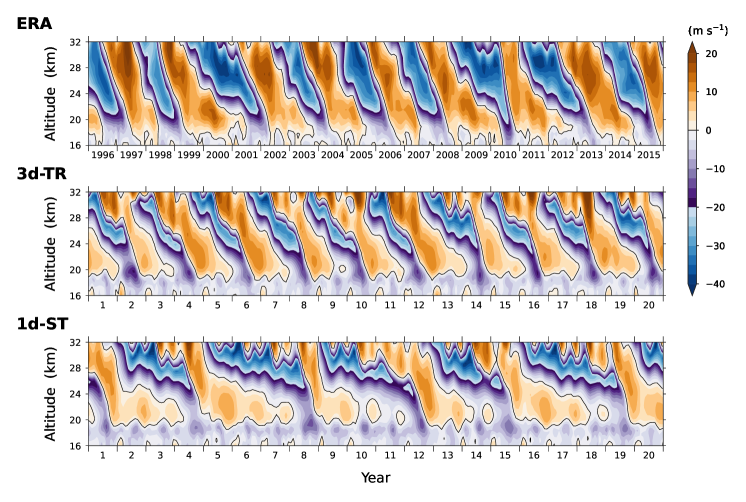
- 采用完整三维瞬态波传播的3d-TR模拟更准确地再现了QBO周期(2年)和峰值振幅,而1d-ST模拟则表现出更长的周期(3–4年)。
- 在1d-ST模拟中,东风相位的下沉显著更慢且更弱,27至19公里高度之间的振幅明显减小,表明无法维持低层平流层的东风西风。
- 斜向传播的重力波,特别是向赤道传播的分量,提供了关键的动量强迫,使低层平流层的东风QBO相位得以维持和放大。
- 3d-TR模拟在垂直和经向风廓线方面与ERA-Interim再分析数据的吻合度更高,尤其在低层平流层表现更优。
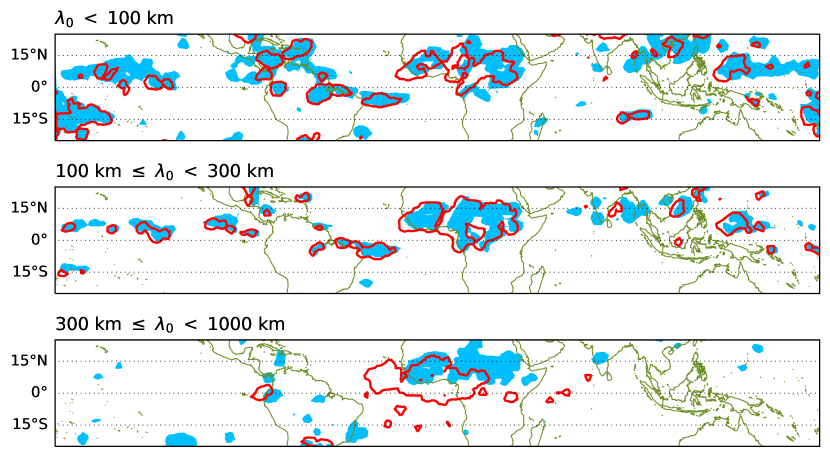
- 包含更大尺度对流源(水平尺度100 km,时间尺度12分钟)可生成波长较长的重力波(>300 km),这些波对低层平流层的强迫作用至关重要。
- 传统的1D稳态参数化(1d-ST)无法捕捉实现真实QBO动力过程所需的全部波动动量通量,导致东风急流强度系统性低估。
更好的研究,从现在开始
从阅读论文到最终审阅,大幅缩短您的研究时间。
无需绑定信用卡
本解读由 AI 生成,并经人工编辑审核。