
[论文解读] Data-Driven Resilient Predictive Control under Denial-of-Service
该论文提出了一种数据驱动的模型预测控制(MPC)方案,用于在拒绝服务(DoS)攻击下稳定未知的线性时不变(LTI)系统,仅使用预先收集的输入-输出轨迹,而无需显式系统模型。该方法在DoS攻击和噪声条件下实现了局部输入-状态稳定性(ISS),其鲁棒性水平与基于模型的控制器相当;通过两种修改可实现全局ISS,但代价是鲁棒性降低或计算量增加。
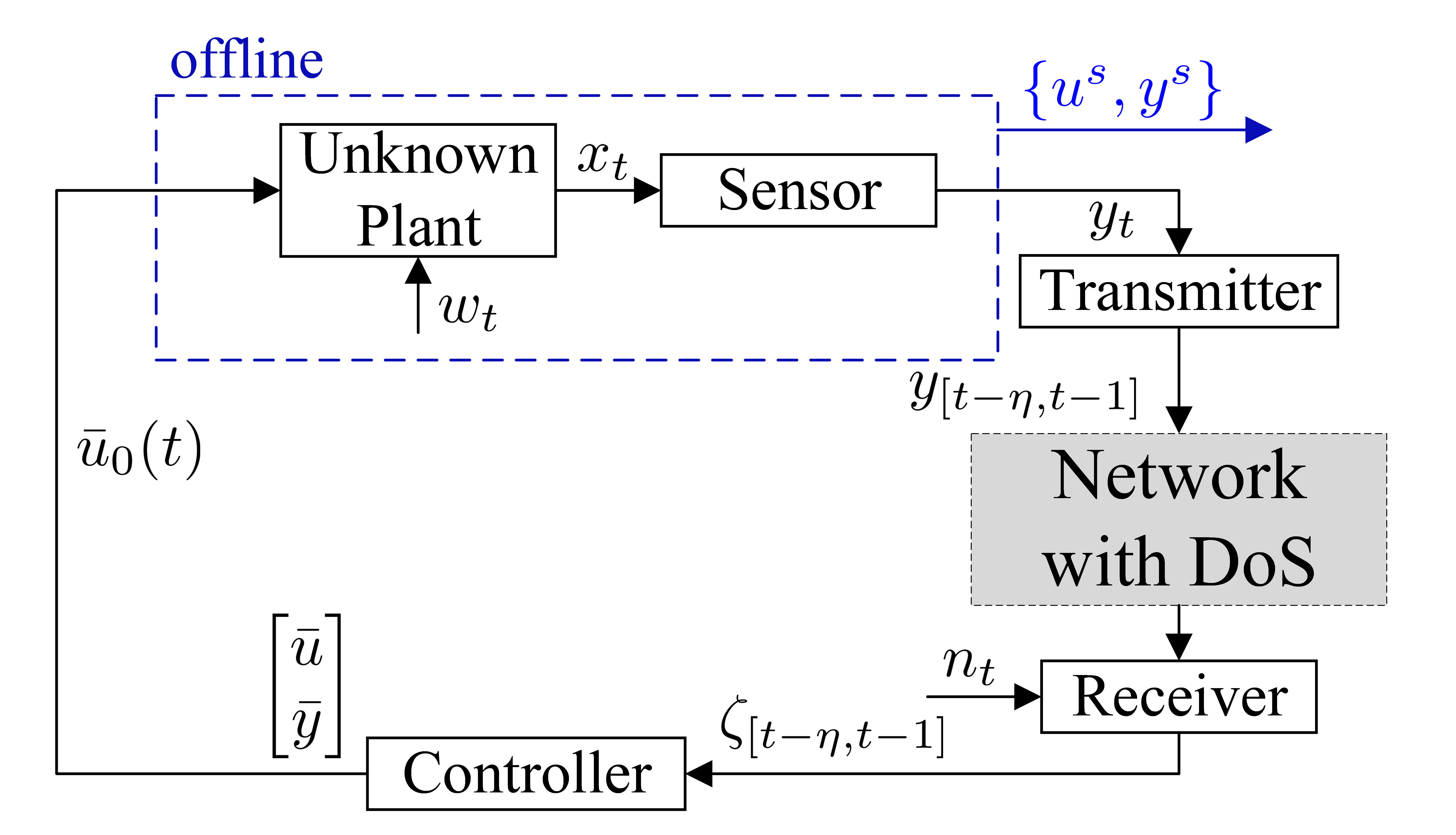
The study of resilient control of linear time-invariant (LTI) systems against denial-of-service (DoS) attacks is gaining popularity in emerging cyber-physical applications. In previous works, explicit system models are required to design a predictor-based resilient controller. These models can be either given a priori or obtained through a prior system identification step. Recent research efforts have focused on data-driven control based on pre-collected input-output trajectories (i.e., without explicit system models). In this paper, we take an initial step toward data-driven stabilization of stochastic LTI systems under DoS attacks, and develop a resilient model predictive control (MPC) scheme driven purely by data-dependent conditions. The proposed data-driven control method achieves the same level of resilience as the model-based control method. For example, local input-to-state stability (ISS) is achieved under mild assumptions on the noise and the DoS attacks. To recover global ISS, two modifications are further suggested at the price of reduced resilience against DoS attacks or increased computational complexity. Finally, a numerical example is given to validate the effectiveness of the proposed control method.
研究动机与目标
- 解决在缺乏显式系统模型时,对未知LTI系统在DoS攻击下实现稳定控制的挑战。
- 开发一种无需系统辨识、仅依赖预先收集的输入-输出轨迹的纯数据驱动控制框架。
- 实现与基于模型的预测控制方法相当的DoS攻击鲁棒性。
- 在无先验系统建模的前提下,确保在噪声和DoS攻击条件下的稳定性与鲁棒性。
- 将基于模型控制器的鲁棒性推广至数据驱动设置,并提供理论保证。
提出的方法
- 利用基本引理(Fundamental Lemma)从预先收集的输入-输出轨迹中构建系统动态的数据依赖表示。
- 开发一种数据驱动的MPC公式,通过在数据矩阵上进行凸优化来计算控制输入和预测输出。
- 控制器采用基于预测器的结构,在DoS导致的数据丢包期间估计系统状态,确保连续控制动作。
- 通过李雅普诺夫函数分析稳定性,推导出关于DoS攻击频率和持续时间以及噪声水平的条件,以确保局部ISS。
- 提出两种修改以将局部ISS扩展至全局ISS:一种通过调整控制律,另一种通过修改优化约束,分别以牺牲鲁棒性或增加计算负载为代价。
- 该方法通过直接使用数据参数化控制律,避免系统辨识,从而实现无模型设计。
实验结果
研究问题
- RQ1在不依赖显式系统模型的前提下,数据驱动MPC方案能否实现与基于模型的预测控制器相当的DoS攻击鲁棒性?
- RQ2在仅使用输入-输出数据的前提下,如何在随机LTI系统受到DoS攻击和测量噪声影响时,保证局部输入-状态稳定性(ISS)?
- RQ3在数据驱动框架中,将局部ISS扩展至全局ISS时会产生哪些权衡?这些权衡如何影响鲁棒性或计算成本?
- RQ4预收集数据的长度和预测时域如何影响在DoS攻击下数据驱动MPC的系统性能?
- RQ5当系统辨识在高维系统中易发生过拟合时,数据驱动方法在多大程度上优于基于模型的方法?
主要发现
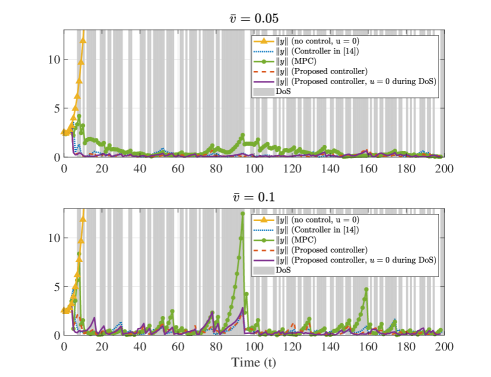
- 该数据驱动MPC在DoS攻击和有界噪声条件下实现了局部输入-状态稳定性(ISS),其鲁棒性水平与基于模型的控制器相当。
- 实现稳定性的DoS攻击条件与现有基于模型方法完全一致,表明具有等效的鲁棒性。
- 通过两种修改可实现全局ISS:一种降低对DoS攻击的鲁棒性,另一种增加计算复杂度。
- 当数据集规模较小时(例如,N=40),由于系统辨识导致的过拟合减少,数据驱动方法优于基于模型的方法。
- 系统性能随数据集长度N的增加而迅速提升,直至达到某一阈值(N≈60),此后性能趋于平稳,表明超过某一数据量后收益递减。
- 只要满足数据可用性约束 L ≥ 2η + nx 且 L ≤ (N - nx + 1)/(max{nu, ny} + 1),预测时域L对性能影响极小。
更好的研究,从现在开始
从阅读论文到最终审阅,大幅缩短您的研究时间。
无需绑定信用卡
本解读由 AI 生成,并经人工编辑审核。