
[论文解读] Decay-assisted collinear resonance ionization spectroscopy: Application to neutron-deficient francium
本研究在CERN的ISOLDE设施CRIS实验中,采用衰变辅助共线共振离子化光谱法,测量了中子缺乏的钫同素体202–206Fr的超精细结构与核性质。通过结合高分辨率激光光谱与α衰变标记技术,该方法首次明确识别出202,204Fr中超精细组分与亚稳态,获得了精确的磁矩与均方根荷电半径,且在203Fr中发现集体性开始出现的证据。
This paper reports on the hyperfine-structure and radioactive-decay studies of the neutron-deficient francium isotopes $^{202-206}$Fr performed with the Collinear Resonance Ionization Spectroscopy (CRIS) experiment at the ISOLDE facility, CERN. The high resolution innate to collinear laser spectroscopy is combined with the high efficiency of ion detection to provide a highly-sensitive technique to probe the hyperfine structure of exotic isotopes. The technique of decay-assisted laser spectroscopy is presented, whereby the isomeric ion beam is deflected to a decay spectroscopy station for alpha-decay tagging of the hyperfine components. Here, we present the first hyperfine-structure measurements of the neutron-deficient francium isotopes $^{202-206}$Fr, in addition to the identification of the low-lying states of $^{202,204}$Fr performed at the CRIS experiment.
研究动机与目标
- 以高灵敏度测量短寿命、中子缺乏的钫同素体(202–206Fr)的超精细结构与核性质。
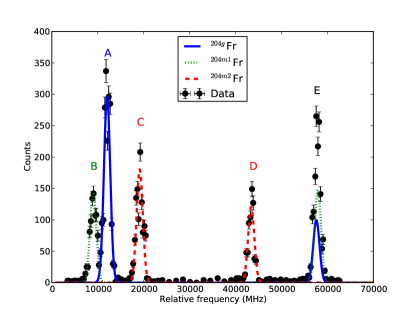
- 利用α衰变标记技术,解析202,204Fr亚稳态激光光谱中重叠的超精细组分。
- 测定202,204Fr中低激发亚稳态的磁矩、均方根荷电半径与分支比。
- 研究中子缺乏的钫同素体中核形变的开始与质子反常组态的作用。
- 通过King图分析校准422.7-nm跃迁的原子因子,以提高未来测量的精度。
提出的方法
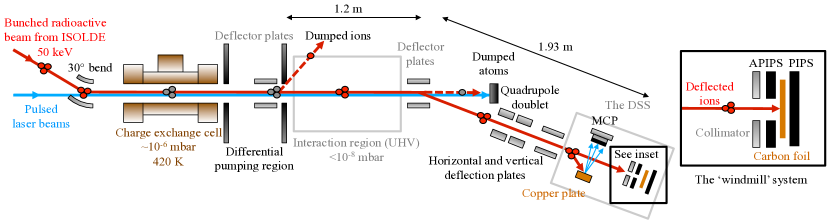
- 在ISOLDE设施采用共线共振离子化光谱法(CRIS),结合高分辨率激光光谱与高效的离子探测技术。
- 利用衰变光谱站标记来自亚稳态的α衰变,实现激光扫描中对超精细组分的识别。
- 对钫的7s 2S₁/₂ → 8p 2P₃/₂跃迁进行激光激发,测量超精细A因子,并通过King图分析校准原子参数。
- 采用1.5 GHz激光线宽以分辨低能级超精细分裂,并提取A_S₁/₂因子。
- 利用CRIS装置的高探测效率与低本底,研究了每秒产量低至1个原子的同素体。
- 将激光光谱与核衰变标记相结合,实现对超精细峰与特定亚稳态的明确归属。
实验结果
研究问题
- RQ1中子缺乏的钫同素体202–206Fr的超精细结构参数与磁矩为何?
- RQ2在202,204Fr的亚稳态中,α衰变标记能否解析重叠的超精细组分?
- RQ3在钫同素体链中,集体性在何种中子数时开始出现?
- RQ4202,204Fr中低激发亚稳态的本质是什么?其磁矩如何反映单粒子或集体行为?
- RQ5能否提取谱学四极矩以判断这些核中形变是静态还是动态的?
主要发现
- 首次实现了对202–206Fr的超精细结构测量,其中202Fr的测量产量达每秒100个原子。
- α衰变标记技术使204Fr中三个低激发亚稳态的识别及其分支比得以明确确定。
- 422.7-nm跃迁的场因子F₄₂₂确定为−20.670(210) GHz/fm²,质量因子M₄₂₂为+750(330) GHz amu。
- 均方根荷电半径的分析表明,集体性在203Fr(N = 116)开始出现,但需通过谱学四极矩测量以确认形变性质。
- 磁矩结果表明,除206m²Fr中的10−亚稳态外,其余状态的单粒子描述均成立,后者表现出偏离,提示可能存在集体性。
- 1.5 GHz激光线宽成功分辨了低能级超精细分裂,实现了A_S₁/₂因子的提取;未来使用更窄线宽激光有望分辨高能级分裂并提取B_P₃/₂因子。
更好的研究,从现在开始
从阅读论文到最终审阅,大幅缩短您的研究时间。
无需绑定信用卡
本解读由 AI 生成,并经人工编辑审核。