
[论文解读] Fate of homogeneous $\mathbb{Z}_2$-symmetric scalar condensates
本文利用非平衡量子场论的闭时路径形式,研究了在膨胀的弗里德曼-勒梅特-罗伯逊-沃尔克(FLRW)宇宙中,一个均匀的 Z₂ 对称标量凝聚态在晚期时间的演化。推导出凝聚态、辐射和时空的耦合粗粒化方程,表明由于凝聚态的衰变速率在低温下比哈勃参数下降得更快,即使在参数共振效率较低的微扰 regime 中,凝聚态始终留下非零的遗迹丰度。
Dark matter, if represented by a $\mathbb{Z}_2$-symmetric scalar field, can manifest as both particles and condensates. In this paper, we study the evolution of an oscillating homogeneous condensate of a $\mathbb{Z}_2$-symmetric scalar field in a thermal plasma in an FLRW universe. We focus on the perturbative regime where the oscillation amplitude is sufficiently small so that parametric resonance is inefficient. This perturbative regime necessarily comprises the late stage of the condensate decay and determines its fate. The coupled coarse-grained equations of motion for the condensate, radiation, and spacetime are derived from first principles using nonequilibrium quantum field theory. We obtain analytical expressions for the relevant microscopic quantities that enter the equations of motion and solve the latter numerically. We find that there is always a nonvanishing relic abundance for a condensate with a $\mathbb{Z}_2$ symmetry that is not spontaneously broken. This is because its decay rate decreases faster than the Hubble parameter at late times due to either the amplitude dependence or the temperature dependence in the condensate decay rate. Consequently, accounting for the condensate contribution to the overall dark matter relic density is essential for $\mathbb{Z}_2$ scalar singlet dark matter.
研究动机与目标
- 理解早期宇宙中均匀 Z₂ 对称标量凝聚态的最终命运,特别是在非微扰效应可忽略的晚期微扰 regime 中。
- 从第一性原理出发,利用非平衡量子场论推导凝聚态、辐射和时空的耦合运动方程。
- 确定凝聚态是否能完全衰变为辐射,或是否留下遗迹丰度,特别是在缺乏参数共振的情况下。
- 计算凝聚态的衰变速率,同时包含振幅和温度依赖性,超越以往研究中使用的高温近似。
提出的方法
- 从闭时路径(CTP)形式出发,推导出包含与热等离子体相互作用的自能修正的非局部凝聚态运动方程。
- 应用多尺度分析将非局部方程马尔可夫化,得到凝聚态包络、辐射能量密度和标度因子演化的耦合粗粒化方程。
- 使用实时形式的热场论技术,显式计算了相关的微观自能(四点顶点型和太阳图型)。
- 数值求解得到的耦合方程组,追踪凝聚态振幅、辐射能量密度和哈勃参数的时间演化。
- 同时纳入振幅依赖和温度依赖的衰变速率,避免了先前研究中使用的高温近似。
- 在凝聚态质量和振幅在自能关联时间尺度内缓慢变化的假设下,采用马尔可夫近似。
实验结果
研究问题
- RQ1在早期宇宙中,Z₂ 对称标量凝聚态是否完全衰变为辐射,还是留下非零的遗迹丰度?
- RQ2凝聚态的衰变速率如何依赖于其振幅和电浆温度,这种依赖关系如何影响其晚期演化?
- RQ3对衰变速率使用的高温近似是否可能导致关于凝聚态衰变完全性的错误结论?
- RQ4时变的阻尼率在决定凝聚态最终遗迹密度方面起什么作用?
- RQ5在微扰 regime 中,凝聚态、辐射和时空的耦合运动方程如何进行数值演化?
主要发现
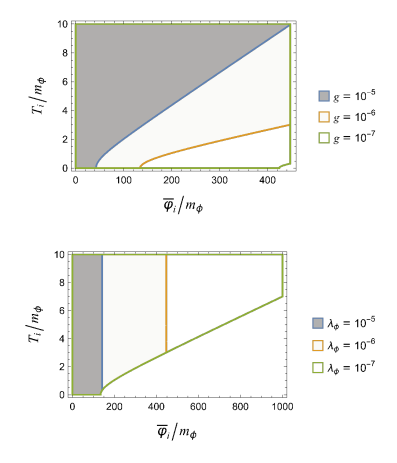
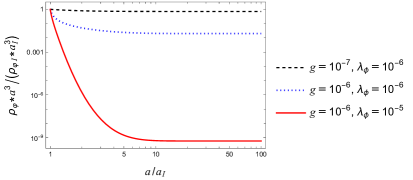
- 由于衰变速率在低温下比哈勃参数下降得更快,凝聚态始终留下非零的遗迹丰度,这是由于振幅和温度依赖的抑制效应。
- 先前研究中使用的高温近似可能具有误导性,因为它可能预测完全衰变;本研究表明,当正确包含温度和振幅依赖性时,这种衰变并不会发生。
- 衰变速率同时具有振幅依赖性和温度依赖性,导致时变的阻尼率,从而抑制晚期衰变。
- 耦合粗粒化方程的数值解证实,凝聚态在晚期经历一种‘冻结’过程,类似于热冻结,但由衰变速率的减小驱动。
- 凝聚态的遗迹密度对初始条件敏感,与标准热冻结不同,因此在 Z₂ 标量单重态暗物质模型中必须予以考虑。
- 所推导的方程适用于微扰暗物质产生和再加热过程,前提是所有电浆粒子均处于热平衡。
更好的研究,从现在开始
从阅读论文到最终审阅,大幅缩短您的研究时间。
无需绑定信用卡
本解读由 AI 生成,并经人工编辑审核。