
[论文解读] Flow-induced nonequilibrium self-assembly in suspensions of stiff, apolar, active filaments
本研究揭示了由流体动力学流驱动的刚性、非极性、活性细丝悬浮液中的一种非平衡自组装机制。伸展型细丝通过侧向吸引形成弹道式平动与旋转的团簇,而收缩型细丝则通过扩散性、非热运动形成与体积分数相关的微结构——星状、团簇及初始凝胶态,展示了超越平衡热力学的层级活性物质自组装的通用路径。
Active bodies in viscous fluids interact hydrodynamically through self-generated flows. Here we study spontaneous aggregation induced by hydrodynamic flow in a suspension of stiff, apolar, active filaments. Lateral hydrodynamic attractions in extensile filaments lead, independent of volume fraction, to anisotropic aggregates which translate and rotate ballistically. Lateral hydrodynamic repulsion in contractile filaments lead, with increasing volume fractions, to microstructured states of asters, clusters, and incipient gels where, in each case, filament motion is diffusive. Our results demonstrate that the interplay of active hydrodynamic flows and anisotropic excluded volume interactions provides a generic nonequilibrium mechanism for hierarchical self-assembly of active soft matter.
研究动机与目标
- 理解活性非极性细丝产生的流体动力学流如何在无热涨落的情况下诱导非平衡自组装。
- 研究各向异性排斥体积与流场对称性(伸展型与收缩型)在决定集体细丝动力学中的作用。
- 识别收缩型细丝悬浮液中随体积分数变化而出现的不同微结构状态。
- 证明集体运动源于内部活性流的时间反演对称性破缺,而非外部作用力。
- 提供一个粒子级模型,捕捉连续介质理论无法描述的短波长流体动力学效应。
提出的方法
- 将单个刚性非极性细丝建模为生成无净力、无净力矩应力张量流的活性质点链。
- 采用不可约应力张量近似,表示每根细丝主导的、长程的流体动力学流场。
- 模拟包含显式流体动力学与排斥体积相互作用的悬浮液,解析近场动力学。
- 追踪细丝的位置、取向及质心运动,以量化扩散与团簇化动力学。
- 计算稳态k-聚体分布P*(k),以跨不同体积分数分类微结构状态。
- 分析均方位移,以区分不同区域中扩散运动与弹道动力学的差异。
实验结果
研究问题
- RQ1伸展型与收缩型活性细丝在流体动力学流作用下如何自组装,其不同动力学的驱动力是什么?
- RQ2排斥体积各向异性在稳定或 destabilize 细丝聚集体中起什么作用?
- RQ3体积分数如何调控收缩型悬浮液中从星状到团簇再到初始凝胶态的转变?
- RQ4在无热噪声的情况下,活性系统中能否出现非热扩散性运动,其扩散系数如何随浓度变化?
- RQ5为何伸展型细丝形成稳定、弹道式运动的团簇,而收缩型细丝虽保持各向同性却呈现微结构特征?
主要发现
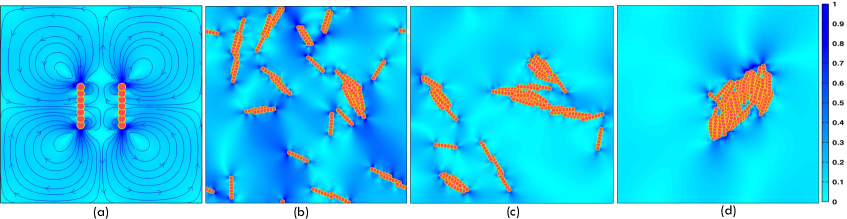
- 伸展型细丝由于侧向流体动力学吸引,自发形成稳定、旋转的二聚体,导致快速二聚化,并进一步聚合成大尺度、弹道式平动的团簇。
- 收缩型细丝表现出与体积分数相关的微结构:在φ = 0.05–0.15时为星状结构,在φ = 0.21–0.24时为团簇结构,在φ = 0.34时形成初始凝胶结构,且在φ ≈ 0.3附近出现急剧转变。
- 所有微结构状态中,细丝质心的均方位移随时间线性增加,证实了非热扩散运动,其扩散系数D随体积分数增加而减小。
- 扩散系数D不遵循Stokes-Einstein关系,因其源于活性、非平衡作用力,而非热运动。
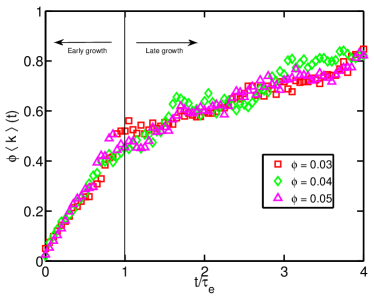
- 伸展型悬浮液中系统表现出两步聚集动力学:快速初始团簇生长,随后缓慢合并为大尺度动态聚集体。
- 迁移率矩阵中不存在Onsager对称性,使细丝之间能够相对运动,从而实现被动系统无法达到的集体非平衡动力学。
更好的研究,从现在开始
从阅读论文到最终审阅,大幅缩短您的研究时间。
无需绑定信用卡
本解读由 AI 生成,并经人工编辑审核。