
[论文解读] Galaxy archaeology for wet mergers: Globular cluster age distributions in the Milky Way and nearby galaxies
本文提出,星系中多模态球状星团(GC)年龄分布可作为过去湿并合事件的示踪器,利用银河系及邻近星系(M31、NGC 1407、NGC 3115)作为实验室。通过将观测到的GC年龄分布与模拟的并合历史进行比较,表明年轻GC群体——尤其是由富气体并合形成的GC——会留下与湿并合事件相关的显著年龄峰值,从而可推断原本无法追踪的并合历史。
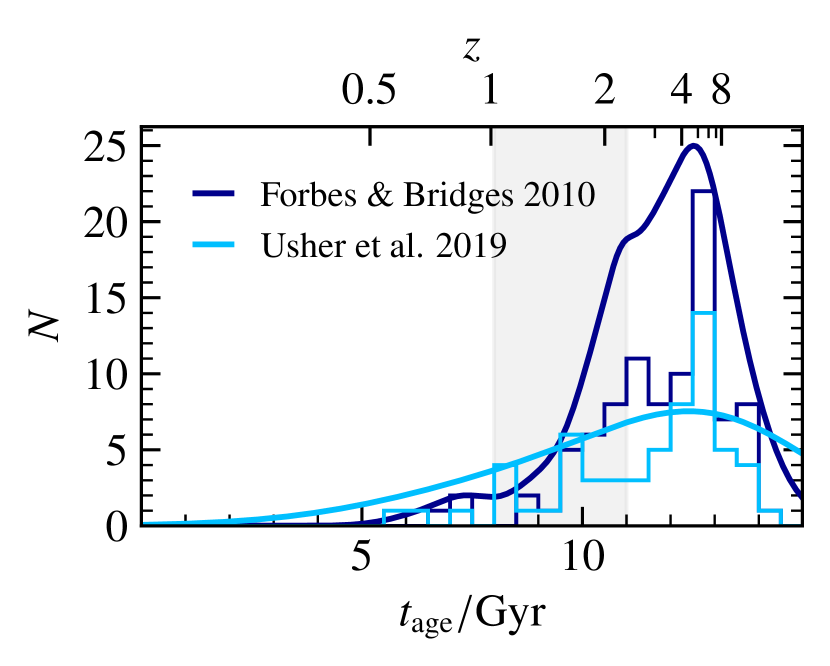
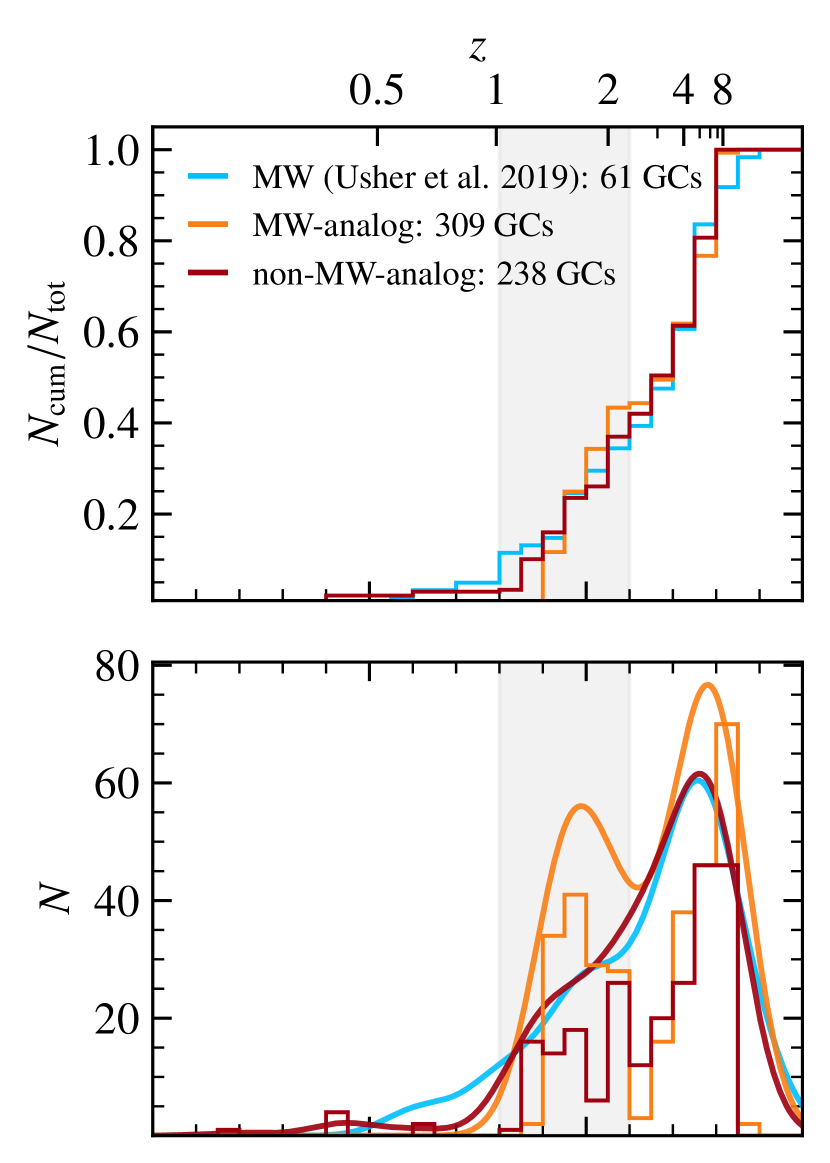
Identifying past wet merger activity in galaxies has been a longstanding issue in extragalactic formation history studies. Gaia's 6D kinematic measurements in our Milky Way (MW) have vastly extended the possibilities for Galactic archaeology, leading to the discovery of early mergers in the MW's past. As recent work has established a link between young globular clusters (GCs) and wet galaxy merger events, the MW provides an ideal laboratory for testing how GCs can be used to trace galaxy formation histories. To test the hypothesis that GCs trace wet mergers, we relate the measured GC age distributions of the MW and three nearby galaxies to their merger histories and interpret the connection with wet mergers through an empirical model for GC formation. For the MW, we cross-match the GCs with their associated progenitor host galaxies to disentangle the connection to the GC age distribution. We find that the MW GC age distribution is bimodal, mainly caused by younger GCs associated with Gaia-Sausage/Enceladus (GSE) and in part by unassociated high-energy GCs. The GSE GC age distribution also appears to be bimodal. We propose that the older GSE GCs were accreted together with GSE, while the younger ones formed through the merger. For the nearby galaxies, we find that peaks in the GC age distributions coincide with early gas-rich mergers. Even small signatures in the GC age distributions agree well with the formation histories of the galaxies inferred through other observed tracers. From the models, we predict that the involved cold gas mass can be estimated from the number of GCs found in the formation burst. Multimodal GC age distributions can trace massive wet mergers as a result of GCs being formed through them. From the laboratory of our own MW and nearby galaxies we conclude that the ages of younger GC populations of galaxies can be used to infer the wet merger history of a galaxy.
研究动机与目标
- 检验球状星团(GC)年龄分布是否可作为星系形成过程中湿并合事件的经验示踪器。
- 研究银河系及邻近星系中观测到的GC年龄分布与其推断的并合历史之间的关联。
- 确定年轻GC群体的存在是否与过去的湿(富气体)并合事件相关,特别是在可观测并合示踪物有限的星系中。
- 建立并验证一个将湿并合期间GC形成爆发与星系中可观测的年龄分布特征相联系的模型。
- 评估利用GC年龄分布作为诊断工具,以约束河外系统中湿并合事件的时间和性质的可行性。
提出的方法
- 整理了银河系、M31、NGC 1407和NGC 3115的观测GC年龄分布数据,来自多项研究,用于对比分析。
- 将银河系GC与其前身星系(如Gaia-Sausage/Enceladus)进行交叉匹配,以分离并合系统对年龄分布的贡献。
- 采用GC形成的经验模型,模拟能够重现观测到的GC年龄分布的星系并合历史。
- 识别出GC年龄分布与观测结果匹配的模拟星系,并将其吸积历史与观测示踪物进行比较。
- 在模拟中追踪年轻GC的形成,将其与湿并合事件(特别是冷气体质量分数较高的并合)联系起来。
- 通过评估年龄峰值在GC分布中的显著程度,特别是低质量比并合系统中的情况,评估湿并合信号的可探测性。
实验结果
研究问题
- RQ1多模态球状星团年龄分布能否用于识别星系中过去的湿并合事件?
- RQ2银河系及邻近星系中球状星团的年龄分布在多大程度上反映了湿并合事件的时间与性质?
- RQ3与吸积系统(如Gaia-Sausage/Enceladus)相关的球状星团年龄分布,与原位形成星团的年龄分布相比有何差异?
- RQ4小规模或次要湿并合事件是否会在球状星团年龄分布中留下可观测的痕迹?
- RQ5在一次并合爆发中形成的球状星团数量与湿并合中涉及的冷气体质量之间存在何种关系?
主要发现
- 银河系的球状星团年龄分布呈双峰分布,主要由与Gaia-Sausage/Enceladus(GSE)并合相关的年轻星团,以及一群未关联的高能GC组成。
- GSE的GC年龄分布同样呈双峰分布,包含早期吸积的年老星团和在并合过程中形成的年轻星团,表明其为湿并合动力学触发的原位形成。
- NGC 3115、M31和NGC 1407的GC年龄分布中存在清晰的峰值,与富气体并合活动的早期阶段相吻合,支持GC形成爆发与湿并合之间的关联。
- 即使是小规模、低质量的湿并合事件,也会在GC年龄分布中留下可探测的、尽管细微的痕迹,尤其在NGC 3115和NGC 1407等系统中表现明显。
- 模拟结果表明,GC年龄分布与银河系和NGC 3115匹配的星系在约8–10 Gyr前经历了一次主要湿并合,与观测到的并合历史一致。
- 该模型预测,一次爆发中形成的GC数量可用于估算湿并合中涉及的冷气体质量,从而在GC形成与并合特性之间建立定量联系。
更好的研究,从现在开始
从阅读论文到最终审阅,大幅缩短您的研究时间。
无需绑定信用卡
本解读由 AI 生成,并经人工编辑审核。