
[论文解读] Graph Denoising Diffusion for Inverse Protein Folding
GraDe-IF 引入离散图形去噪扩散模型,以生成可以折叠成给定蛋白骨架的多样性氨基酸序列,达到最先进的恢复率并实现受进化先验与二级结构引导的多样性序列设计。
Inverse protein folding is challenging due to its inherent one-to-many mapping characteristic, where numerous possible amino acid sequences can fold into a single, identical protein backbone. This task involves not only identifying viable sequences but also representing the sheer diversity of potential solutions. However, existing discriminative models, such as transformer-based auto-regressive models, struggle to encapsulate the diverse range of plausible solutions. In contrast, diffusion probabilistic models, as an emerging genre of generative approaches, offer the potential to generate a diverse set of sequence candidates for determined protein backbones. We propose a novel graph denoising diffusion model for inverse protein folding, where a given protein backbone guides the diffusion process on the corresponding amino acid residue types. The model infers the joint distribution of amino acids conditioned on the nodes' physiochemical properties and local environment. Moreover, we utilize amino acid replacement matrices for the diffusion forward process, encoding the biologically-meaningful prior knowledge of amino acids from their spatial and sequential neighbors as well as themselves, which reduces the sampling space of the generative process. Our model achieves state-of-the-art performance over a set of popular baseline methods in sequence recovery and exhibits great potential in generating diverse protein sequences for a determined protein backbone structure.
研究动机与目标
- 通过为固定骨架生成多样且可行的氨基酸序列,解决反蛋白质折叠中的“一对多”映射问题。
- 利用扩散模型捕捉以骨架结构和环境为条件的多模态序列分布。
- 结合生物学意义的先验(BLOSUM)和二级结构来约束扩散和采样。
- 利用旋转-平移等变的图神经网络,在去噪过程中保持几何信息与化学信息。
提出的方法
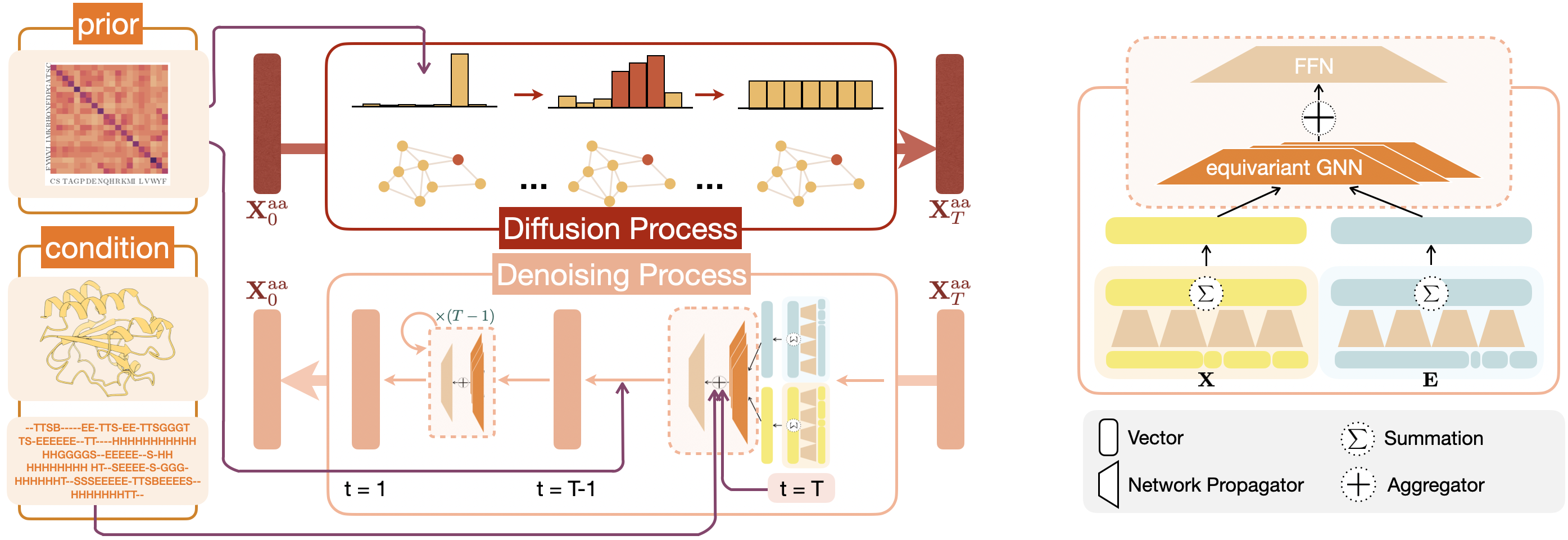
- 将反折叠任务建模为蛋白质残基图上的离散图去噪扩散过程。
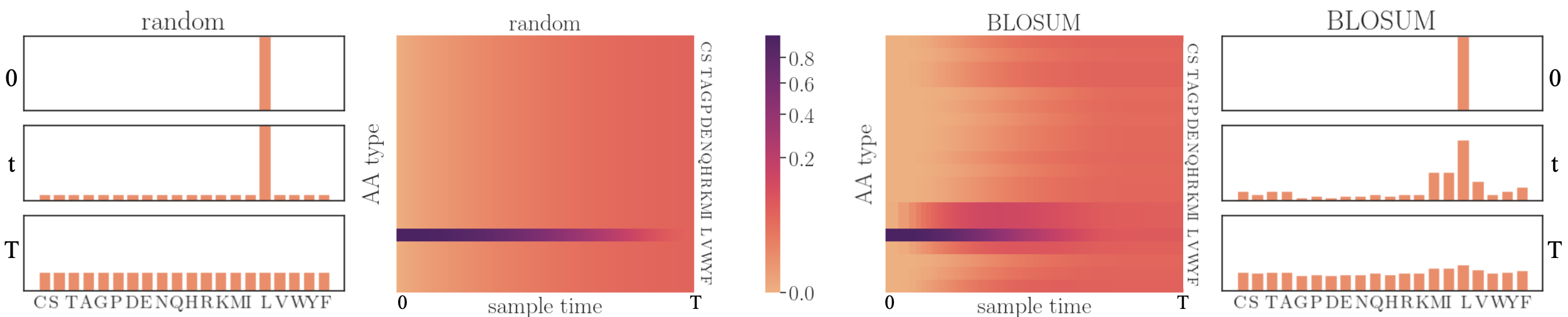
- 使用基于 BLOSUM 的转移矩阵推动前向扩散并引导采样朝向生物学上可行的替换。
- 通过 SE(3) 等变的图神经网络对分解器进行图结构、二级结构和局部环境的条件化。
- 在离散扩散设置中应用受 DDIM 启发的确定性采样以加速推理。
- 通过对氨基酸类型预测的交叉熵损失进行训练,以学习去噪映射。
实验结果
研究问题
- RQ1基于扩散的生成模型是否能比判别基线更准确地在固定蛋白骨架上恢复原生氨基酸序列?
- RQ2以二级结构和局部环境进行条件化是否能提高生成序列的生物学可行性和折叠性?
- RQ3引入生物学意义的先验(BLOSUM)是否在保持多样性的同时减少采样空间?
- RQ4在为同一骨架生成多条序列时,多样性与折叠能力之间的权衡是什么?
主要发现
- GraDe-IF 在基于 CATH 的基准上实现了最先进的恢复率,单链蛋白提升了 4.2%,短序列提升了 5.4%,相较强基线。
- 生成的序列能折叠成与本地结构高度相似的结构,在对选定案例评估时,AlphaFold2 预测的结构与本地结构的 RMSD 约为 1 Å。
- 通过调整采样步数可以提高多样性(较低步数产生更具多样性的序列),同时保持如 TM 分数和 pLDDT 这样的高折叠性指标。
- 保守核心残基的恢复率高于表面残基,恢复与残基接触数及二级结构上下文相关。
- 该模型生成的生物学上可行序列在折叠性评估(TM 分数、pLDDT、RMSD)中仍保持结构完整性。
更好的研究,从现在开始
从阅读论文到最终审阅,大幅缩短您的研究时间。
无需绑定信用卡
本解读由 AI 生成,并经人工编辑审核。