
[论文解读] Helium as an Indicator of the Neutron-Star Merger Remnant Lifetime and its Potential for Equation of State Constraints
本文提出利用千新星光谱中的氦发射线——特别是He i λ1083.3 nm谱线——作为探测中子星并合残余物寿命的探针。通过分析AT2017gfo的光谱,作者将残余物的寿命约束在≤30 ms以内,暗示双星总质量接近直接形成黑洞的阈值(M_thres ≲ 2.93 M⊙),进而将中子星状态方程的上限限制为M_max ≲ 2.3 M⊙,以及质量为1.6 M⊙的中子星半径约为~12 ± 1 km。
The time until black hole formation in a binary neutron-star (NS) merger contains invaluable information about the nuclear equation of state (EoS) but has thus far been difficult to measure. We propose a new way to constrain the merger remnant's NS lifetime, which is based on the tendency of the NS remnant neutrino-driven winds to enrich the ejected material with helium. Based on the He I $λ1083.3$ nm line, we show that the feature around 800-1200 nm in AT2017gfo at 4.4 days seems inconsistent with a helium mass fraction of $X_{\mathrm{He}} \gtrsim 0.05$ in the polar ejecta. Our recent neutrino-hydrodynamic simulations of merger remnants are only compatible with this limit if the NS remnant collapses within 20-30 ms. Such a short lifetime implies that the total binary mass of GW170817, $M_\mathrm{ m tot}$, lay close to the threshold binary mass for direct gravitational collapse, $M_\mathrm{thres}$, for which we estimate $M_{\mathrm{thres}}\lesssim 2.93 M_\odot$. This upper bound on $M_\mathrm{thres}$ yields upper limits on the radii and maximum mass of cold, non-rotating NSs, which rule out simultaneously large values for both quantities. In combination with causality arguments, this result implies a maximum NS mass of $M_\mathrm{max}\lesssim2.3 M_\odot$. The combination of all limits constrains the radii of 1.6 M$_\odot$ NSs to about 12$\pm$1 km for $M_\mathrm{max}$ = 2.0 M$_\odot$ and 11.5$\pm$1 km for $M_\mathrm{max}$ = 2.15 M$_\odot$. This $\sim2$ km allowable range then tightens significantly for $M_\mathrm{max}$ above $\approx2.15$ M$_\odot$. This rules out a significant number of current EoS models. The short NS lifetime also implies that a black-hole torus, not a highly magnetized NS, was the central engine powering the relativistic jet of GRB170817A. Our work motivates future developments... [abridged]
研究动机与目标
- 开发一种利用喷射物中氦富集来约束中子星并合残余物寿命的新方法。
- 将AT2017gfo光谱中未检测到氦的现象与残余物存活时间的约束联系起来。
- 利用残余物寿命和黑洞形成临界总双星质量阈值,推导核状态方程(EoS)的边界。
- 评估残余物寿命对GRB170817A中心引擎的影响,特别是其是否为黑洞-吸积盘或磁星结构。
提出的方法
- 分析AT2017gfo在并合后4.4天的光学/红外光谱中He i λ1083.3 nm谱线特征。
- 利用中子星并合残余物的中微子-流体动力学模拟,预测极向喷射物中氦质量分数(X_He)随残余物寿命变化的关系。
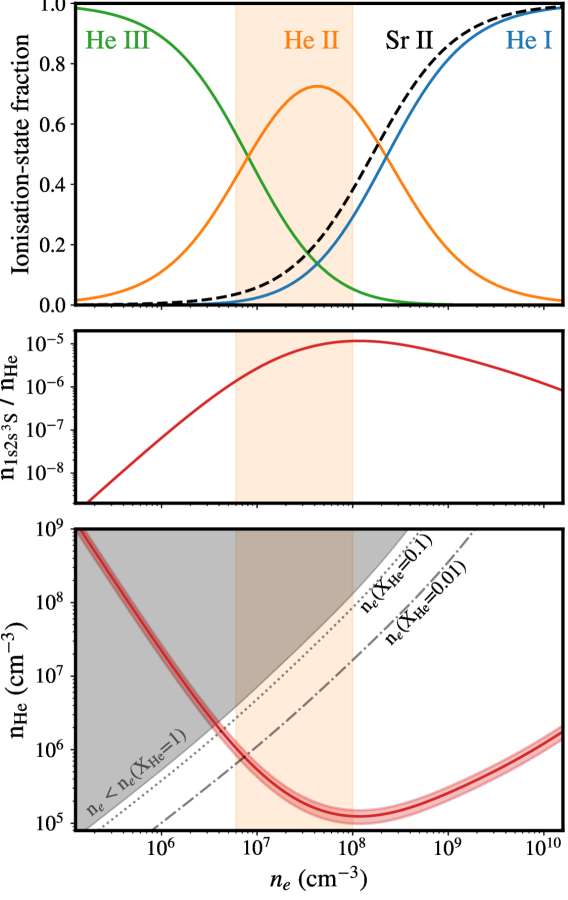
- 应用光谱建模,推断在非局部热动平衡条件和理想化喷射物几何构型下,X_He的上限。
- 基于模拟的X_He(τ_BH)关系,将推断出的X_He上限映射为残余物最大寿命20–30 ms。
- 利用与状态方程相关的模拟,从残余物寿命推导出直接形成黑洞的临界总双星质量M_thres。
- 结合因果性约束与质量-半径关系,利用R_1.6与M_max之间的反比关系,对M_max和R_1.6进行边界约束。
![Figure 1: VLT/X-shooter spectrum of AT2017gfo 4.4 days post merger with a blackbody continuum overlaid ( $T_{\rm BB}=3200$ K from the best-fit blackbody compilation in Sneppen et al. [ 66 ] ) and P Cygni features for various helium abundances computed using the model described in Sect. II . Given a](https://ar5iv.labs.arxiv.org/html/2411.03427/assets/x1.png)
实验结果
研究问题
- RQ1千新星光谱中的氦发射线能否用于推断中子星并合残余物的寿命?
- RQ2AT2017gfo极向喷射物中氦质量分数的上限是多少?这对其残余物存活时间有何含义?
- RQ3残余物寿命如何约束直接形成黑洞的临界总双星质量M_thres?
- RQ4在M_thres ≲ 2.93 M⊙的条件下,中子星状态方程的边界(特别是M_max和R_1.6)是什么?
- RQ5残余物寿命对GRB170817A的中心引擎意味着什么?其是否为黑洞-吸积盘结构而非磁星?
主要发现
- AT2017gfo在并合后4.4天的He i λ1083.3 nm谱线特征,与极向喷射物中氦质量分数X_He ≳ 0.05的情况不一致。
- 只有当中子星残余物在20–30 ms内坍缩时,中微子-流体动力学模拟才与该X_He上限相容。
- 这表明对于GW170817,直接形成黑洞的临界总双星质量M_thres ≲ 2.93 M⊙。
- M_thres的上限结合因果性约束,得出最大中子星质量M_max ≲ 2.3 M⊙。
- 当M_max = 2.0 M⊙时,1.6 M⊙中子星的半径被约束为R_1.6 = 12 ± 1 km;当M_max = 2.15 M⊙时,R_1.6 = 11.5 ± 1 km。
- 约20 ms的残余物寿命表明,GRB170817A由黑洞-吸积盘中心引擎驱动,而非磁星。
更好的研究,从现在开始
从阅读论文到最终审阅,大幅缩短您的研究时间。
无需绑定信用卡
本解读由 AI 生成,并经人工编辑审核。