
[论文解读] Identification of core-periphery structure in networks
本文提出了一种基于统计原理的算法,通过期望最大化和信念传播对随机块模型进行最大似然拟合,以识别网络中的核心-外围结构。该方法在真实和合成网络中成功检测到核心-外围结构,且无检测阈值——即使在结构信号极弱的情况下也有效。
Many networks can be usefully decomposed into a dense core plus an outlying, loosely-connected periphery. Here we propose an algorithm for performing such a decomposition on empirical network data using methods of statistical inference. Our method fits a generative model of core-periphery structure to observed data using a combination of an expectation--maximization algorithm for calculating the parameters of the model and a belief propagation algorithm for calculating the decomposition itself. We find the method to be efficient, scaling easily to networks with a million or more nodes and we test it on a range of networks, including real-world examples as well as computer-generated benchmarks, for which it successfully identifies known core-periphery structure with low error rate. We also demonstrate that the method is immune from the detectability transition observed in the related community detection problem, which prevents the detection of community structure when that structure is too weak. There is no such transition for core-periphery structure, which is detectable, albeit with some statistical error, no matter how weak it is.
研究动机与目标
- 开发一种基于第一性原理的统计推断方法,用于检测无向网络中的核心-外围结构。
- 通过采用生成模型和最大似然估计,克服现有启发式方法的局限性。
- 在大规模网络(包括互联网和政治博客网络等真实案例)上展示其鲁棒性和可扩展性。
- 证明核心-外围结构的可检测性不依赖于信号强度,与社区检测中存在检测阈值的情况不同。
- 提供一种可扩展、高效的算法,适用于节点数达一百万个的网络。
提出的方法
- 使用专为核心-外围结构设计的随机块模型,区分核心-核心、核心-外围和外围-外围节点对之间的连接概率。
- 应用期望最大化(EM)算法,从观测到的网络数据中估计模型参数。
- 采用信念传播算法,基于估计的参数计算每个节点最可能的核心-外围归属。
- 实现线性化信念传播近似,以提高计算效率和可扩展性。
- 在迭代推理框架中结合EM与信念传播,联合优化模型参数与节点归属。
- 采用生成模型方法,将网络视为随机过程,从而实现严谨的统计推断。
实验结果
研究问题
- RQ1在结构信号微弱或不明显的网络中,能否可靠检测到核心-外围结构?
- RQ2所提出方法在真实和合成网络上与现有启发式方法相比表现如何?
- RQ3该方法是否能高效扩展到节点数超过一百万个的大规模网络?
- RQ4核心-外围结构是否存在类似社区检测中的检测阈值?
- RQ5该算法在多大程度上基于结构角色而非仅度数来区分核心节点?
主要发现
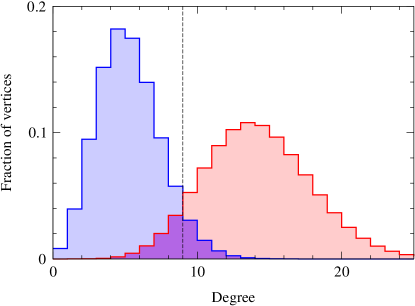
- 该算法在基准网络中以低错误率成功识别出已知的核心-外围结构。
- 其在节点数超过一百万个的大规模网络中表现出高效的可扩展性,展示了在大规模系统中的实际适用性。
- 即使在信号极其微弱的情况下,该方法仍能检测到核心-外围结构,且无检测阈值——这与社区检测不同。
- 在互联网AS网络中,该算法正确地将一组少量骨干节点识别为核心,而将大多数边缘节点置于外围,即使某些高阶节点因网络位置而处于外围。
- 在政治博客网络中,该算法在保守派和自由派社区中分别识别出显著的核心,对应于如Daily Kos和National Review等知名且具影响力的博客。
- 信念传播近似实现了快速推理,线性化版本在保持精度的同时显著提升了计算速度。
更好的研究,从现在开始
从阅读论文到最终审阅,大幅缩短您的研究时间。
无需绑定信用卡
本解读由 AI 生成,并经人工编辑审核。