
[论文解读] Large-scale universality in quantum reaction-diffusion from Keldysh field theory
该论文基于Keldysh场论框架,推导出费米气体中$A+A\to\emptyset$湮灭过程的普适性量子反应-扩散动力学方程。研究表明,在反应受限区域,粒子密度以与维度相关的指数发生代数衰减,该指数偏离了平均场理论的预测;同时,通过图解方法系统地推导出时间依赖的广义吉布斯系综(TGGE),并借助场论方法验证了TGGE假设的有效性。
We consider the quantum reaction-diffusion dynamics in $d$ spatial dimensions of a Fermi gas subject to binary annihilation reactions $A+A o \emptyset$. These systems display collective nonequilibrium long-time behavior, which is signalled by an algebraic decay of the particle density. Building on the Keldysh formalism, we devise a field theoretical approach for the reaction-limited regime, where annihilation reactions are scarce. By means of a perturbative expansion of the dissipative interaction, we derive a description in terms of a large-scale universal kinetic equation. Our approach shows how the time-dependent generalized Gibbs ensemble assumption, which is often employed for treating low-dimensional nonequilibrium systems, emerges from systematic diagrammatics. It also allows to exactly compute -- for arbitrary spatial dimension -- the decay exponent of the particle density. The latter is based on the large-scale description of the quantum dynamics and it differs from the mean-field prediction even in dimension larger than one. We moreover consider spatially inhomogeneous setups involving an external potential. In confined systems the density decay is accelerated towards the mean-field algebraic behavior, while for deconfined scenarios the power-law decay is replaced by a slower non-algebraic decay.
研究动机与目标
- 建立量子反应-扩散系统大规模普适行为的场论基础。
- 在反应受限区域,通过系统图解方法推导出时间依赖的广义吉布斯系综(TGGE)。
- 在任意空间维度$d$下,计算超越平均场预测的精确粒子密度衰减指数。
- 研究空间非均匀性(如阱势)对衰减动力学的影响。
- 阐明禁闭系统中幂律衰减的失效及其与非代数弛豫的关系。
提出的方法
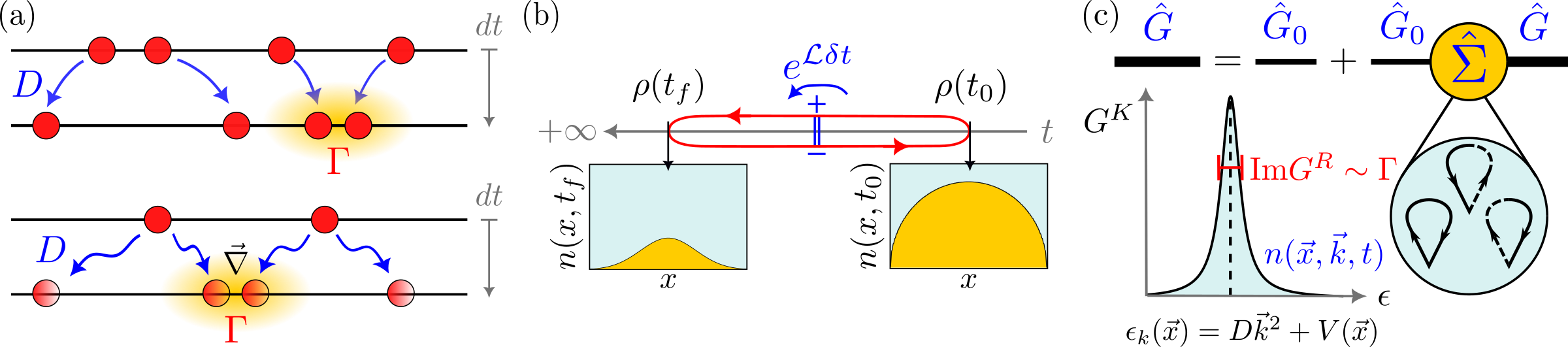
- 采用Keldysh路径积分形式化方法,表示耗散动力学的量子主方程。
- 对作用量中的耗散相互作用顶点进行微扰展开,保留主导的时空导数项。
- 推导出等价于Wigner函数$n(\vec{x},\vec{k},t)$的玻尔兹曼型方程的大尺度普适性动力学方程。
- 通过谱表示和Wigner变换,将Keldysh格林函数$G^K$映射到Wigner分布。
- 利用费曼图,特别是泡 diagrams(tadpoles),计算准粒子的有限寿命,并与TGGE假设建立联系。
- 通过数值分析淬火协议(阱势释放和双阱到单阱淬火),提取有效衰减指数。
实验结果
研究问题
- RQ1在任意空间维度$d$下,量子反应-扩散系统中的粒子密度如何衰减,且其衰减行为如何超越平均场理论?
- RQ2广泛使用的时变广义吉布斯系综(TGGE)假设能否从场论原理出发系统推导?
- RQ3在$d>1$维中,为何会出现非平均场的衰减指数?它如何从大尺度量子动力学中自然涌现?
- RQ4空间非均匀性(如阱势)如何影响粒子密度的长期衰减行为?
- RQ5为何在去禁闭系统中幂律衰减会失效?其替代机制是什么?
主要发现
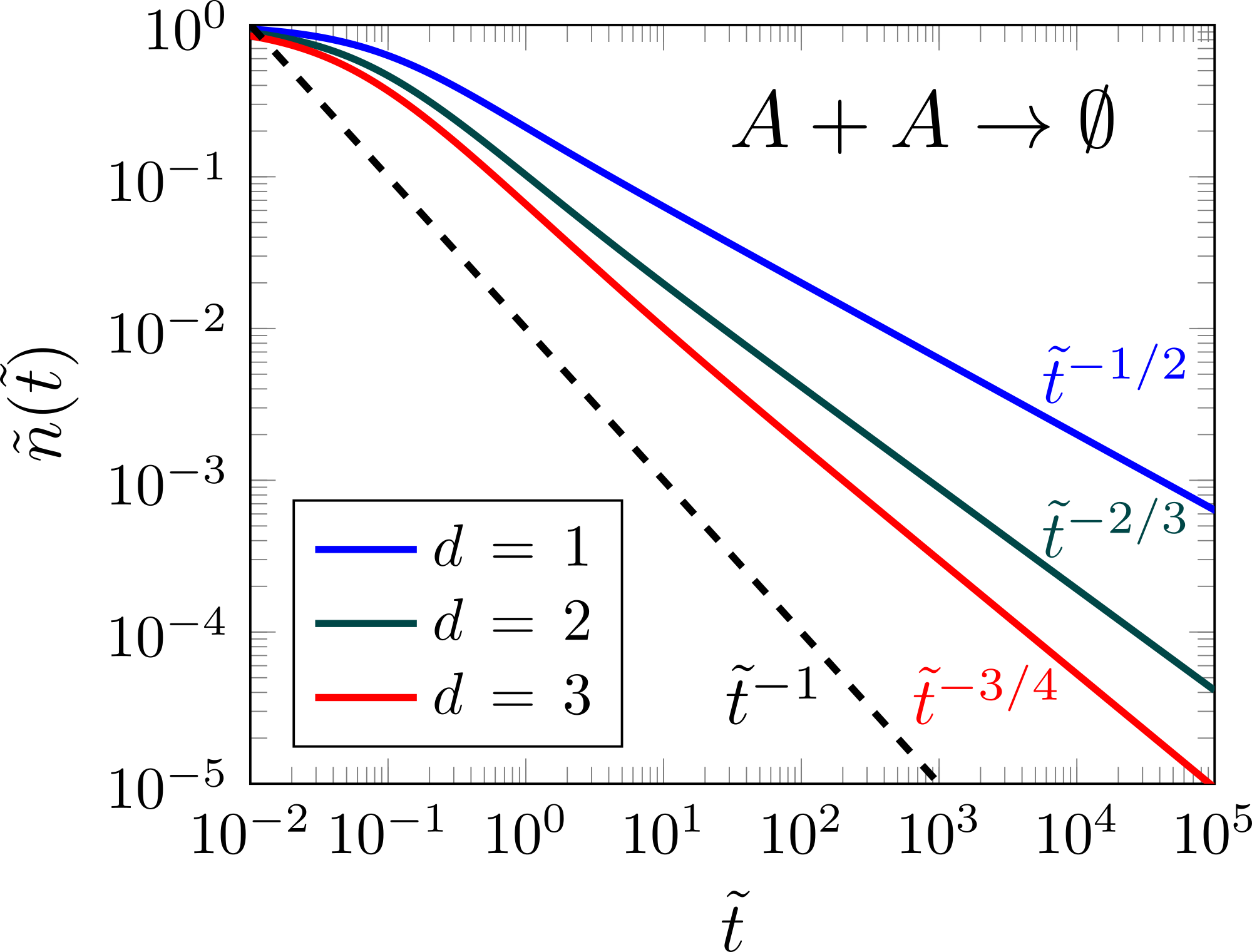
- 即使在$d>1$维中,粒子密度仍以偏离平均场预测的指数发生代数衰减,表明存在非平凡的量子修正。
- 时间依赖的广义吉布斯系综(TGGE)在空间-时间梯度的主导阶下,自然地从Keldysh图解中涌现,为TGGE的使用提供了场论依据。
- 通过大尺度场论,精确计算出衰减指数,展现出与微观细节无关的普适性行为。
- 在受限系统(双阱到单阱淬火)中,由于增强的混合效应,衰减指数被加速趋近于平均场值。
- 在去禁闭情形(阱势释放)中,幂律衰减被更慢的、非代数的衰减所取代,且有效指数随时间减小。
- 对于有限的阱势释放参数$\Omega$,观察到一个中间幂律区域,其最大有效指数$\xi_M$随$\Omega$增大而缩小并提前出现。
更好的研究,从现在开始
从阅读论文到最终审阅,大幅缩短您的研究时间。
无需绑定信用卡
本解读由 AI 生成,并经人工编辑审核。