
[论文解读] Lens Stochastic Diffraction: A Signature of Compact Structures in Gravitational-Wave Data
本文提出了透镜随机衍射(LSD),一种由致密透镜引起的引力波数据中新型随机信号,其源自微弱、多重成像的引力波信号。通过相干叠加来自泊松分布的致密天体的微弱、时延信号,LSD使探测质量更大的暗物质晕和超大质量黑洞的灵敏度提升一个数量级,尤其适用于质量超过 ~10³M☉ 的天体。
Every signal propagating through the universe is diffracted by the gravitational fields of intervening objects, aka gravitational lenses. Diffraction is most efficient when caused by compact lenses, which invariably produce additional images of a source. The signals associated with additional images are generically faint, but their collective effect may be detectable with coherent sources, such as gravitational waves (GWs), where both amplitude and phase are measured. Here, I describe lens stochastic diffraction (LSD): Poisson-distributed fluctuations after GW events caused by compact lenses. The amplitude and temporal distribution of these signals encode crucial information about the mass and abundance of compact lenses. Through the collective stochastic signal, LSD offers an order-of-magnitude improvement over single lens analysis for objects with mass $\gtrsim 10^3 M_\odot$. This gain can improve limits on compact dark-matter halos and allows next-generation instruments to detect supermassive black holes, given the abundance inferred from quasar luminosity studies.
研究动机与目标
- 识别由致密透镜引起的微弱、多重成像引力波所产生的集体随机信号。
- 在单透镜事件分析之外,提升对大质量致密暗物质结构的探测灵敏度。
- 使下一代引力波探测器能够利用类星体光度函数的丰度约束,探测超大质量黑洞。
- 开发一种相干的、类似背景的信号分析方法,充分利用引力波数据中的振幅和相位信息。
- 量化LSD的信噪比与时间分布,针对真实的透镜群体进行分析
提出的方法
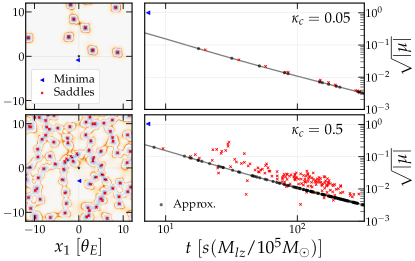
- 使用标准透镜放大率公式建模点状致密透镜的引力波信号,其中通量缩放为 |μ₋| ≈ yₗ⁻⁴,振幅调制为 √|μ₋| ≈ yₗ⁻²。
- 假设透镜投影到单一透镜平面上,且服从泊松分布,平均数量为 N_c(<yₗ) = κ_c yₗ²,其中 κ_c 为致密物体面密度引起的汇聚度。
- 推导出二次像的时间随机分布为时间延迟的泊松过程,时间延迟在大分离时满足 Δt ∝ yₗ⁻²。
- 通过在所有透镜像上相干积分,计算集体LSD信号的信噪比(SNR),假设引力波探测器具有相位相干性。
- 使用由宇宙学参数和致密物体分数 f_c 相对于暗物质密度 Ω_DM 推导出的平均汇聚度 κ̄_c(z_S)。
- 将LSD框架应用于估计下一代引力波天文台中致密暗物质晕和超大质量黑洞的可探测性极限
实验结果
研究问题
- RQ1由致密透镜引起的微弱、多重成像引力波信号是否能产生可探测的集体随机背景?
- RQ2与单透镜探测相比,LSD信号的信噪比如何随透镜质量和丰度变化?
- RQ3LSD在多大程度上能改善对质量 > 10³M☉ 的致密暗物质晕的约束?
- RQ4若基于类星体光度的丰度估计成立,LSD是否能实现通过透镜特征探测超大质量黑洞?
- RQ5LSD信号在多个探测器上的时间分布与相干结构如何?
主要发现
- 透镜随机衍射(LSD)在时间上产生泊松分布的随机信号,其特征时间延迟分布与 yₗ⁻² 成正比,适用于大透镜-源分离的情况。
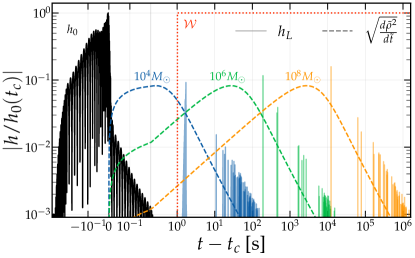
- 对于质量 > 10³M☉ 的致密天体,集体LSD信号相比单透镜分析,信噪比提升一个数量级。
- 对于质量 > 10³M☉ 的致密暗物质晕,LSD能提供比单透镜探测更紧的约束,尤其在低质量区域表现更优。
- 若超大质量黑洞的丰度与类星体光度函数推导出的结果一致,LSD框架可使下一代引力波探测器实现对超大质量黑洞的探测。
- 信号振幅受 √|μ₋| ≈ yₗ⁻² 调制,使致密透镜产生的微弱图像比电磁观测中更易探测。
- LSD的随机特性使其可通过互相关或背景推断技术检测,即使单个图像无法分辨亦可实现
更好的研究,从现在开始
从阅读论文到最终审阅,大幅缩短您的研究时间。
无需绑定信用卡
本解读由 AI 生成,并经人工编辑审核。