
[论文解读] Local minima in quantum systems
本文证明,经典计算机在量子系统中寻找局部极小值是计算困难的,但量子计算机可通过热梯度下降算法高效求解。关键贡献在于证明:尽管局部极小值比基态更简单,但在BQP难的哈密顿量下,它们对经典计算仍属不可行,凸显了在模拟自然冷却过程中的量子优势。
Finding ground states of quantum many-body systems is known to be hard for both classical and quantum computers. As a result, when Nature cools a quantum system in a low-temperature thermal bath, the ground state cannot always be found efficiently. Instead, Nature finds a local minimum of the energy. In this work, we study the problem of finding local minima in quantum systems under thermal perturbations. While local minima are much easier to find than ground states, we show that finding a local minimum is computationally hard for classical computers, even when the task is to output a single-qubit observable at any local minimum. In contrast, we prove that a quantum computer can always find a local minimum efficiently using a thermal gradient descent algorithm that mimics the cooling process in Nature. To establish the classical hardness of finding local minima, we consider a family of two-dimensional Hamiltonians such that any problem solvable by polynomial-time quantum algorithms can be reduced to finding ground states of these Hamiltonians. We prove that for such Hamiltonians, all local minima are global minima. Therefore, assuming quantum computation is more powerful than classical computation, finding local minima is classically hard and quantumly easy.
研究动机与目标
- 研究在热扰动下,量子多体系统中寻找局部极小值的计算复杂度。
- 确定局部极小值虽比基态更简单,但是否仍对经典计算不可行。
- 通过构建多项式时间量子算法,确立求解局部极小值问题的量子优势。
- 证明对于一大类哈密顿量,所有局部极小值均为全局极小值,从而将问题与BQP难性联系起来。
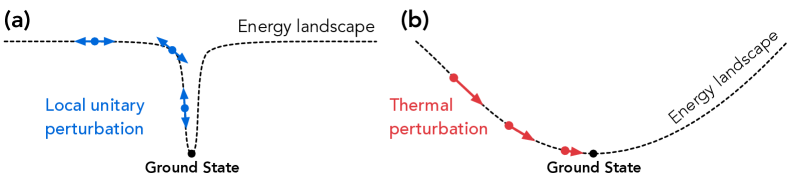
- 通过热扰动和局部幺正扰动,形式化定义量子系统中的局部极小值,提供物理上合理的定义。
提出的方法
- 通过小规模热扰动和局部幺正扰动下的能量期望值,定义量子系统中的局部极小值。
- 提出一种热梯度下降算法,模拟量子计算机上自然冷却过程。
- 使用热 Lindbladian 模型描述与低温热库耦合的开放量子系统。
- 证明在小扰动下,热扰动下的能量梯度具有单调性,确保收敛性。
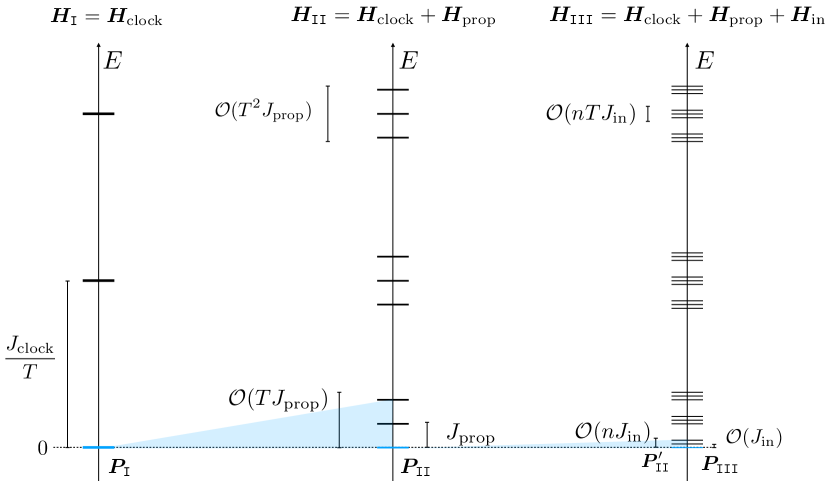
- 应用微扰理论分析本征值和本征子空间的变化,尤其关注低能子空间。
- 将任意 BQP 问题约化为二维局部哈密顿量的基态问题,其中所有局部极小值均为全局极小值。
实验结果
研究问题
- RQ1在量子系统中寻找局部极小值对经典计算机是否计算困难?
- RQ2量子计算机能否通过物理上合理的算法高效找到局部极小值?
- RQ3是否存在所有局部极小值也都是全局极小值的哈密顿量?此类问题的复杂度如何?
- RQ4在热扰动下,能量梯度的行为如何?其在小哈密顿量变化下是否能保持不变?
- RQ5局部极小值的计算困难性与BQP中量子优势之间有何关系?
主要发现
- 寻找局部极小值对经典计算机是计算困难的:即使输出局部极小值处的单量子比特可观测量,也对经典计算机不可行。
- 存在一种基于热梯度下降的多项式时间量子算法,可高效找到局部极小值,从而证明了量子优势。
- 对于一类二维局部哈密顿量,所有局部极小值均为全局极小值,且基态问题为BQP完全。
- 在小扰动下,热扰动下的能量梯度可被保留,前提是扰动不过大(相对于能隙)。
- 在某些情况下,小扰动可完全破坏能量梯度,表明梯度保持并非自动成立。
- 量子算法的成功依赖于能级分裂下能量梯度的单调性,该性质通过微扰理论与久保近似得到证明。
更好的研究,从现在开始
从阅读论文到最终审阅,大幅缩短您的研究时间。
无需绑定信用卡
本解读由 AI 生成,并经人工编辑审核。