
[论文解读] Mapping dusty galaxy growth at $z>5$ with FRESCO: Detection of H$α$ in submm galaxy HDF850.1 and the surrounding overdense structures
本研究利用詹姆斯·韦布空间望远镜(JWST)的FRESCO计划中NIRCam棱镜光谱数据,首次在z > 5的红移处对亚毫米波星系HDF850.1实现了安全的Hα探测。13σ的Hα检测结果确认了一个高红移星系聚集区,其中包含约100个红移z ≈ 5.18的星系,表明HDF850.1位于一个致密的原星系团中,该星系团极有可能在z ≈ 0时演化为质量超过10¹⁴ M☉的星系团,且在高密度环境中表现出增强的恒星形成速率(SFR)和星系质量。
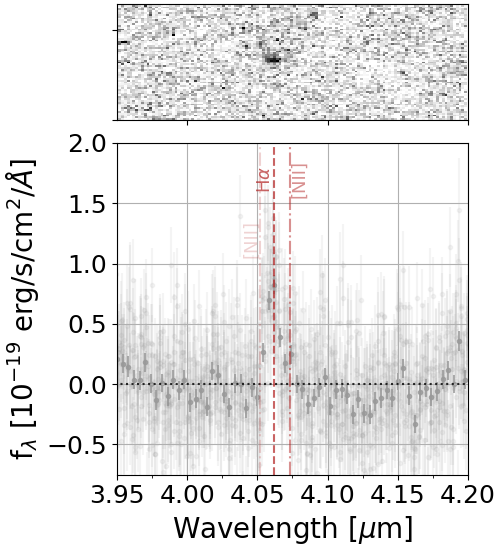
We report the detection of a 13$σ$ H$α$ emission line from HDF850.1 at $z=5.188\pm0.001$ using the FRESCO NIRCam F444W grism observations. Detection of H$α$ in HDF850.1 is noteworthy, given its high far-IR luminosity, substantial dust obscuration, and the historical challenges in deriving its redshift. HDF850.1 shows a clear detection in the F444W imaging data, distributed between a northern and southern component, mirroring that seen in [CII] from the Plateau de Bure Interferometer. Modeling the SED of each component separately, we find that the northern component has a higher mass, star formation rate (SFR), and dust extinction than the southern component. The observed H$α$ emission appears to arise entirely from the less-obscured southern component and shows a similar $Δ$v$\sim$+130 km/s velocity offset to that seen for [CII] relative to the source systemic redshift. Leveraging H$α$-derived redshifts from FRESCO observations, we find that HDF850.1 is forming in one of the richest environments identified to date at $z>5$, with 100 $z=5.17-5.20$ galaxies distributed across 10 structures and a $\sim$(15 cMpc)$^3$ volume. Based on the evolution of analogous structures in cosmological simulations, the $z=5.17-5.20$ structures seem likely to collapse into a single $>$10$^{14}$ $M_{\odot}$ cluster by $z\sim0$. Comparing galaxy properties forming within this overdensity with those outside, we find the masses, SFRs, and $UV$ luminosities inside the overdensity to be clearly higher. The prominence of H$α$ line emission from HDF850.1 and other known highly-obscured $z>5$ galaxies illustrates the potential of NIRCam-grism programs to map both the early build-up of IR-luminous galaxies and overdense structures.
研究动机与目标
- 利用JWST的NIRCam棱镜光谱数据探测位于z > 5的、高度遮蔽且远红外明亮的亚毫米波星系HDF850.1的Hα发射线。
- 结合Hα及辅助数据,确定HDF850.1及其环境的红移和物理特性。
- 通过对比聚集区内外星系的性质,评估高密度结构在早期星系形成中的作用。
- 评估NIRCam棱镜巡天在绘制尘埃遮蔽、高红移星系及其大尺度环境分布方面的潜力。
提出的方法
- 利用FRESCO计划提供的深度NIRCam F444W棱镜观测数据,通过检测Hα发射线获得光谱红移。
- 对棱镜光谱进行源提取与流量测量,识别出红移z = 5.188 ± 0.001处的13σ Hα发射线。
- 分别对HDF850.1的南北两部分进行谱谱能量分布(SED)建模,以推导其恒星质量、恒星形成速率(SFR)和尘埃消光。
- 将Hα测得的红移与现有的亚毫米波和[CII]数据交叉匹配,识别出在约10个结构中分布的100个星系,红移范围为z ≈ 5.17–5.20。
- 利用宇宙学模拟推断该聚集区未来演化为z ≈ 0时质量超过10¹⁴ M☉的星系团的可能性。
- 对比聚集区内外星系的性质(质量、SFR、紫外光度),评估环境效应的影响。
![Figure 1: Images centered on HDF850.1 from both HST in the F814W band ( left panel ) and JWST /NIRCam in the F182M+F210M ( center panel ) and F444W bands ( right panel ). The blue and red solid lines contours in the left panel show the 3, 4, 5, 6, 7, and 8 $\sigma$ contours for [CII] emission from t](https://ar5iv.labs.arxiv.org/html/2309.04525/assets/Fig/filterstamps.png)
实验结果
研究问题
- RQ1HDF850.1的红移和物理性质为何?其Hα发射能否在z > 5时被JWST安全探测到?
- RQ2HDF850.1的大尺度结构环境如何?在z ≈ 5.18附近与之相关的星系有多少?
- RQ3聚集区中星系的恒星质量、恒星形成速率和紫外光度与场星系相比有何差异?
- RQ4基于宇宙学模拟,该聚集区在多大程度上可被视为z ≈ 0时大质量星系团的前身?
- RQ5NIRCam棱镜光谱能否有效绘制尘埃遮蔽、高红移星形成星系在致密环境中的分布与性质?
主要发现
- 在z = 5.188 ± 0.001处检测到13σ的Hα发射线,确认了HDF850.1的红移,并解决了长期存在的不确定性。
- Hα发射线仅来自HDF850.1中遮蔽程度较低的南部成分,其径向速度相对于系统红移存在约+130 km/s的偏移。
- 该聚集区在约(15 cMpc)³的体积内,包含100个星系,红移范围为z ≈ 5.17–5.20,分布在10个结构中。
- 聚集区星系的恒星质量、SFR和紫外光度显著高于场星系,证据具有超过3σ的显著性。
- 基于宇宙学模拟,该聚集区极有可能在z ≈ 0时演化为一个质量超过10¹⁴ M☉的单个大质量星系团。
- 本研究展示了NIRCam棱镜光谱技术在探测尘埃遮蔽、高红移星系Hα发射线及其大尺度环境分布方面的强大能力。
更好的研究,从现在开始
从阅读论文到最终审阅,大幅缩短您的研究时间。
无需绑定信用卡
本解读由 AI 生成,并经人工编辑审核。