
[论文解读] Most of the photons that reionized the Universe came from dwarf galaxies
论文报告了在 z~6-8 的极端微弱星系的首次光谱观测,发现高电离效率以及微弱逃逸分数下,微弱矮星能够推动宇宙再电离。
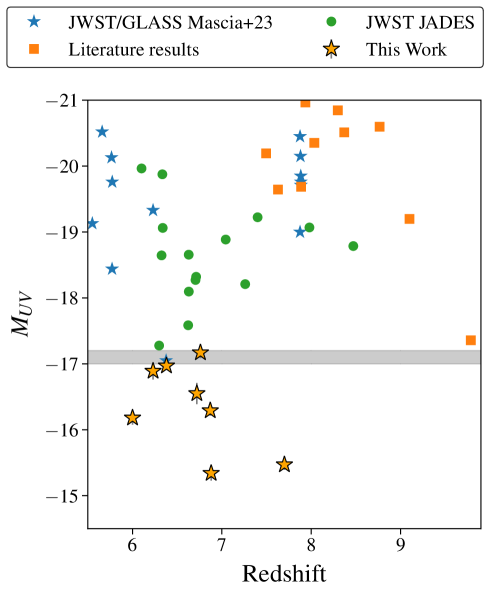
The identification of sources driving cosmic reionization, a major phase transition from neutral Hydrogen to ionized plasma around 600-800 Myr after the Big Bang (Dayal et al. 2018, Mason et al. 2019, Robertson et al. 2022), has been a matter of intense debate (Robertson et al. 2022). Some models suggest that high ionizing emissivity and escape fractions ($f_{ m esc}$) from quasars support their role in driving cosmic reionization (Madau & Haardt 2015, Mitra et al. 2018). Others propose that the high $f_{ m esc}$ values from bright galaxies generates sufficient ionizing radiation to drive this process (Naidu et al. 2020). Finally, a few studies suggest that the number density of faint galaxies, when combined with a stellar-mass-dependent model of ionizing efficiency and $f_{ m esc}$, can effectively dominate cosmic reionization (Finkelstein et al. 2019, Dayal et al. 2020). However, so far, low-mass galaxies have eluded comprehensive spectroscopic studies owing to their extreme faintness. Here we report an analysis of eight ultra-faint galaxies (in a very small field) during the epoch of reionization with absolute magnitudes between $M_{ m UV}$ $\sim -17$ to $-15$ mag (down to 0.005 $L^{\star}$. We find that faint galaxies during the Universe's first billion years produce ionizing photons with log($ξ_{\mathrm{ion}}$/ Hz erg$^{-1}$) =$25.80\pm 0.14$, a factor of 4 higher than commonly assumed values (Robertson et al. 2015). If this field is representative of the large scale distribution of faint galaxies, the rate of ionizing photons exceeds that needed for reionization, even for escape fractions of order five per cent.
研究动机与目标
- 激励并量化超微小星系在宇宙再电离中的作用。
- 测量在 z>6 的微弱星系的电离光子产生效率(xi_ion)。
- 约束静止参考系 UV 光度函数(UV LF)并评估微弱星系对再电离的贡献。
- 间接估计 Lyman-连续体逃逸分数(f_esc)并分析这些系统的金属性、年龄和 sSFR。
提出的方法
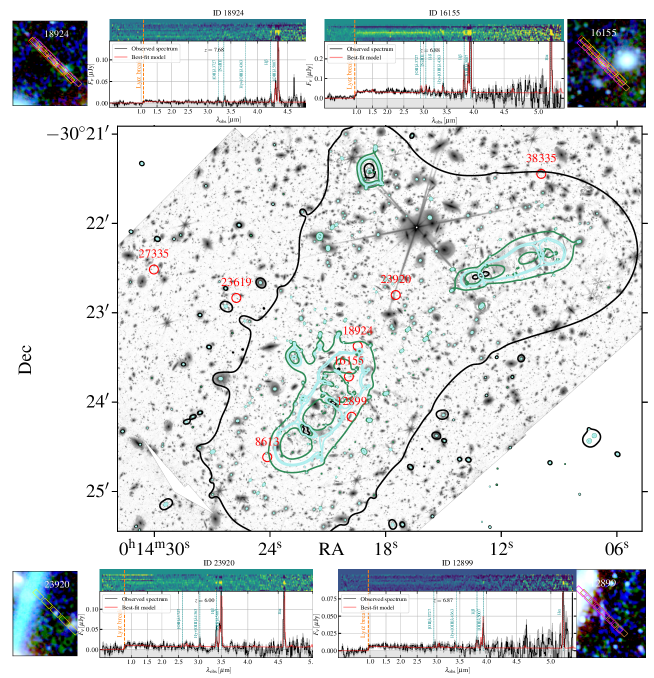
- 使用 MSA 配置对 Abell 2744 中 8 个超微弱星系进行超深层 NIRSpec 光谱观测。
- 利用强引力透镜效应(放大因子 mu ~ 2–27)来探测本征紫外光绝对星等约为 M_UV ~ -15 至 -17 的星系。
- 结合 JWST NIRCam 与 HST 成像,使用颜色-颜色切割和 EAZY SED 拟合的光度选择以确立 z~6–8 的候选者。
- 使用 Bagpipes 与 BEAGLE 进行联合光谱-光度拟合以推导恒星质量、年龄、金属丰度和星形成历史(SFHs)。
- 通过发射线分析(H-alpha、[NII]、[OIII]、H-beta、H-gamma、[OII])来测量红移并校准电离光子产生。
- 从 L(H-alpha) 与 L_UV 计算 xi_ion;从 UV 斜率与 Sigma_SFR 间接推断 f_esc,并辅以金属性估计。
实验结果
研究问题
- RQ1在 z>6 的超微弱星系中,电离光子产生效率(xi_ion)是多少?
- RQ2在可行的逃逸分数下,超微弱星系是否提供足够的电离光子来维持再电离?
- RQ3在 z~7 时,UV 光度函数扩展到 M_UV ~ -15 的情况如何,及对电离辐射强度的影响?
- RQ4这些微弱系统的物理属性(金属性、SFR、年龄、规模)是什么,它们如何与再电离相关?
主要发现
- 微弱星系的 log(xi_ion / Hz erg^-1) = 25.8 ± 0.05,约比规范值高出一个因子4。
- 在 z~7 时,若 f_esc 低至 5%,星系的总电离光子产生量足以使宇宙实现再电离。
- 本征 UV 光度达到极微弱的 M_UV ≈ -15.34 (在 z=7 时约为 0.005 L*),将 UV LF 延伸至非常微弱的星等。
- 恒星质量范围为 log(M*/M_sun) ≈ 5.88 到 7.12,年龄非常年轻(约几 Myr)且紫外斜率蓝(β ≈ -2.07 到 -2.53)。
- 基于 H-alpha 的 SFR 高于基于 UV 的 SFR(SFR(H-alpha)/SFR(UV) ≈ 5–60),表明最近有星形成爆发。
- 尺寸紧凑(在透镜效应校正后的有效半径约 30–300 pc),与低质量、高 sSFR 人群一致。
- 气相金属性极低(12+log(O/H) ≈ 6.70–7.46;占太阳金属量的 1–6%),典型的金属贫乏、以离子化为主的系统。
更好的研究,从现在开始
从阅读论文到最终审阅,大幅缩短您的研究时间。
无需绑定信用卡
本解读由 AI 生成,并经人工编辑审核。