
[论文解读] Multipartite entanglement in two-dimensional chiral topological liquids
本文利用共形场论和体-边界对应关系,为二维手性拓扑液体中的多体纠缠提供了一个分析框架。它推导出在有理共形场论中 $ p $-顶点态的通用马尔可夫间隙 $ h = \frac{c}{3}\ln 2 $,解释了超越双体测量的拓扑纠缠结构,并通过数值证据加以确认。
The multipartite entanglement structure for the ground states of two dimensional topological phases is an interesting albeit not well understood question. Utilizing the bulk-boundary correspondence, the calculation of tripartite entanglement in 2d topological phases can be reduced to that of the vertex state, defined by the boundary conditions at the interfaces between spatial regions. In this paper, we use the conformal interface technique to calculate entanglement measures in the vertex state, which include area law terms, corner contributions, and topological pieces, and a possible additional order one contribution. This explains our previous observation of the Markov gap $h = \frac{c}{3} \ln 2$ in the 3-vertex state, and generalizes this result to the $p$-vertex state, general rational conformal field theories, and more choices of subsystems. Finally, we support our prediction by numerical evidence, finding precise agreement.
研究动机与目标
- 为了发展对二维手性拓扑相中多体纠缠的解析理解,尽管双体纠缠已有进展,但该问题仍理解不足。
- 将此前在自由费米子模型中观察到的通用马尔可夫间隙 $ h = \frac{c}{3}\ln 2 $ 推广至一般有理共形场论和 $ p $-顶点态。
- 建立一种系统化方法,利用缺陷共形场论和共形界面技术计算三体及更高体纠缠度量(如反射熵和纠缠负性)。
- 为晶格模型中马尔可夫间隙作为楚留珊绝缘体中下界这一数值观测结果提供解析依据,其中 $ h \geq \frac{c}{3}\ln 2 $。
- 证明马尔可夫间隙是拓扑液体中稳定、不可关闭边缘模式的普遍特征,与手性中心势 $ c $ 相关联。
提出的方法
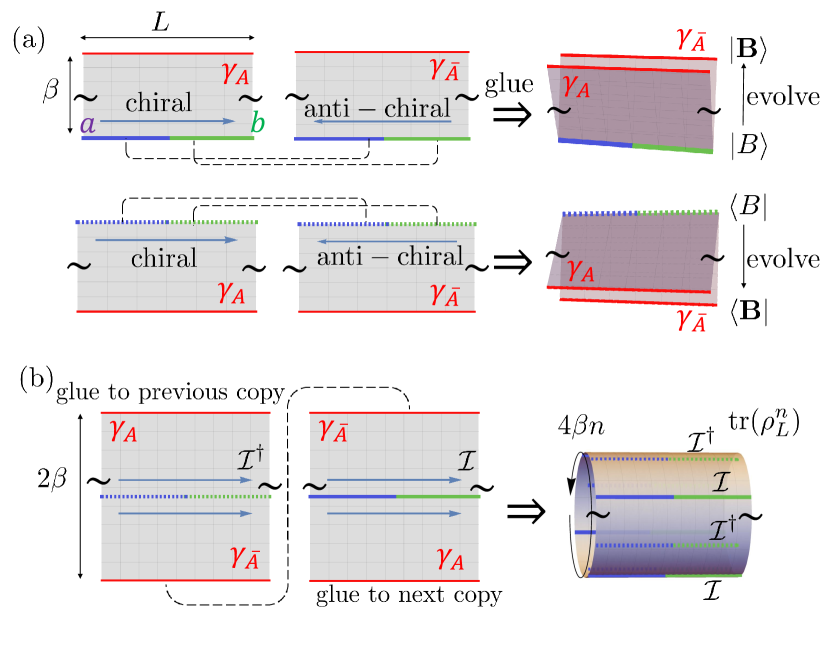
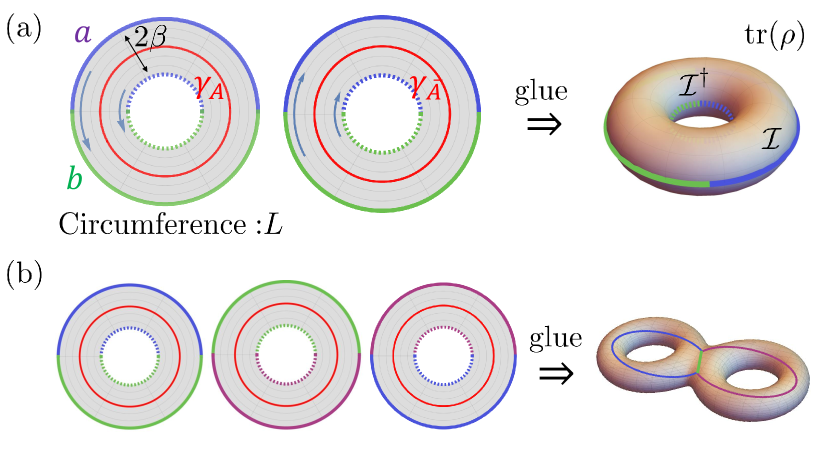
- 利用体-边界对应关系,将二维拓扑基态的纠缠结构映射到具有缺陷的黎曼曲面上的边界共形场论(CFT)。
- 应用共形界面技术计算顶点态中的纠缠度量,该顶点态编码了空间节点处的边界条件。
- 在 1+1D 共形场论中使用扭算符形式化方法,计算约化密度矩阵的矩,以提取纠缠熵、互信息、反射熵和负性。
- 通过黎曼-许瓦兹公式推导复制流形的亏格,以确定相关函数中 OPE 系数的拓扑依赖性。
- 将反射熵的 OPE 系数视为普遍量,并将其解析计算为 $ C_{n,m} = (2m)^{-4h_n} $,从而导出通用的 $ \frac{c}{3}\ln 2 $ 马尔可夫间隙。
- 通过晶格模型的数值模拟验证解析结果,显示与预测的普遍行为精确一致。
实验结果
研究问题
- RQ1能否在一般手性拓扑液体中,对自由费米子拓扑相中观察到的通用马尔可夫间隙 $ h = \frac{c}{3}\ln 2 $ 进行解析推导?
- RQ2多体纠缠结构(特别是反射熵和纠缠负性)如何依赖于空间划分的拓扑结构和底层共形场论?
- RQ3缺陷和界面共形场论技术在计算二维拓扑相顶点态中纠缠度量时起到何种作用?
- RQ4马尔可夫间隙是否是手性中心势 $ c $ 的稳健指标,即使在自由费米子模型之外,也适用于相互作用的有理共形场论?
- RQ5在复制技巧中,反射熵和负性的 OPE 系数能否以一种揭示普遍拓扑贡献的方式进行解析计算?
主要发现
- 在有理共形场论中,$ p $-顶点态的马尔可夫间隙被解析推导为 $ h = \frac{c}{3}\ln 2 $,确认了该拓扑纠缠特征的普遍性。
- 通过扭算符的三线性函数计算反射熵和互信息,OPE 系数贡献了马尔可夫间隙的通用 $ \frac{c}{3}\ln 2 $ 项。
- 由于在高亏格黎曼曲面上 OPE 系数不具普遍性,纠缠负性未产生通用对数项,这使其与反射熵区分开来。
- 在晶格楚留珊绝缘体上的数值模拟证实了分析预测,显示马尔可夫间隙被 $ \frac{c}{3}\ln 2 $ 下界限制,在理想 CFT 极限下取等。
- 源自体-边界对应的顶点态形式化方法,可通过共形场论技术精确计算拓扑相中的多体纠缠。
- 该结果确立了马尔可夫间隙作为手性中心势 $ c $ 的普遍探测器,表明二维拓扑液体中存在稳定、不可关闭的边缘模式。
更好的研究,从现在开始
从阅读论文到最终审阅,大幅缩短您的研究时间。
无需绑定信用卡
本解读由 AI 生成,并经人工编辑审核。