
[论文解读] Non-Coplanar Magnetic Orders in Classical Square-Kagome Antiferromagnets
本文研究了正方形-尖晶石晶格上经典海森堡模型中的非共面磁序,揭示了广泛的简并性、按序由序效应以及包含非共面自旋螺旋和手性态的丰富相图。通过广泛数值模拟,识别出诸如多步比热异常等关键热力学特征,并基于对称性对非共面序进行了分类,为S=1/2体系中手性自旋液体和自旋向列态等量子对应物奠定了基础。
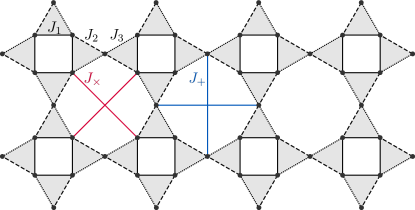
Motivated by the recent synthesis of a number of Mott insulating square-kagome materials, we explore the rich phenomenology of frustrated magnetism induced by this lattice geometry, also referred to as the squagome or shuriken lattice. On the classical level, square-kagome antiferromagnets are found to exhibit extensive degeneracies, order-by-disorder, and non-coplanar ordering tendencies, which we discuss for an elementary, classical Heisenberg model with nearest-neighbor and cross-plaquette interactions. Having in mind that upon introducing quantum fluctuations non-coplanar order can melt into chiral quantum spin liquids, we provide detailed information on the multitude of non-coplanar orders, including some which break rotational symmetry (possibly leading to nematic quantum orders), as well as a number of (incommensurate) spin spiral phases. Using extensive numerical simulations, we also discuss the thermodynamic signatures of these phases, which often show multi-step thermal ordering. Our comprehensive discussion of the classical square-kagome Heisenberg model, often drawing comparisons to the conventional kagome antiferromagnet, sets the stage for future explorations of quantum analogs of the various phases, either conceptually such as in quantum spin-1/2 generalizations of our model or experimentally such as in the Cu-based candidate materials.
研究动机与目标
- 系统研究具有近邻相互作用和跨元胞相互作用的正方形-尖晶石海森堡反铁磁体的经典磁相图。
- 利用对称性分析,识别并分类非共面磁序,包括手性和向列态。
- 表征诸如多步比热转变和熵平台等热力学特征。
- 为理解低自旋体系中手性自旋液体和自旋向列态等量子对应物奠定基础。
- 通过识别增强跨元胞耦合的化学路径(例如通过阳离子或阴离子取代),指导材料合成。
提出的方法
- 在具有周期性边界条件的有限尺寸正方形-尖晶石晶格上,使用蒙特卡洛和热浴算法进行数值模拟。
- 实现具有近邻J+和对角跨元胞J×相互作用的经典海森堡哈密顿量。
- 计算热力学可观测量:比热、自旋手性标量和结构因子,以检测非共面序。
- 通过自旋构型的对称性分析对非共面态进行分类,包括时间反演破缺和向列序参数。
- 利用序参量分析和有限尺寸标度法识别相变和交叉行为。
- 与传统尖晶石晶格进行对比,突出正方形-尖晶石几何结构的独特特性。
实验结果
研究问题
- RQ1在具有跨元胞相互作用的经典正方形-尖晶石海森堡模型中,会涌现出哪些类型的非共面磁序?
- RQ2诸如比热异常等热力学特征如何区分不同的磁相?
- RQ3哪些非共面态会破坏旋转对称性,并可能在量子化后导致向列量子序?
- RQ4在简并性和按序由序效应方面,正方形-尖晶石与传统尖晶石晶格的相图有何不同?
- RQ5哪些化学改性可增强跨元胞耦合,以在真实材料中稳定手性自旋液体相?
主要发现
- 该模型表现出广泛的经典简并性和按序由序效应,即使在经典极限下无长程序,仍能稳定非共面自旋构型。
- 识别出多种非共面态,包括在铁磁序与八边形序之间插值的雨伞状双锥态,具有有限的自旋手性标量。
- 发现非共面自旋螺旋相,其特征为调制的结构因子和独特的比热异常。
- 热力学特征包括多步比热峰,表明存在顺序的有序转变,以及暗示合作顺磁相的熵平台。
- 对称性分析表明,某些非共面态破坏时间反演和旋转对称性,可能在S=1/2体系中导致手性和向列量子自旋液体。
- 预测通过用Cs取代Na或用SeO₄²⁻取代SO₄²⁻等化学路径可增强J×耦合,促进候选材料中的手性序。
![Figure 2: The nearest-neighbor model. (a) Zero-temperature phase diagram as a function of nearest-neighbor couplings $J_{2}$ and $J_{3}$ , reproduced from Ref. [ 26 ] . (b) Specific heat traces for three representative points along the $J_{2}=J_{3}$ diagonal in the phase diagram of panel (a). The on](https://ar5iv.labs.arxiv.org/html/2302.04171/assets/x2.png)
更好的研究,从现在开始
从阅读论文到最终审阅,大幅缩短您的研究时间。
无需绑定信用卡
本解读由 AI 生成,并经人工编辑审核。