
[论文解读] On the Radio Stripe Deployment for Indoor RF Wireless Power Transfer
本文提出了一种用于室内射频无线能量传输系统中无线电条网络的最优部署策略,旨在最大化能量采集热点处的最小接收功率。通过几何规划方法,设计了直线形和多边形形无线电条,其性能优于集中式全数字阵列,能有效降低路径损耗并实现更优的近场波束成形,尤其在长条长度和低频条件下优势显著。
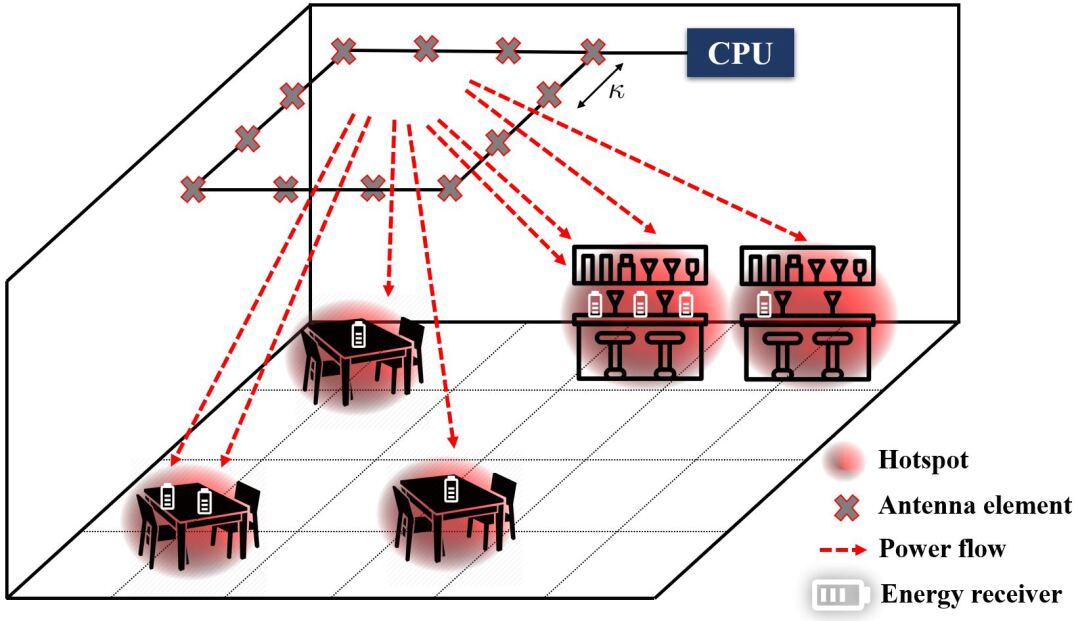
One of the primary goals of future wireless systems is to foster sustainability, for which, radio frequency (RF) wireless power transfer (WPT) is considered a key technology enabler. The key challenge of RF-WPT systems is the extremely low end-to-end efficiency, mainly due to the losses introduced by the wireless channel. Distributed antenna systems are undoubtedly appealing as they can significantly shorten the charging distances, thus, reducing channel losses. Interestingly, radio stripe systems provide a cost-efficient and scalable way to deploy a distributed multi-antenna system, and thus have received a lot of attention recently. Herein, we consider an RF-WPT system with a transmit radio stripe network to charge multiple indoor energy hotspots, i.e., spatial regions where the energy harvesting devices are expected to be located, including near-field locations. We formulate the optimal radio stripe deployment problem aimed to maximize the minimum power received by the users and explore two specific predefined shapes, namely the straight line and polygon-shaped configurations. Then, we provide efficient solutions relying on geometric programming to optimize the location of the radio stripe elements. The results demonstrate that the proposed radio stripe deployments outperform a central fully-digital square array with the same number of elements and utilizing larger radio stripe lengths can enhance the performance, while increasing the system frequency may degrade it.
研究动机与目标
- 为解决室内环境中射频无线能量传输(WPT)端到端效率低下的问题,主要归因于高路径损耗。
- 探索通过无线电条实现分布式天线部署,作为共址阵列的低成本替代方案,以缩短充电距离并提升能量传输效率。
- 建立并求解一个优化问题,以最大化预设室内能量热点处的最小接收功率。
- 在相同硬件约束条件下,与集中式全数字方形阵列基准进行性能对比。
- 评估无线电条形状(直线形与多边形形)、长度及工作频率对系统性能的影响。
提出的方法
- 将无线电条部署问题建模为几何规划(GP)优化问题,以最大化用户位置处的最小接收功率。
- 将发射端建模为沿电缆(无线电条)分布的天线单元阵列,采用均匀间距与相位控制。
- 考虑两种预设形状:直线形与多边形形配置,优化天线单元位置以实现波束成形增益。
- 采用最大比率传输(MRT)与基于半定规划(SDP)的预编码方法计算波束成形权重。
- 采用近场信道模型以考虑球面波前,实现超越远场波束成形的空间功率聚焦。
- 设定系统参数,包括频率、总功率、天线单元数量及热点位置,以评估不同配置下的性能表现。
实验结果
研究问题
- RQ1在室内射频-WPT中,无线电条部署在最小接收功率方面的性能与集中式全数字阵列相比如何?
- RQ2如何最优布置无线电条天线单元(直线形或多边形形)以最大化室内热点处的最小能量采集?
- RQ3增加无线电条长度如何影响系统性能?其是否始终能提升能量传输效果?
- RQ4在高频工作条件下,系统效率如何变化?尽管单位长度内天线数量更多,但路径损耗也随之增加。
- RQ5不同形状(直线形与多边形形)如何影响波束成形的指向性与近场聚焦能力?
主要发现
- 所提出的无线电条部署方案在最小接收功率方面优于集中式全数字方形阵列,尤其在近场条件下表现更优。
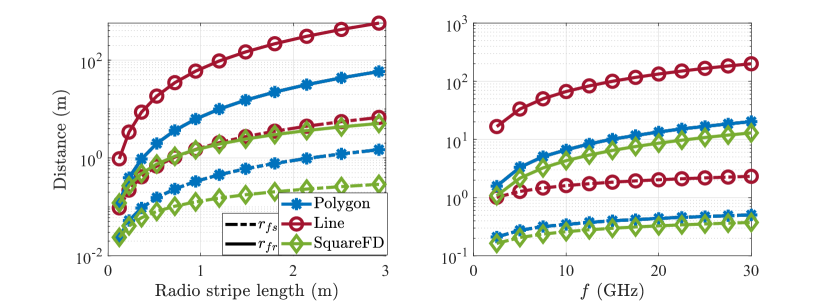
- 增加无线电条长度可通过在更大区域分布更多天线单元,提升波束成形自由度并缩短平均用户距离,从而改善系统性能。
- 较高工作频率会因路径损耗增加而降低系统性能,尽管单位长度内天线数量更多。
- 多边形形无线电条在MRT预编码下性能优于直线形配置,主要因其对热点的接近程度更均匀。
- 在更大区域中,无线电条与集中式阵列之间的性能差距进一步扩大,后者因天线单元共址导致路径损耗更高。
- 采用SDP预编码时,多边形形部署性能最佳,而直线形部署性能显著下降,趋近于中心全数字基准的性能水平。
更好的研究,从现在开始
从阅读论文到最终审阅,大幅缩短您的研究时间。
无需绑定信用卡
本解读由 AI 生成,并经人工编辑审核。