
[论文解读] Palatini $f(R)$ gravity tests in the weak field limit: Solar System, seismology and galaxies
本文利用SPARC数据集和一种新型归一化附加速度(NAV)方法,测试了Palatini $f(R)$引力作为星系中暗物质的替代方案。研究发现,Palatini $f(R)$引力与Eddington-inspired Born-Infeld引力均无法拟合旋转速度曲线数据,模型效率 $E_{\text{M}} < -2.0$,表明在所有测试的自由参数 $\alpha$ 值下均与观测结果存在强烈不兼容。无论 $\alpha$ 为常数还是按星系变化,该结果均成立。
Palatini $f(R)$ gravity is probably the simplest extension of general relativity (GR) and the simplest realization of a metric-affine theory. It has the same number of degrees of freedom as GR and, in vacuum, it is straightforwardly mapped into GR with a cosmological constant. The mapping between GR and Palatini $f(R)$ inside matter is possible but at the expense of reinterpreting the meaning of the matter fields. The physical meaning and consequences of such mapping will depend on the physical context. Here we consider three such cases within the weak field limit: Solar System dynamics, planetary internal dynamics (seismology), and galaxies. After revising our previous results on the Solar System and Earth's seismology, we consider here the possibility of $f(R)$ Palatini as a dark matter candidate. For any $f(R)$ that admits a polynomial approximation in the weak field limit, we show here, using SPARC data and a recent method that we proposed, that the theory cannot be used to replace dark matter in galaxies. We also show that the same result applies to the Eddington-inspired Born-Infeld gravity. Differently from the metric $f(R)$ case, the rotation curve data are sufficient for this conclusion. This result does not exclude a combination of modified gravity and dark matter.
研究动机与目标
- 测试Palatini $f(R)$引力是否能在不引入额外物质场的情况下替代星系中的暗物质。
- 利用太阳系、地震学和星系旋转曲线数据,评估Palatini $f(R)$引力在弱场区域的可行性。
- 评估该理论是否能通过最近提出的归一化附加速度(NAV)方法,在122个SPARC星系中重现观测到的旋转速度曲线。
- 鉴于Eddington-inspired Born-Infeld(EiBI)引力具有相似的弱场行为,将分析扩展至该理论。
- 确定该理论在包括行星内部和星系动力学在内的不同物理情境下是否保持一致。
提出的方法
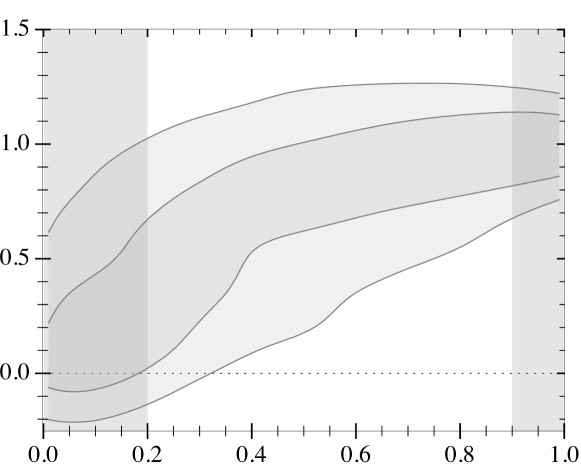
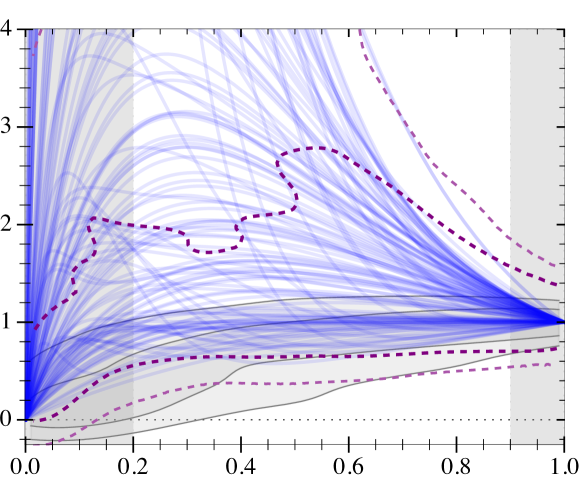
- 本研究采用归一化附加速度(NAV)方法,量化122个SPARC星系中预测与观测旋转速度曲线之间的差异。
- 使用Palatini $f(R)$引力的弱场近似,导出修正的泊松方程:$\nabla^2\phi = \frac{\kappa}{2}(\rho + \alpha \nabla^2\rho)$,其中 $\alpha$ 为自由参数。
- 通过模型效率 $E_{\text{M}}$ 作为指标,评估预测速度分布与观测数据的匹配程度。
- 分析假设星系结构为薄盘近似,并对 $\alpha$ 为常数和按星系变化两种情况均进行应用。
- 将相同方法应用于具有相同弱场极限的Eddington-inspired Born-Infeld(EiBI)引力。
- 将模型预测与SPARC数据集中的观测数据进行比较,重点关注旋转曲线及其偏差。
实验结果
研究问题
- RQ1Palatini $f(R)$引力是否能仅通过SPARC数据集,在不引入暗物质的情况下重现观测到的星系旋转速度曲线?
- RQ2NAV方法对Palatini $f(R)$引力中自由参数 $\alpha$ 在星系间的约束如何?
- RQ3当该理论在地球地震学数据和太阳系动力学中进行检验时,其是否仍具可行性?
- RQ4Palatini $f(R)$引力无法拟合旋转速度曲线的原因是理论本身的结构缺陷,还是 $\alpha$ 的选择所致?
- RQ5鉴于Eddington-inspired Born-Infeld引力具有相似的弱场行为,该结论是否同样适用于该理论?
主要发现
- Palatini $f(R)$引力无法在星系中替代暗物质,因为模型效率 $E_{\text{M}}$ 小于 -2.0,表明与观测数据存在强烈不兼容。
- 该结果对自由参数 $\alpha$ 的任意取值均成立,无论 $\alpha$ 在星系间是否为常数,或是否按星系变化。
- NAV方法显示,大多数模型预测值远偏离观测数据区域,表明存在显著的系统性偏差。
- 该失败结果具有鲁棒性,不依赖于 $\alpha$ 的具体取值,表明其与星系旋转曲线存在根本性不兼容。
- 由于Eddington-inspired Born-Infeld引力具有相同的弱场极限,该结论同样适用于该理论,证实结果不仅限于Palatini $f(R)$引力。
- 本研究排除了Palatini $f(R)$引力作为旋转支持星系中暗物质可行替代方案的可能性,即使允许 $\alpha$ 变化亦如此。
更好的研究,从现在开始
从阅读论文到最终审阅,大幅缩短您的研究时间。
无需绑定信用卡
本解读由 AI 生成,并经人工编辑审核。