
[论文解读] Probing for chiral $Z^\prime$ gauge boson through scattering measurement experiments
本文研究了在 $U(1)_X$ 扩展的规范模型中手征 $Z^\prime$ 规范玻色子的性质,其中左手和右手费米子对 $Z^\prime$ 的耦合不同,导致独特的 $Z^\prime$ 交换散射过程。通过重新分析 FASER$\nu$(2)、SND@\text{LHC}、COHERENT、NA64、MUonE、BaBaR、LHCb、CMS 和 LEP 的数据,推导出对 $g_X$ 和 $M_{Z^\prime}$ 的严格约束,表明散射和束流打靶实验可探测 0.02 至 150 GeV 范围内的 $Z^\prime$ 质量。
Motivated by the observation of tiny neutrino mass can not be explained within the framework of Standard Model (SM), we consider extra gauge extended scenarios in which tiny neutrino masses are generated through seesaw mechanism. These scenarios are equipped with beyond the standard model (BSM) neutral gauge boson called $Z^\prime$ in the general $U(1)_X$ symmetry which is a linear combination of $U(1)_Y$ and $U(1)_{B-L}$. In this case, left and right handed fermions interact differently with the $Z^\prime$. The $Z^\prime$ gives rise to different processes involving neutrino-nucleon, neutrino-electron, electron-nucleus and electron-muon scattering processes. By comparing with proton, electron beam-dump experiments data, recast data from searches for the long-lived and dark photon at BaBaR, LHCb and CMS experiments, the electron and muon $g-2$ data, and the data of the dilepton and dijet searches at the LEP experiment, we derive bounds on the gauge coupling and the corresponding gauge boson mass for different $U(1)_X$ charges and evaluate the prospective limits from the future beam-dump scenarios at DUNE, FASER(2) and ILC. We conclude that large parameter regions could be probed by scattering, beam-dump and collider experiments in future.
研究动机与目标
- 探索在左手和右手费米子具有不同 $U(1)_X$ 电荷的 $U(1)_X$ 扩展标准模型中手征 $Z^\prime$ 规范玻色子的唯象学。
- 利用 $Z^\prime$ 交换的散射过程,推导 $U(1)_X$ 规范耦合常数 $g_X$ 和 $Z^\prime$ 质量 $M_{Z^\prime}$ 的约束。
- 比较散射、束流打靶和对撞机实验的现有与潜在实验约束,评估在 0.02–150 GeV 范围内对 $Z^\prime$ 的探测灵敏度。
- 评估不同实验(如 FASER$\nu$(2)、NA64、LHCb 和未来的 ILC-BD)在不同 $Z^\prime$ 质量区间的互补性。
- 评估 $g-2$ 测量在 $Z^\prime$ 探测中的作用,表明由于费米子耦合的普遍性,其灵敏度较低。
提出的方法
- 重新分析 FASER$\nu$(2)、SND@$\text{LHC}$、COHERENT、NA64、MUonE 等实验的现有数据,推导 $Z^\prime$ 交换的中微子-核子、电子-原子核和电子-μ子散射过程中对 $g_X$ 和 $M_{Z^\prime}$ 的限制。
- 利用 $U(1)_X$ 模型中具有手征耦合的 $Z^\prime$ 交换 $t$-通道过程,其中费米子在 $U(1)_X$ 下的电荷破缺了左右对称性。
- 应用异常消除条件以确保规范和混合规范-引力异常自由,要求存在三代右手中微子,且其 $U(1)_X$ 电荷非普遍。
- 重新分析 BaBaR、LHCb 和 CMS 的暗光子搜索数据,以约束 $g_X$ 和 $M_{Z^\prime}$,尤其在 1–150 GeV 范围内。
- 分析电子和μ子实验的 $g-2$ 数据,假设费米子世代间耦合普遍,以约束 $Z^\prime$ 的贡献。
- 将结果与 LEP 的二轻子和二胶子喷注搜索结果进行比较,评估在不同质量与耦合区域中约束的互补性与鲁棒性。
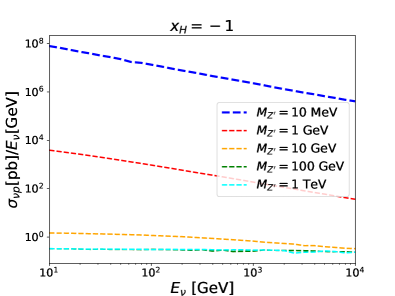
![Figure 1: Number of muon neutrino pass through the FASER $\nu$ (left panel) and SND@LHC (right panel) detectors. Thirty energy bins are defined uniformly on the logarithmic scale in [10, $10^{4}$ ] GeV.](https://ar5iv.labs.arxiv.org/html/2307.09737/assets/x1.png)
实验结果
研究问题
- RQ1在 $\mathcal{G}_{\rm SM} \otimes U(1)_X$ 模型中,手征 $U(1)_X$ 电荷如何影响 $Z^\prime$ 对左手和右手费米子的耦合?
- RQ2在 0.02–150 GeV 范围内,$Z^\prime$ 交换散射过程对 $g_X$ 和 $M_{Z^\prime}$ 的最强实验约束是什么?
- RQ3与 FASER$\nu$(2) 和 JSNS2 等散射实验相比,NA64、E141 和 DUNE 等束流打靶实验在探测 $Z^\prime$ 方面的灵敏度如何?
- RQ4当费米子耦合与世代无关时,$g-2$ 测量在约束 $Z^\prime$ 耦合方面起到什么作用?
- RQ5未来实验中,FASER$\nu$(2)、ILC-BD 或 DUNE 哪一个对轻 $Z^\prime$ 玻色子具有最有望的探测灵敏度?
主要发现
- 散射实验如 FASER$\nu$(2)、SND@$\text{LHC}$ 和 JSNS2 可探测 0.02–0.2 GeV 范围内的 $Z^\prime$ 质量,对 $M_{Z^\prime} \leq 0.04$ GeV 的情况,灵敏度可达 $g_X \sim 10^{-6}$。
- LHCb 的暗光子搜索对 $M_{Z^\prime} \geq 0.21$ GeV 提供严格限制,$M_{Z^\prime}$ 在 0.21–70 GeV 范围内 $g_X \in [3.5 \times 10^{-6}, 10^{-4}]$,在 $M_{Z^\prime} \approx 10$ GeV 附近边界更紧。
- BaBaR 和 CMS 的暗光子搜索在 $M_{Z^\prime} \approx 1$ GeV 和 $3$ GeV 附近提供最强限制,窄窗内 $g_X \lesssim 10^{-5}$。
- 由于模型中费米子耦合的普遍性,电子和μ子实验的 $g-2$ 数据对 $Z^\prime$ 的约束弱于散射和束流打靶实验。
- 未来束流打靶实验(如 FASER$\nu$(2)、ILC-BD 和 DUNE)预计可探测 $g_X \sim 10^{-6}$ 的 $M_{Z^\prime} \leq 0.04$ GeV,JSNS2 的限制将根据 $x_H$ 的不同而超越未来灵敏度。
- 现有束流打靶实验(如 $\nu$-cal、E137、NA64)已排除 $M_{Z^\prime} \leq 0.08$ GeV 范围内 $g_X \in [10^{-6}, 0.01]$ 的参数区,而 DUNE 在此质量区间提供较弱的约束。
更好的研究,从现在开始
从阅读论文到最终审阅,大幅缩短您的研究时间。
无需绑定信用卡
本解读由 AI 生成,并经人工编辑审核。