
[论文解读] Quantum quenches in driven-dissipative quadratic fermionic systems with parity-time symmetry
本文研究了具有宇称-时间(PT)对称性的驱动-耗散二次费米子系统中的量子淬火动力学,引入了PT对称广义吉布斯系综(PTGGE)作为稳态描述。研究展示了关联的光锥传播、子系统熵的线性增长与体积定律饱和,以及由非厄米拓扑支配的方向性泵浦相,揭示了通过PTGGE的软模在泵浦速率中出现的新类型动力学临界性。
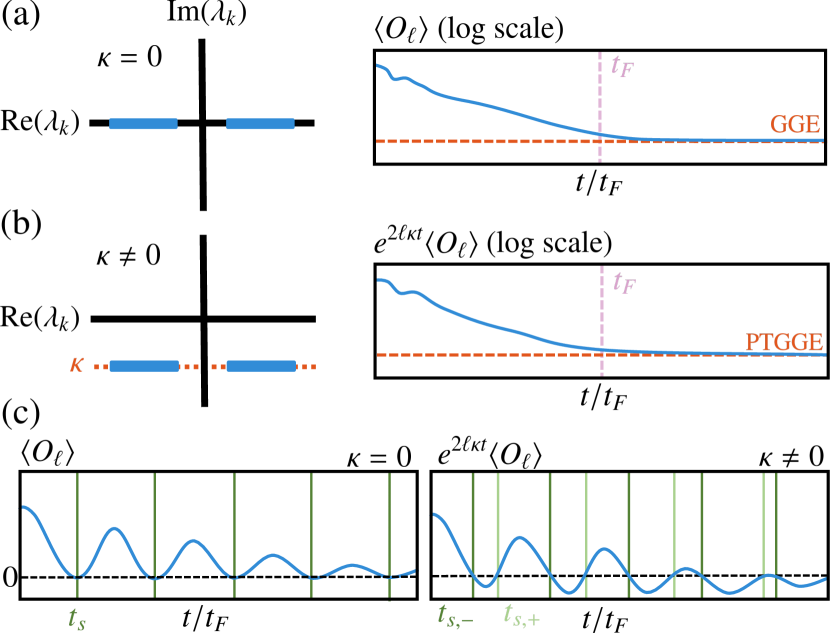
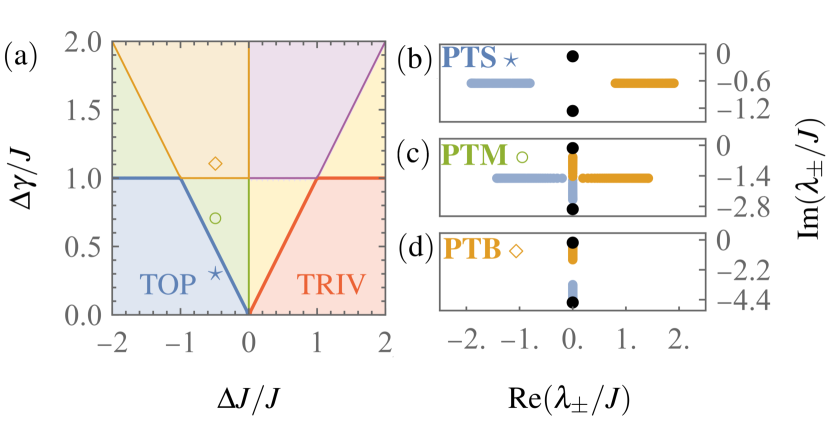
We study the quench dynamics of noninteracting fermionic quantum many-body systems that are subjected to Markovian drive and dissipation and are described by a quadratic Liouvillian which has parity-time (PT) symmetry. In recent work, we have shown that such systems relax locally to a maximum entropy ensemble that we have dubbed the PT-symmetric generalized Gibbs ensemble (PTGGE), in analogy to the generalized Gibbs ensemble that describes the steady state of isolated integrable quantum many-body systems after a quench. Here, using driven-dissipative versions of the Su-Schrieffer-Heeger (SSH) model and the Kitaev chain as paradigmatic model systems, we corroborate and substantially expand upon our previous results. In particular, we confirm the validity of a dissipative quasiparticle picture at finite dissipation by demonstrating light cone spreading of correlations and the linear growth and saturation to the PTGGE prediction of the quasiparticle-pair contribution to the subsystem entropy in the PT-symmetric phase. Further, we introduce the concept of directional pumping phases, which is related to the non-Hermitian topology of the Liouvillian and based upon qualitatively different dynamics of the dual string order parameter and the subsystem fermion parity in the SSH model and the Kitaev chain, respectively: Depending on the postquench parameters, there can be pumping of string order and fermion parity through both ends of a subsystem corresponding to a finite segment of the one-dimensional lattice, through only one end, or there can be no pumping at all. We show that transitions between dynamical pumping phases give rise to a new and independent type of dynamical critical behavior of the rates of directional pumping, which are determined by the soft modes of the PTGGE.
研究动机与目标
- 理解具有马尔可夫驱动和耗散的开放量子多体系统的非平衡动力学。
- 在有限系统-热库耦合下,建立广义热化框架的有效性。
- 识别并表征由李维利安谱中的非厄米拓扑所引发的新颖动力学相——方向性泵浦相。
- 研究光锥传播与熵增长等普遍特征在驱动-耗散系统中的出现。
- 证明即使在有限耗散下,PT对称广义吉布斯系综(PTGGE)仍能支配稳态,从而扩展广义热化理论的适用范围。
提出的方法
- 本研究采用具有二次李维利安算符并表现出PT对称性的Su-Schrieffer-Heeger(SSH)模型和Kitaev链的驱动-耗散版本作为典型模型。
- 通过密度矩阵的李维利安-冯诺依曼方程分析动力学,李维利安算符被设计为保持PT对称性。
- 稳态被识别为PT对称广义吉布斯系综(PTGGE),其基于在PT对称约束下的最大熵原理推导得出。
- 利用准粒子图像计算关联函数与子系统熵,时间演化通过块矩阵的傅里叶变换在动量空间求解。
- 通过追踪如弦序参量和费米子宇称等可观测量的时间演化,识别方向性泵浦行为。
- 在热力学极限下,利用相位驻定近似分析关联函数的渐近行为。
实验结果
研究问题
- RQ1在有限耗散下,PT对称广义吉布斯系综(PTGGE)是否能准确描述驱动-耗散二次费米子系统的稳态?
- RQ2在有限耗散下,光锥传播关联与子系统熵线性增长等普遍特征是否仍然存在?
- RQ3方向性泵浦相是否可能在非厄米系统中出现,其与李维利安谱拓扑之间有何关系?
- RQ4在不同泵浦相之间相变时,会涌现出何种动力学临界行为,其泵浦速率由什么决定?
- RQ5PTGGE的软模如何影响系统中泵浦速率的动力学?
主要发现
- 即使在有限耗散下,系统仍会局部弛豫至PT对称广义吉布斯系综(PTGGE),证实了广义热化在开放量子系统中的鲁棒性。
- 观察到关联的光锥传播,表明准粒子图像在驱动-耗散区域依然有效。
- 子系统熵表现出线性增长与体积定律饱和,与PTGGE预测一致,证实了普遍纠缠动力学的持续存在。
- 方向性泵浦相出现,其特征为弦序参量与费米子宇称的显著动力学差异,泵浦可仅通过一端、两端发生,或完全不发生,具体取决于淬火后参数。
- 泵浦相之间的相变引发了一类新的动力学临界性,其中方向性泵浦速率由PTGGE的软模所支配。
- 利用相位驻定近似,在热力学极限下解析推导出密度自相关函数,揭示了渐近幂律衰减,其受指数阻尼与振荡项调制。
更好的研究,从现在开始
从阅读论文到最终审阅,大幅缩短您的研究时间。
无需绑定信用卡
本解读由 AI 生成,并经人工编辑审核。