
[论文解读] Scale-Free Networks beyond Power-Law Degree Distribution
本文证明了度-度距离分布(DDDD)比传统的度分布(DD)更能作为无标度网络的普适指标,表明所有具有幂律DD的网络也表现出幂律DDDD,但反之不成立。作者提出了两种基于优先连接和优值机制的网络模型,可在不具幂律DD的情况下生成幂律DDDD,证明DDDD更能捕捉现实世界网络中无标度性的潜在机制。
Complex networks across various fields are often considered to be scale free -- a statistical property usually solely characterized by a power-law distribution of the nodes' degree $k$. However, this characterization is incomplete. In real-world networks, the distribution of the degree-degree distance $η$, a simple link-based metric of network connectivity similar to $k$, appears to exhibit a stronger power-law distribution than $k$. While offering an alternative characterization of scale-freeness, the discovery of $η$ raises a fundamental question: do the power laws of $k$ and $η$ represent the same scale-freeness? To address this question, here we investigate the exact asymptotic {relationship} between the distributions of $k$ and $η$, proving that every network with a power-law distribution of $k$ also has a power-law distribution of $η$, but \emph{not} vice versa. This prompts us to introduce two network models as counterexamples that have a power-law distribution of $η$ but not $k$, constructed using the preferential attachment and fitness mechanisms, respectively. Both models show promising accuracy by fitting only one model parameter each when modeling real-world networks. Our findings suggest that $η$ is a more suitable indicator of scale-freeness and can provide a deeper understanding of the universality and underlying mechanisms of scale-free networks.
研究动机与目标
- 探究幂律度-度距离分布(DDDD)与幂律度分布(DD)是否在复杂网络中代表相同的无标度性。
- 确定度 $k$ 与度-度距离 $\eta$ 的分布之间的渐近关系。
- 构建反例,证明存在具有幂律DDDD但无幂律DD的网络,从而挑战DD作为无标度性唯一指标的主导地位。
- 提出DDDD作为更稳健、更具普适性的无标度网络机制指标,尤其在DD不呈现幂律行为时更具优势。
- 通过引入DDDD,将无标度网络理论(如渗流和动力系统理论)拓展至不具幂律DD的网络。
提出的方法
- 通过解析推导与极限分析,理论分析度分布 $f(k) \propto k^{-\alpha}$ 与度-度距离分布 $g(\eta)$ 之间的渐近关系。
- 推导 Erdős–Rényi 随机图模型的DDDD,表明其并非幂律分布,即使在 $p_0$ 固定时,也因 $\eta$ 的有限上界和指数衰减项而无法呈现幂律。
- 构建两种网络模型:一种基于时间依赖的优值阈值优先连接机制,另一种基于优值的连接机制,两者均设计为生成幂律DDDD但不具幂律DD。
- 对两种模型进行解析推导,显示在渐近区域内 $g(\eta) \propto \eta^{-\beta}$,其中 $\beta \approx 2.5$,而 $f(k)$ 并非幂律分布。
- 使用度-度距离 $\eta = \exp\left|\ln k_i - \ln k_j\right|$ 作为基于边的度量,量化连接不平衡性,替代或补充基于节点的度 $k$。
- 在真实世界网络(如 Facebook、WorldCity)上验证模型,表明仅需每模型一个可调参数即可实现高精度拟合,支持其经验相关性。
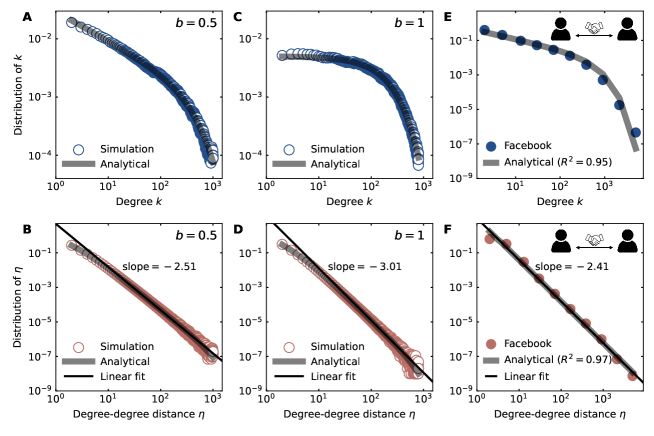
实验结果
研究问题
- RQ1度-度距离 $\eta$ 的幂律分布是否为网络被视为无标度的必要或充分条件?
- RQ2是否每个具有幂律度分布 $f(k)$ 的网络也表现出幂律度-度距离分布 $g(\eta)$?
- RQ3是否存在具有幂律 $g(\eta)$ 但无幂律 $f(k)$ 的网络?若存在,其生成机制为何?
- RQ4DDDD 与 DD 相比,如何更有效地捕捉现实世界复杂网络的潜在机制?
- RQ5DDDD 是否可作为比传统 DD 更具普适性与鲁棒性的无标度性指标,尤其在有限尺寸或非理想网络中?
主要发现
- 所有具有幂律度分布 $f(k) \propto k^{-\alpha}$ 的网络也表现出幂律度-度距离分布 $g(\eta) \propto \eta^{-\beta}$,证明幂律DDDD是幂律DD的必然结果。
- 反之不成立:如通过优先连接与优值机制构建的两个模型所示,网络可具有幂律DDDD但无幂律DD。
- Erdős–Rényi 随机图模型的DDDD并非幂律分布,即使在大 $N$ 极限下,也因 $\eta$ 的有限上界和指数衰减项而无法呈现幂律。
- 所构建的优先连接与优值驱动模型均产生幂律DDDD,其指数 $\beta \approx 2.5$,同时避免了幂律DD,证实DDDD可独立于DD呈现幂律。
- DDDD 作为无标度性指标比DD更具普适性,因其可在度分布不显示幂律时仍捕捉尺度不变的连接不平衡性。
- 基于DDDD的模型在真实世界网络(如 Facebook、WorldCity)上的拟合达到高精度,且每模型仅需一个可调参数,表明其在复杂系统建模中的实际应用潜力。
![Figure 2: Distributions of (a,c) $k$ and (b,d) $\eta$ for the "hard-threshold" model, a network model that assigns a uniformly distributed fitness $\omega\in[0,\omega_{\max}=1]$ to each node, where two nodes are linked if and only if their fitness sum is larger than a threshold $z$ . The model simul](https://ar5iv.labs.arxiv.org/html/2310.08110/assets/x2.png)
更好的研究,从现在开始
从阅读论文到最终审阅,大幅缩短您的研究时间。
无需绑定信用卡
本解读由 AI 生成,并经人工编辑审核。