
[论文解读] Shedding light on the MRI driven dynamo in a stratified shearing box
本研究通过高分辨率模拟与一种新型反演方法(IROS),在分层、净通量为零的剪切盒中研究了磁流体动力学驱动的MRI发电机。结果揭示了一种$\alpha$-$\Omega$发电机机制:$\alpha_{yy}$效应将环向磁场转化为极向磁场,而剪切则再生环向磁场,平均场输运主要由垂直流出和湍流抽运主导,而非扩散性。
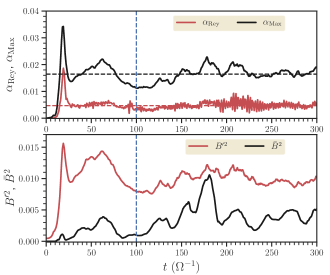
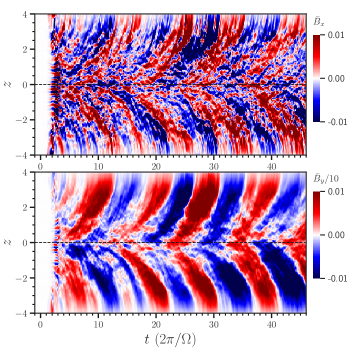
We study the magneto-rotational instability (MRI) driven dynamo in a geometrically thin disc ($H/R\ll 1$) using stratified zero net flux (ZNF) shearing box simulations. We find that mean fields and EMFs oscillate with a primary frequency $f_{ m dyn} = 0.017$ ($\approx 9$ orbital period), but also have higher harmonics at $3f_{ m dyn}$. Correspondingly, the current helicity, has two frequencies $2f_{ m dyn}$ and $4f_{ m dyn}$ respectively, which appear to be the beat frequencies of mean fields and EMFs as expected from the magnetic helicity density evolution equation. Further, we adopt a novel inversion algorithm called the `Iterative Removal Of Sources' (IROS), to extract the turbulent dynamo coefficients in the mean-field closure using the mean magnetic fields and EMFs obtained from the shearing box simulation. We show that an $α-$effect ($α_{yy}$) is predominantly responsible for the creation of the poloidal field from the toroidal field, while shear generates back a toroidal field from the poloidal field; indicating that an $α-Ω$-type dynamo is operative in MRI-driven accretion discs. We also find that both strong outflow ($\bar{v}_z$) and turbulent pumping ($γ_z$ ) transport mean fields away from the mid-plane. Instead of turbulent diffusivity, they are the principal sink terms in the mean magnetic energy evolution equation. We find encouraging evidence that a generative helicity flux is responsible for the effective $α$-effect. Finally, we point out potential limitations of horizontal ($x-y$) averaging in defining the `mean' on the extraction of dynamo coefficients and their physical interpretations.
研究动机与目标
- 理解几何薄层、分层、净通量为零的吸积盘中MRI驱动发电机的本质。
- 利用无偏置反演方法,从剪切盒模拟中提取湍流发电机系数(如$\alpha$、$\eta$)。
- 研究平均场输运机制(尤其是垂直流出和湍流抽运)在磁场能量演化中的作用。
- 评估在水平(x-y)平均下发电机系数物理解释的合理性及其潜在的退化问题。
- 探讨是否存在生成性螺旋度通量,以解释MRI湍流中观测到的有效$\alpha$-效应。
提出的方法
- 对$H/R \ll 1$的等温、分层、净通量为零的剪切盒中的MRI湍流进行高分辨率模拟。
- 应用“迭代去除源”(IROS)算法,将平均磁场与电磁力(EMFs)反演为湍流发电机系数。
- 利用时间平均的平均场与EMFs,计算平均场闭合框架中的$\alpha_{ij}$、$\eta_{ij}$与$\gamma_{ij}$系数。
- 对$\eta_{yy} = f_\eta \eta_{xx}$施加约束,以检验系数恢复中的敏感性与退化问题,比较有无约束条件下的拟合效果。
- 分析垂直剖面与残差EMFs,以验证反演质量,并评估$\alpha$与$\eta$项的相对贡献。
- 研究磁场螺旋度密度演化方程,以解释平均场与EMFs中观测到的振荡频率的起源。
实验结果
研究问题
- RQ1在分层、净通量为零的剪切盒中,MRI驱动湍流下的主导发电机机制(如$\alpha$-效应、$\alpha$-$\Omega$)是什么?
- RQ2垂直流出($\bar{v}_z$)与湍流抽运($\gamma_z$)如何影响平均磁场与能量的演化?
- RQ3所提取的发电机系数在多大程度上依赖于平均方案的选择,特别是水平(x-y)平均?
- RQ4生成性螺旋度通量是否能解释MRI湍流中观测到的有效$\alpha$-效应?
- RQ5湍流扩散系数($\eta_{ij}$)的行为如何?它们对发电机过程的物理解释施加了何种约束?
主要发现
- MRI驱动的发电机通过$\alpha$-$\Omega$机制运行,其中$\alpha_{yy}$是主导项,负责将环向磁场转化为极向磁场。
- 平均场与EMFs的主要振荡频率为$f_{\rm dyn} = 0.017$,对应约9个轨道周期,且存在$3f_{\rm dyn}$的高次谐波。
- 当前螺旋度在$2f_{\rm dyn}$与$4f_{\rm dyn}$处具有频率,与磁场螺旋度密度演化方程预期的拍频一致。
- 垂直流出($\bar{v}_z$)与湍流抽运($\gamma_z$)是平均磁场能量演化方程中的主要汇项,其作用超过湍流扩散性。
- 有效$\alpha$-效应很可能是由生成性螺旋度通量驱动的,这一结论得到观测到的振荡行为与螺旋度动力学相关性的支持。
- $\eta_{yy}$系数几乎为零,而$\eta_{xx}$与$\eta_{yx}$为正;然而,当通过$\eta_{yy} = f_\eta \eta_{xx}$对$\eta_{yy}$进行缩放时,$\eta_{yx}$逐渐变为负值,表明这两项之间存在强烈关联。
更好的研究,从现在开始
从阅读论文到最终审阅,大幅缩短您的研究时间。
无需绑定信用卡
本解读由 AI 生成,并经人工编辑审核。