
[论文解读] Spatial segregation of dust grains in transition disks. SPHERE observations of 2MASS J16083070-3828268 and RXJ1852.3-3700
本研究利用多波长VLT/SPHERE与ALMA观测,调查了两个过渡盘J1608和J1852中的尘埃颗粒分异现象,结果表明由于径向漂移和沉降作用,微米级颗粒在径向和垂直方向上延伸得更远,而毫米级颗粒则较局限。辐射转移建模显示,在22个过渡盘中,有15个在散射光中观测到的空洞小于毫米波段的空洞,表明空洞由行星驱动形成,其中15个系统与质量低于13 M<sub>J</sub>的巨行星一致,另有7个系统需要质量更大或存在多个伴星。
Context. The mechanisms governing the opening of cavities in transition disks are not fully understood. Several processes have been proposed but their occurrence rate is still unknown. Aims. We present spatially resolved observations of two transition disks and aim at constraining their vertical and radial structure using multiwavelength observations. Methods. We have obtained near-IR scattered light observations with VLT/SPHERE of the transition disks J1608 and J1852. We complement our datasets with ALMA observations and with unresolved photometric observations covering a wide range of wavelengths. We performed radiative transfer modeling to analyze the morphology of the disks and compare the results with a sample of 20 other transition disks observed with both SPHERE and ALMA. Results. The scattered light image of J1608 reveals a very inclined disk, with two bright lobes and a large cavity. J1852 shows an inner ring extending beyond the coronagraphic radius up to 15au, a gap and a second ring at 42au. Our radiative transfer model of J1608 indicates that the millimeter-sized grains are less extended vertically and radially than the micron-sized grains, indicating advanced settling and radial drift. We find good agreement with the observations of J1852 with a similar model, but due to the low inclination of the system, the model remains partly degenerate. The analysis of 22 transition disks shows that, in general, the cavities observed in scattered light are smaller than the ones detected at millimeter wavelengths. Conclusions. The analysis of a sample of transition disks indicates that the small grains can flow inward of the region where millimeter grains are trapped. While 15 out of the 22 cavities in our sample could be explained by a planet of less than 13 Jupiter masses, the others either require the presence of a more massive companion or of several low-mass planets.
研究动机与目标
- 理解过渡盘中空洞形成机制,特别是行星-盘相互作用的作用。
- 利用多波长观测研究过渡盘中不同尺寸尘埃颗粒的空间分布。
- 确定在散射光与毫米波发射中观测到的空洞尺寸差异是否源于径向漂移和垂直沉降引起的尘埃颗粒分异。
- 利用辐射转移建模与观测数据,约束导致空洞形成的潜在行星伴星质量。
- 通过分析包含22个过渡盘的样本,评估行星诱导空洞清除的普遍性。
提出的方法
- 使用VLT/SPHERE在偏振模式下获取J1608和J1852的高分辨率近红外散射光图像。
- 补充使用档案ALMA数据在毫米波段探测更大尺寸的尘埃颗粒。
- 结合宽波段范围内的未分辨测光数据,以约束尘埃特性。
- 执行三维辐射转移建模,以重现观测到的盘形态,并推断颗粒尺寸分布及垂直/径向范围。
- 采用de Juan Ovelar等人(2013年)的方案,估算与观测空洞尺寸一致的伴星质量。
- 整理并分析了22个同时被SPHERE与ALMA成像的过渡盘样本,以评估空洞尺寸差异的一般趋势。
实验结果
研究问题
- RQ1由于径向漂移和垂直沉降,过渡盘中的微米级尘埃颗粒是否延伸超过毫米级颗粒?
- RQ2散射光与毫米波发射中观测到的空洞尺寸差异的成因是什么?
- RQ3J1608和J1852中观测到的空洞形态能否由单个巨行星或多个伴星解释?
- RQ4在过渡盘样本中,尘埃颗粒分异现象有多普遍?这对行星形成机制有何启示?
- RQ5在22个盘的样本中,解释观测空洞尺寸所需的伴星质量范围是什么?
主要发现
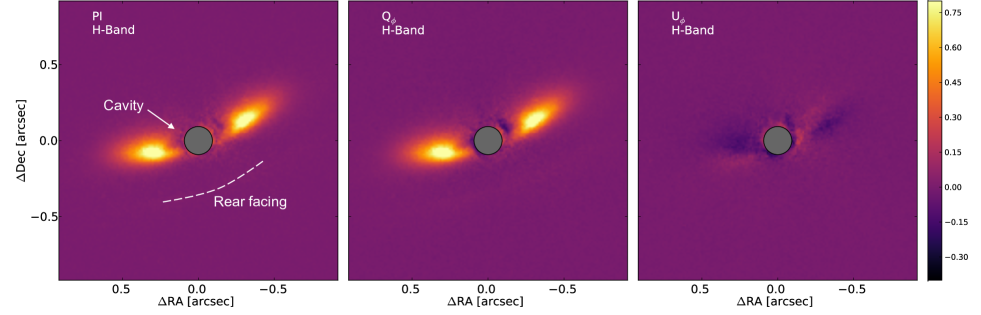
- 在J1608中,散射光延伸至0.54″(108 au),揭示了一个倾角较大的盘(i ~ 74°),具有显著的空洞和两个明亮的瓣状结构,且对后向散射面有微弱检测。
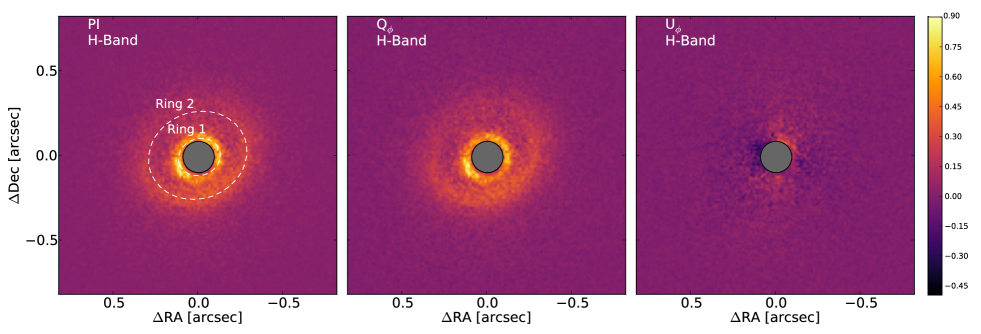
- 在J1852中,内环延伸至日冕仪半径之外,达15 au,存在一个间隙和位于42 au的第二个环,表明存在复杂的径向结构。
- 辐射转移建模显示,在J1608中,毫米级颗粒的垂直和径向扩展均小于微米级颗粒,证实了颗粒已发生显著的沉降与径向漂移。
- 同一模型对J1852的拟合效果良好,尽管低倾角导致参数推导存在退化问题。
- 在22个同时拥有SPHERE与ALMA数据的过渡盘中,散射光空洞始终小于毫米波空洞,表明存在尘埃颗粒分异。
- 在22个系统中,有15个与质量低于13 M<sub>J</sub>的单个巨行星一致;其余7个系统需要质量更大或存在多个低质量行星。
更好的研究,从现在开始
从阅读论文到最终审阅,大幅缩短您的研究时间。
无需绑定信用卡
本解读由 AI 生成,并经人工编辑审核。