
[论文解读] The quantum geometric origin of capacitance in insulators
该论文确立了在带绝缘体中,纵向电导率源于源自量子几何张量(特别是量子度规)的本征电容,该电容控制着虚激发的带间跃迁。关键结果表明,该电容与量子度规和能隙之比成正比,为hBN对齐的扭曲双层石墨烯、金刚石及其他受阻原子绝缘体等绝缘体的介电响应提供了可观测的、受拓扑影响的贡献。
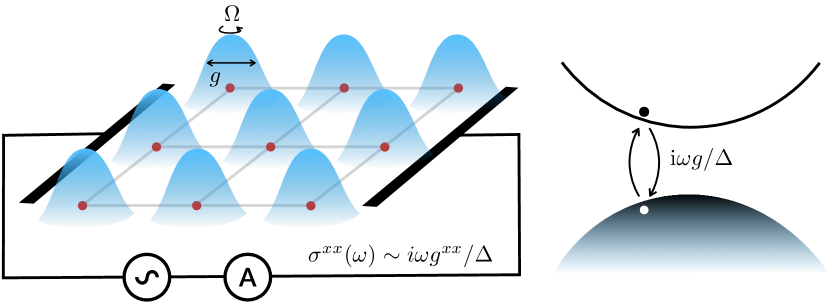
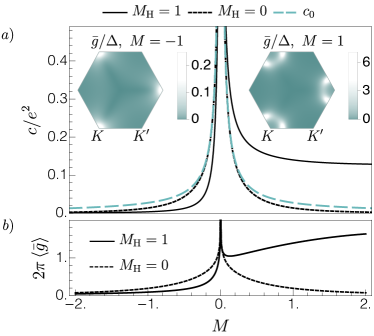
In band insulators, where the Fermi surface is absent, adiabatic transport is allowed only due to the geometry of the Hilbert space. By driving the system at a small but finite frequency $ω$, transport is still expected to depend sensitively on the quantum geometry. Here we show that this expectation is correct and can be made precise by expressing the Kubo formula for conductivity as the variation of the \emph{time-dependent polarization} with respect to the applied field. In particular, a little appreciated effect is that at linear order in frequency, the longitudinal conductivity results from an intrinsic capacitance, determined by the ratio of the quantum metric and the spectral gap. We demonstrate that this intrinsic capacitance has a measurable effect in a wide range of insulators with non-negligible metric, including the electron gas in a quantizing magnetic field, the gapped bands of hBN-aligned twisted bilayer graphene, and obstructed atomic insulators such as diamond whose large refractive index has a topological origin. We also discuss the influence of quantum geometry on the dielectric constant.
研究动机与目标
- 识别带绝缘体中纵向电导率的起源,超越传统输运机制。
- 研究量子几何(特别是量子度规)如何影响绝缘体在低频下的响应。
- 建立量子几何张量与清洁绝缘体本征电容之间的直接联系。
- 证明该电容在具有非零量子度规的实际材料中是一种可观测的、非微扰效应。
- 阐明量子几何在确定介电常数(特别是光学介电常数 $\epsilon_\infty$)中的作用。
提出的方法
- 使用Kubo公式推导线性响应电导率,将其表示为时间依赖极化对所加电场的泛函导数。
- 在频率上应用准静态展开,表明电导率的主导纵向贡献由本征电容 $c = \varepsilon_0 \chi$ 所支配。
- 通过 $\chi \propto \sum_{m \neq n} \frac{g^{xx}_{mn}}{\omega_{mn}}$ 将静态磁化率 $\chi$ 与量子度规联系起来,其中 $g^{xx}_{mn}$ 是量子度规的面内分量。
- 使用线性响应表达式 $\epsilon = 1 + \frac{2e^2}{\hbar \varepsilon_0} \sum_{m \neq n} \int_{\text{BZ}} f_n(1 - f_m) \frac{g^{xx}_{mn}}{\omega_{mn}}$ 将介电常数与量子几何联系起来。
- 使用从头算和紧束缚模型,计算各种材料(包括hBN、石墨烯、金刚石和氧化物)的理论 $\epsilon_\infty$ 和 $\left<\bar{g}\right>_z$ 值。
- 将 $\left<\bar{g}\right>_z \propto a_z \Delta \chi$ 的行为与传统的 $\epsilon_\infty \Delta$ 进行比较,以突出其与量子几何的更强相关性。
实验结果
研究问题
- RQ1量子几何张量如何影响绝缘体在低频下的纵向电导率?
- RQ2绝缘体中的本征电容能否从量子度规和能隙推导出来,且是否可观测?
- RQ3为何传统的 $\epsilon_\infty \Delta$ 分析在不同材料间表现出强烈变化,而 $\left<\bar{g}\right>_z$ 却表现出更普遍的趋势?
- RQ4在具有非平凡能带拓扑的材料中,量子度规在介电响应中占据主导地位的程度如何?
- RQ5量子几何起源的电容与经典或有效介质贡献有何不同?
主要发现
- 在低频下,绝缘体的纵向电导率主要由本征电容 $c$ 主导,该电容源于量子度规,且与 $g^{xx}_{mn}/\Delta$ 成正比。
- 该本征电容是一种纯粹的量子效应,由相干的虚带间跃迁驱动,在量子度规为零的系统中则不存在。
- 在hBN对齐的扭曲双层石墨烯和金刚石等材料中,量子度规导致可观测的电容贡献,其大小与能隙的倒数成正比。
- 介电常数 $\epsilon_\infty$ 并非普遍与 $\Delta^{-1}$ 成正比,其变化更佳地由量子度规贡献 $\left<\bar{g}\right>_z$ 解释。
- 补充表1显示,基于量子几何张量计算的理论 $\epsilon_\infty$ 值与SiO₂、ZnO和MgO等材料的实验数据高度吻合。
- 尽管材料的能隙差异显著,$\left<\bar{g}\right>_z$ 的变化幅度小于2.5倍,表明其几何控制作用比传统的 $\epsilon_\infty \Delta$ 标度更为稳健。
更好的研究,从现在开始
从阅读论文到最终审阅,大幅缩短您的研究时间。
无需绑定信用卡
本解读由 AI 生成,并经人工编辑审核。