
[论文解读] The second data release from the European Pulsar Timing Array V. Search for continuous gravitational wave signals
论文报告在欧洲脉冲星定时阵列 DR2 数据中搜索连续引力波信号,突出显示发现的最显著候选事件。
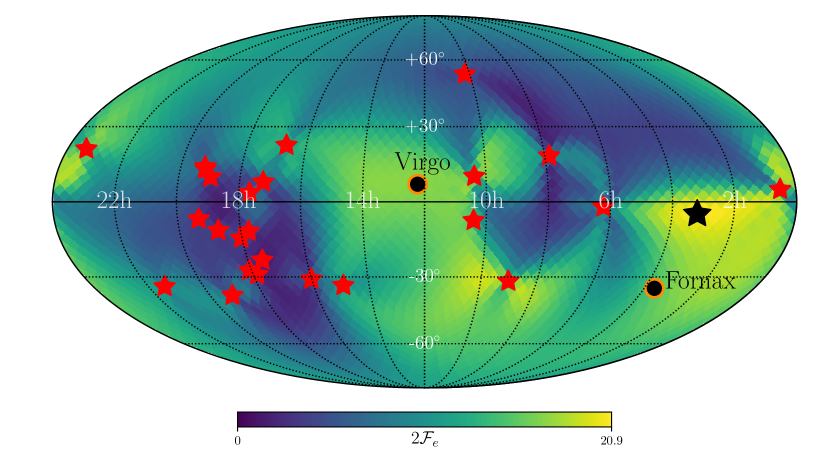
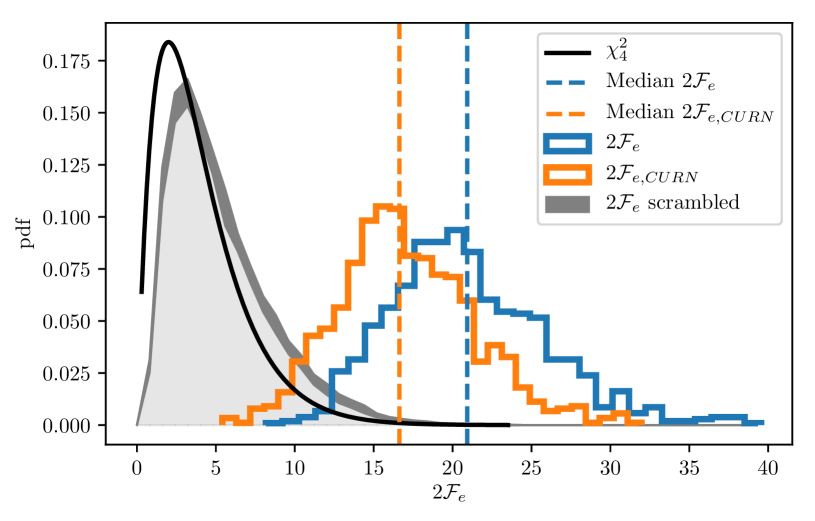
We present the results of a search for continuous gravitational wave signals (CGWs) in the second data release (DR2) of the European Pulsar Timing Array (EPTA) collaboration. The most significant candidate event from this search has a gravitational wave frequency of 4-5 nHz. Such a signal could be generated by a supermassive black hole binary (SMBHB) in the local Universe. We present the results of a follow-up analysis of this candidate using both Bayesian and frequentist methods. The Bayesian analysis gives a Bayes factor of 4 in favor of the presence of the CGW over a common uncorrelated noise process, while the frequentist analysis estimates the p-value of the candidate to be 1%, also assuming the presence of common uncorrelated red noise. However, comparing a model that includes both a CGW and a gravitational wave background (GWB) to a GWB only, the Bayes factor in favour of the CGW model is only 0.7. Therefore, we cannot conclusively determine the origin of the observed feature, but we cannot rule it out as a CGW source. We present results of simulations that demonstrate that data containing a weak gravitational wave background can be misinterpreted as data including a CGW and vice versa, providing two plausible explanations of the EPTA DR2 data. Further investigations combining data from all PTA collaborations will be needed to reveal the true origin of this feature.
研究动机与目标
- 动机和约束使用欧洲脉冲星定时阵列的 DR2 数据进行连续引力波搜索。
- 表征 DR2 数据集中 CGW 的灵敏度与探测统计。
- 识别并报告最显著的候选连续引力波事件并评估其显著性。
提出的方法
- 在 DR2 PTA 数据中执行连续引力波信号的搜索。
- 应用脉冲星时延残差中 CGW 信号提取的技术。
- 评估候选事件并将其显著性相对于噪声进行量化。
- 若未发现可靠的探测,则深入数据以设定 CGW 应变的上限。
实验结果
研究问题
- RQ1是否能够在 EPTA 的 DR2 数据集中检测到连续引力波信号?
- RQ2DR2 中最显著的 CGW 候选的显著性有多大,以及它与噪声期望相比如何?
- RQ3可以从 DR2 派生出关于 CGW 应变的哪些上限?
- RQ4DR2 CGW 搜索结果对 CGW 群体模型有何约束?
- RQ5在 DR2 中是否存在可能模拟 CGW 信号的系统性效应?
主要发现
- 使用 EPTA 数据集对 DR2 进行了 CGW 的搜索。
- 在 DR2 搜索中确定了最显著的 CGW 候选事件。
- 本文量化了该候选的显著性并讨论了其含义。
- 在摘要中未给出确定性检测的主张;该候选与噪声期望进行比较评估。
- 该研究为 CGW 的灵敏度及适用于 DR2 及未来数据发布的方法提供了背景。
更好的研究,从现在开始
从阅读论文到最终审阅,大幅缩短您的研究时间。
无需绑定信用卡
本解读由 AI 生成,并经人工编辑审核。