
[论文解读] Thermometry by correlated dephasing of impurities in a 1D Fermi gas
本文提出了一种新颖的量子测温方法,利用一维超冷费米气体中两个静态杂质量子比特的关联退相干。通过功能行列式方法精确求解动力学过程,作者表明,通过介质介导的Ruderman–Kittel–Kasuya–Yosida(RKKY)型相互作用,杂质之间产生关联,使测温灵敏度超越独立探测器的极限——尤其在低温和弱耦合条件下,且可通过标准拉比姆干涉仪实现,无需复杂的态制备。
We theoretically investigate the pure dephasing dynamics of two static impurity qubits embedded within a common environment of ultracold fermionic atoms, which are confined to one spatial dimension. Our goal is to understand how bath-mediated interactions between impurities affect their performance as nonequilibrium quantum thermometers. By solving the dynamics exactly using a functional determinant approach, we show that the impurities become correlated via retarded interactions of the Ruderman-Kittel-Kasuya-Yosida type. Moreover, we demonstrate that these correlations can provide a metrological advantage, enhancing the sensitivity of the two-qubit thermometer beyond that of two independent impurities. This enhancement is most prominent in the limit of low temperature and weak collisional coupling between the impurities and the gas. We show that this precision advantage can be exploited using standard Ramsey interferometry, with no need to prepare correlated initial states nor to individually manipulate or measure the impurities. We also quantitatively assess the impact of ignoring these correlations when constructing a temperature estimate, finding that acceptable precision can still be achieved from a simplified model of independent impurities. Our results demonstrate the rich nonequilibrium physics of impurities dephasing in a common Fermi gas, and may help to provide better temperature estimates at ultralow temperatures.
研究动机与目标
- 研究两杂质量子比特在一维费米气体中通过介质介导的相互作用如何影响其作为非平衡量子测温器的性能。
- 确定由共同费米子介质诱导的关联是否能在温度估计中提供计量优势。
- 评估是否可利用标准拉比姆干涉仪在无需纠缠初始态或单个量子比特控制的前提下,利用这些关联。
- 量化在简化独立杂质模型中忽略介质诱导关联所引入的误差。
提出的方法
- 采用功能行列式方法精确求解两个静态杂质与一维费米气体耦合的多体问题,以处理退相干动力学。
- 推导所有自旋构型通道的退相干函数,包括非马尔可夫性和长时间行为。
- 利用累积量展开分析弱耦合、低温区域的退相干行为。
- 通过Ruderman–Kittel–Kasuya–Yosida(RKKY)机制分析介质诱导的相互作用,该机制介导杂质间的延迟相互作用。
- 利用互信息和量子失谐量化量子与经典关联,通过超越方程进行失谐的解析计算。
- 利用量子费希尔信息评估测温精度,比较关联与独立杂质模型。

实验结果
研究问题
- RQ1在一维费米气体中,两个杂质量子比特通过介质介导的相互作用是否能带来量子测温中的计量优势?
- RQ2RKKY型关联的存在如何影响杂质的退相干动力学及其温度敏感性?
- RQ3在无需纠缠初始态或单个量子比特控制的前提下,标准拉比姆干涉仪能在多大程度上从关联杂质中提取增强的精度?
- RQ4在使用简化独立杂质模型估计温度时,忽略介质诱导关联会产生何种影响?
- RQ5在存在关联退相干的情况下,测温精度如何依赖于温度、耦合强度和杂质间距?
主要发现
- 由于RKKY介导的相互作用导致的关联退相干,使测温灵敏度超越独立杂质的普适量子极限,尤其在低温和弱耦合区域表现显著。
- 当杂质间距较小时,RKKY相互作用最强且呈现振荡行为,此时精度优势最为明显。
- 通过标准拉比姆干涉仪即可实现灵敏度增强,无需纠缠初始态或对单个量子比特的操控。
- 两杂质系统在所有时间点均保持可分,表明纠缠并非计量优势的来源,但量子失谐与经典关联对信息增益有贡献。
- 在某些参数区域忽略介质诱导关联仍可接受,但当RKKY相互作用较强时,关联模型能提供显著更高的精度。
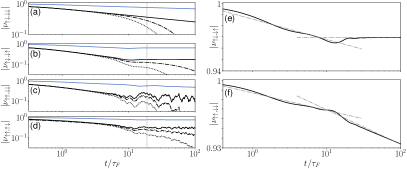
- $\nu_{\uparrow\uparrow,\uparrow\downarrow}$ 通道的退相干函数在低温下因耦合至低频激发而出现减缓,表明存在超退相干效应。
更好的研究,从现在开始
从阅读论文到最终审阅,大幅缩短您的研究时间。
无需绑定信用卡
本解读由 AI 生成,并经人工编辑审核。