
[论文解读] Variational Quantum Fidelity Estimation
本文提出变分量子保真度估计算法(VQFE),一种混合量子-经典算法,可在 $\rho$ 为低秩时,计算可调节、单调收紧的量子态保真度 $F(\rho,\sigma)$ 上下界。通过变分对角化 $\rho$,在 $\rho$ 的本征基下估计 $\sigma$ 的矩阵元,并利用截断保真度,VQFE 实现了 $\widetilde{O}(m^6/\zeta^2)$ 的运行时间,附加误差 $\gamma$ 随 $m$ 增加而减小,其紧致性与量子比特需求均优于先前的 SSFB 方法。
Computing quantum state fidelity will be important to verify and characterize states prepared on a quantum computer. In this work, we propose novel lower and upper bounds for the fidelity $F(ρ,σ)$ based on the "truncated fidelity" $F(ρ_m, σ)$, which is evaluated for a state $ρ_m$ obtained by projecting $ρ$ onto its $m$-largest eigenvalues. Our bounds can be refined, i.e., they tighten monotonically with $m$. To compute our bounds, we introduce a hybrid quantum-classical algorithm, called Variational Quantum Fidelity Estimation, that involves three steps: (1) variationally diagonalize $ρ$, (2) compute matrix elements of $σ$ in the eigenbasis of $ρ$, and (3) combine these matrix elements to compute our bounds. Our algorithm is aimed at the case where $σ$ is arbitrary and $ρ$ is low rank, which we call low-rank fidelity estimation, and we prove that a classical algorithm cannot efficiently solve this problem. Finally, we demonstrate that our bounds can detect quantum phase transitions and are often tighter than previously known computable bounds for realistic situations.
研究动机与目标
- 开发一种高效、混合的量子-经典算法,用于估计低秩量子态 $\rho$ 与任意态 $\sigma$ 之间的保真度,这对验证近期量子计算至关重要。
- 解决在标准复杂性假设下,当 $\rho$ 为低秩时,经典算法难以估计保真度的问题。
- 提供关于 $F(\rho,\sigma)$ 的边界,使其随着截断中保留的最大本征值数量 $m$ 单调收紧。
- 通过仅需 $2n+1$ 量子比特,显著降低资源开销,相较先前方法(如 SSFB)所需的 $4n+1$ 量子比特。
提出的方法
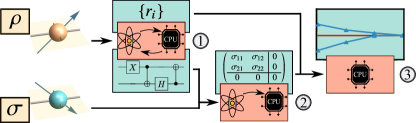
- 通过参数化量子线路对 $\rho$ 进行变分对角化,以制备其本征基,并估计最大的本征值与本征态。
- 在 $2n+1$ 量子比特上使用交换测试,估计 $\sigma$ 在 $\rho$ 本征基下的矩阵元 $\sigma_{ij} = \langle \psi_i | \sigma | \psi_j \rangle$。
- 计算截断保真度 $F(\rho_m, \sigma)$,其中 $\rho_m$ 是 $\rho$ 投影到其前 $m$ 个最大本征值上的结果,以生成边界。
- 基于保真度谱与微扰理论,推导新不等式,构建 $F(\rho,\sigma)$ 的上下界。
- 利用集中不等式与误差传播,界定总附加误差 $\gamma$,其依赖于 $\epsilon = \|\rho - \rho_m\|_1$、$C$(对角化误差)与 $\zeta$(估计精度)。
- 将保真度谱——即所有截断保真度 $F(\rho_m, \sigma)$ 的集合——作为比单一保真度值更丰富的态相似性表征。
实验结果
研究问题
- RQ1在经典算法在标准假设下失效的低秩情形下,我们能否高效估计量子态保真度?
- RQ2我们能否设计一种混合量子-经典算法,使保真度边界随保留本征模数量 $m$ 的增加而单调收紧?
- RQ3与最先进的次保真度与超保真度边界(SSFB)相比,我们的边界在紧致性与资源成本方面表现如何?
- RQ4保真度谱是否能提供比单一保真度值更丰富的关于量子态相似性的信息?
- RQ5为实现期望的保真度近似精度,所提算法的量子线路复杂度与误差标度为何?
主要发现
- VQFE 实现了 $\widetilde{O}(m^6/\zeta^2)$ 的运行时间,附加误差 $\gamma = \sqrt{2\epsilon + (2+\sqrt{2})\sqrt{mC}} + \sqrt{\epsilon + \sqrt{mC}} + \zeta\|T\|$,其中 $\epsilon = \|\rho - \rho_m\|_1$,$C$ 为对角化误差,$\zeta$ 控制估计精度。
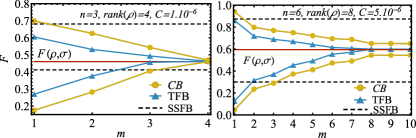
- 该算法以至少 $1-\delta$ 的概率输出 $F(\rho,\sigma)$ 的 $\pm\gamma$ 近似值,且误差 $\gamma$ 随 $m$ 增加而单调减小。
- VQFE 仅需 $2n+1$ 个量子比特,显著少于 SSFB 方法所需的 $4n+1$ 个量子比特,提升了资源效率。
- 在数值演示中,VQFE 的边界比 SSFB 更紧致,尤其在真实的低秩场景下表现更优,且可通过追踪保真度谱检测量子相变。
- 保真度谱(即所有截断保真度 $F(\rho_m, \sigma)$ 的集合)提供了比单一保真度值更丰富的关于态相似性的信息。
- 理论分析证明,在标准复杂性假设下,无经典算法能高效解决低秩保真度估计问题,从而证明了像 VQFE 这类量子算法的必要性。
更好的研究,从现在开始
从阅读论文到最终审阅,大幅缩短您的研究时间。
无需绑定信用卡
本解读由 AI 生成,并经人工编辑审核。