
[论文解读] Volatile-to-sulfur Ratios Can Recover a Gas Giant's Accretion History
本文提出,通过系外行星大气中SO₂检测得到的挥发性元素与硫的比率(C/S 和 O/S),可区分气态巨行星形成的星子吸积与微粒吸积模型。利用针对WASP-39b的三维光化学模型网格与合成透射光谱,研究显示SO₂仅在C/S与O/S比率较低(约≤1.5倍太阳值)时可被探测到,表明WASP-39b观测到的1–10 ppm SO₂更符合星子吸积而非微粒吸积模型,尽管部分微粒吸积模型亦可解释该结果。
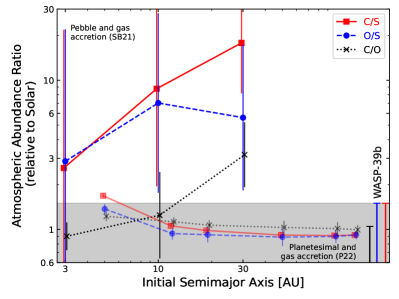
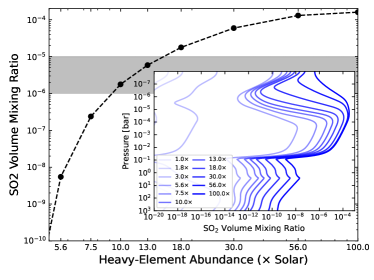
The newfound ability to detect SO2 in exoplanet atmospheres presents an opportunity to measure sulfur abundances and so directly test between competing modes of planet formation. In contrast to carbon and oxygen, whose dominant molecules are frequently observed, sulfur is much less volatile and resides almost exclusively in solid form in protoplanetary disks. This dichotomy leads different models of planet formation to predict different compositions of gas giant planets. Whereas planetesimal-based models predict roughly stellar C/S and O/S ratios, pebble accretion models more often predict superstellar ratios. To explore the detectability of SO2 in transmission spectra and its ability to diagnose planet formation, we present a grid of atmospheric photochemical models and corresponding synthetic spectra for WASP-39b (where SO2 has been detected). Our 3D grid contains 11^3 models (spanning 1--100x the solar abundance ratio of C, O, and S) for thermal profiles corresponding to the morning and evening terminators, as well as mean terminator transmission spectra. Our models show that for a WASP-39b-like O/H and C/H enhancement of ~10x Solar, SO2 can only be seen for C/S and O/S <~1.5, and that WASP-39b's reported SO2 abundance of 1--10 ppm may be more consistent with planetesimal accretion than with pebble accretion models (although some pebble models also manage to predict similarly low ratios). More extreme C/S and O/S ratios may be detectable in higher-metallicity atmospheres, suggesting that smaller and more metal-rich gas and ice giants may be particularly interesting targets for testing planet formation models. Future studies should explore the dependence of SO2 on a wider array of planetary and stellar parameters, both for the prototypical SO2 planet WASP-39b, as well as for other hot Jupiters and smaller gas giants.
研究动机与目标
- 测试系外行星大气中SO₂丰度是否可通过探测挥发性元素与硫的比率来约束行星形成模型。
- 评估在不同C、O和S丰度条件下SO₂在透射光谱中的可探测性。
- 确定WASP-39b中观测到的SO₂水平是否更支持星子吸积而非微粒吸积模型。
- 识别使用SO₂作为诊断工具测试形成理论的最佳目标。
提出的方法
- 构建了包含11³种C、O和S丰度组合(1–100倍太阳值)的三维光化学模型网格,适用于类似WASP-39b的条件。
- 采用晨昏 terminator 的温度分布,计算平均 terminator 透射光谱。
- 模型中纳入H₂O与H₂S的光解反应,通过以下反应生成SO₂:H₂S + 2 H₂O + 光子 → SO₂ + 3 H₂。
- 改变紫外辐射通量与湍流扩散系数(Kzz),以评估其对SO₂丰度垂直分布的影响。
- 生成合成光谱,模拟JWST/NIRSpec与MIRI/LRS观测,用于可探测性分析。
- 模型考虑了SO₂垂直分布的非均匀性,避免假设其随高度恒定。
实验结果
研究问题
- RQ1系外行星大气中SO₂丰度是否可用于推断挥发性元素与硫的比率(C/S、O/S),从而约束行星形成机制?
- RQ2在类似WASP-39b的热木星透射光谱中,SO₂在何种C/S与O/S比率范围内可被探测到?
- RQ3WASP-39b中观测到的SO₂丰度(1–10 ppm)是否更支持星子吸积模型而非微粒吸积模型?
- RQ4紫外辐射通量与垂直混合(Kzz)的变化如何影响SO₂的可探测性与丰度分布?
- RQ5更小、金属丰度更高的气态与冰巨星是否是通过SO₂探测形成历史的更佳目标?
主要发现
- 在类似WASP-39b的O/H与C/H增强(约10倍太阳值)条件下,仅当C/S与O/S比率≤1.5倍太阳值时,SO₂才可在透射光谱中被探测到。
- WASP-39b观测到的1–10 ppm SO₂丰度更符合星子吸积模型,尽管部分微粒吸积模型亦可产生较低比率。
- 高金属丰度大气可能使更极端的C/S与O/S比率得以探测,因此更小、金属丰度更高的气态与冰巨星是极具前景的探测目标。
- 紫外辐射通量变化对SO₂丰度影响较小,但若FUV通量显著增加,SO₂可能减少达10⁴倍。
- 假设SO₂丰度随高度恒定可能低估真实SO₂水平,因其峰值位于0.01–10 mbar,影响反演精度。
- 硫与氮的比率未来或可作为探测吸积模式的另一指标,尤其在氮丰度可测量时。
更好的研究,从现在开始
从阅读论文到最终审阅,大幅缩短您的研究时间。
无需绑定信用卡
本解读由 AI 生成,并经人工编辑审核。