
[论文解读] Warm inflation with bulk viscous pressure for different solutions of an anisotropic universe
本文研究了在各向异性Bianchi I时空中具有体粘性压强的温热暴胀,分析了不同膨胀模型(中间型、对数中间型、指数型)在恒定与可变耗散参数下的情况。研究发现,在特定范围的各向异性参数 $m$ 下,模型与Planck和BK14数据具有观测一致性,尤其在可变 $γ$、$ξ$ 情况下 $1 \leq m \leq 3.5$,且当 $N>20$ 时非高斯性参数 $f_{NL}$ 趋近于零,而景观约束范围较窄。
We study a warm inflationary model for different expansions assuming an anisotropic universe described by Bianchi I metric. The universe is filled with a scalar field or inflaton, radiation, and bulk viscous pressure. We carry out the inflationary analysis for different solutions of such universe in two different cases of the bulk viscosity coefficient $ξ$ and the dissipation coefficient $Γ$ as constant and variable parameters, respectively. We compare the obtained results with the recent observations, in order to find the observational constraints on the parameters space of the models. Moreover, we attempt to present a better judgment among the considered models by calculation of the non-linear parameter $f_{NL}$ describing the non-Gaussianity property of the models. Additionally, we investigate the warm inflationary models with viscous pressure from the Weak Gravity Conjecture approach, considering the swampland criteria.
研究动机与目标
- 研究各向异性Bianchi I时空中具有体粘性压强的温热暴胀,扩展至标准各向同性模型之外。
- 评估不同精确暴胀解(中间型、对数中间型、指数型)在具有粘性效应的温热暴胀下的可行性。
- 利用近期CMB数据(Planck、BK14)约束模型参数,并评估与 $n_s$ 和 $r$ 观测边界的一致性。
- 通过不同耗散区域的 $f_{NL}$ 分析非高斯性,并评估模型区分能力。
- 通过评估 $c$ 与 $c'$ 参数,检验与景观标准(尤其是弱引力猜想)的兼容性。
提出的方法
- 通过Bianchi I度规建模各向异性宇宙,包含标量场、辐射与体粘性压强。
- 采用两种情形分析暴胀:恒定与可变的体粘性系数 $\xi$ 及耗散系数 $\Gamma$。
- 应用慢滚近似与哈密顿-雅可比形式化方法,推导背景动力学与标量场演化。
- 针对特定模型(如指数型)重构有效势 $V(\varphi)$,并以特殊函数表示 $\varphi(t)$。
- 计算宇宙学可观测量:谱指数 $n_s$、张量标量比 $r$ 与非高斯性参数 $f_{NL}$,基于扰动谱。
- 应用来自Planck 2018、BK14与联合数据集的观测约束,确定 $m$ 的允许参数范围。
实验结果
研究问题
- RQ1在各向异性Bianchi I宇宙中,具有体粘性压强的温热暴胀下,哪些暴胀膨胀模型(中间型、对数中间型、指数型)在观测上依然可行?
- RQ2不同数据组合(Planck、BK14、完整CMB数据集)与 $e$-fold 数 $N=50$ 和 $N=60$ 下,各向异性参数 $m$ 的观测约束如何变化?
- RQ3在强与弱耗散区域,非高斯性参数 $f_{NL}$ 的行为如何?其与 $m$ 和 $N$ 的依赖关系如何?
- RQ4景观标准参数 $c$ 与 $c'$ 如何约束模型?这对所提暴胀情景的理论可行性有何含义?
- RQ5体粘性压强的引入如何影响不同模型中有效势 $V(\varphi)$ 的重构与标量场演化 $\varphi(t)$?
主要发现
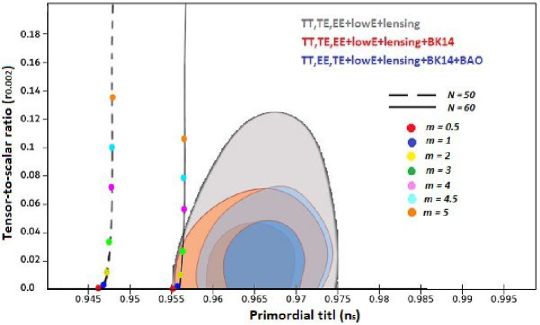
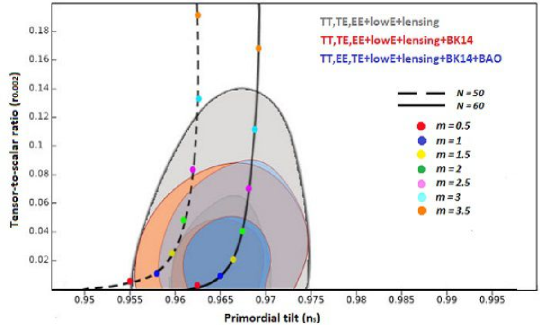
- 对于恒定 $\Gamma$ 与 $\xi$ 的对数中间型模型,仅使用Planck数据时,$N=50$ 下在68%置信水平下 $1.5 \leq m < 5$,在95%置信水平下收紧为 $1.5 \leq m \leq 3$。
- 在对数中间型模型的可变 $\Gamma$ 与 $\xi$ 情况下,使用完整CMB数据时,$N=60$ 下在68%置信水平下 $1 < m < 4$ 受到青睐,95%置信水平下为 $2 \leq m \leq 3.5$。
- 对于可变 $\Gamma$ 与 $\xi$ 的指数型模型,$N=60$ 时在68%置信水平下 $0.5 < m < 2$ 与Planck + BK14数据一致,且在强耗散区域 $f_{NL} \sim 0$。
- 所有模型中,当 $N > 20$ 时,非高斯性参数 $f_{NL}$ 趋近于零,表明晚期暴胀阶段非高斯性可忽略。
- 景观参数 $c$ 与 $c'$ 显示 $c$ 范围极窄,$c'$ 值较大,表明对模型可行性有强烈理论约束。
- 在可变 $\Gamma$ 与 $\xi$ 的中间型模型中,使用完整数据时 $N=50$ 下在68%置信水平下 $1 < m < 2.5$,且仅在强耗散区域 $m \geq 0.5$ 时出现 $f_{NL}$。
更好的研究,从现在开始
从阅读论文到最终审阅,大幅缩短您的研究时间。
无需绑定信用卡
本解读由 AI 生成,并经人工编辑审核。