
[논문 리뷰] 3D-Var Data Assimilation using a Variational Autoencoder
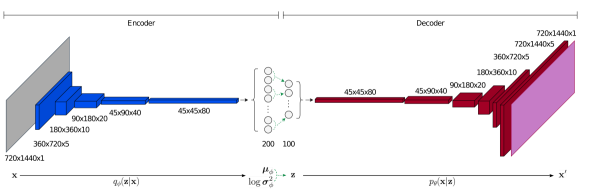
이 논문은 3D-Var 자료 통합을 감소된 잠재 공간에서 수행하는 변동형 오토에인코드르(VAE)를 활용하여 효율적인 최적화를 위한 자동 미분 기반 기울기 계산을 가능하게 하는 새로운 신경망 자료 통합(NNDA) 프레임워크를 제안한다. 이 방법은 유동에 따라 달라지는 계절적 변화를 반영한 배경 오차 공분산을 포착하며, 잠재 공간에서 준대각형 B-행렬을 나타내며, 단일 모델을 통해 열대 및 온대 기상 구조를 정확하게 표현함으로써 단일 온도 변수에 대한 정확한 분석 증분을 가능하게 한다.
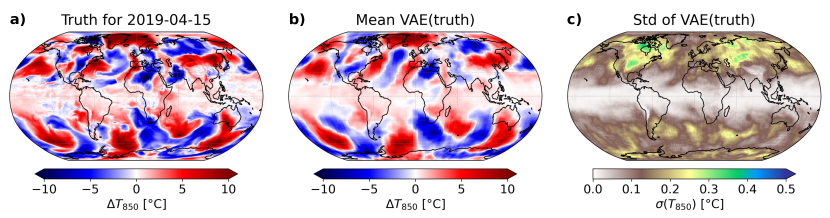
Data assimilation of atmospheric observations traditionally relies on variational and Kalman filter methods. Here, an alternative neural-network data assimilation (NNDA) with variational autoencoder (VAE) is proposed. The three-dimensional variational (3D-Var) data assimilation cost function is utilised to determine the analysis that optimally fuses simulated observations and the encoded short-range persistence forecast (background), accounting for their errors. The minimisation is performed in the reduced-order latent space, discovered by the VAE. The variational problem is auto-differentiable, simplifying the computation of the cost function gradient necessary for efficient minimisation. We demonstrate that the background-error covariance ($\mathbf{B}$) matrix measured and represented in the latent space is quasi-diagonal. The background-error covariances in the grid-point space are flow-dependent, evolving seasonally and depending on the current state of the atmosphere. Data assimilation experiments with a single temperature observation in the lower troposphere indicate that the $\mathbf{B}$-matrix simultaneously describes both tropical and extratropical background-error covariances.
연구 동기 및 목표
- 기존의 배경 오차 공분산 모델링을 대체하기 위해 변동형 오토에인코드르(VAE)를 활용해 저차원 표현을 학습하는 신경망 기반 자료 통합(NNDA) 프레임워크를 개발하는 것.
- 단순한 비선형 최적화 솔버(L-BFGS 등)를 사용할 수 있도록, VAE가 학습한 잠재 공간에서 배경 상태를 인코딩하고 관측치를 잠재 공간으로 투영함으로써 3D-Var 비용 함수의 효율적 최소화를 가능하게 하는 것.
- 단일 VAE로 학습한 잠재 공간 배경 오차 공분산(B-행렬)이 열대 및 온대 대기 동역학을 동시에 표현할 수 있는지 조사하는 것.
- 풍선 및 기하학적 위치 에너지 필드와 같은 다변량 설정에서 VAE-NNDA 프레임워크가 기류 평형 분석 증분을 얼마나 잘 생성할 수 있는지 평가하는 것.
- 확률적 오토에인코드르와 하이브리드 예측 모델을 통합함으로써 향후 4D-Var 및 독립형 신경망 기반 날씨 예측으로의 확장 기반을 마련하는 것.
제안 방법
- 기후 재분석 데이터인 ERA5를 기반으로 VAE를 훈련하여 대기 상태 필드(예: 850 hPa 온도)의 저차원이고 가우시안 분포를 가진 잠재 표현을 학습한다.
- 3D-Var 비용 함수를 재정의하고, 배경 상태를 단기 예측(persistence)에서 인코딩한 후 관측치를 잠재 공간으로 투영하여 잠재 공간에서 최소화한다.
- 배경 오차 공분산 행렬(B)은 잠재 공간에서 암묵적으로 표현되며, 복잡한 오차 구조를 효과적으로 저랭크 근사화하고 있음을 나타내는 준대각형 행렬임이 확인되었다.
- 비용 함수의 기울기는 자동 미분를 통해 계산되며, L-BFGS와 같은 표준 비선형 최적화 솔버를 사용한 효율적 최적화를 가능하게 한다.
- 분석 증분은 잠재 공간에서 계산된 후 그리드 포인트 공간으로 디코딩되어 평가된다.
- 검증을 위해 850 hPa 온도의 합성 관측치를 사용하여 분석 증분의 구조와 배경 오차 공분산의 특성을 평가한다.
실험 결과
연구 질문
- RQ1VAE로 학습한 잠재 공간이 3D-Var 자료 통합에 필요한 배경 오차 공분산 구조를 효과적으로 표현할 수 있는가?
- RQ2잠재 공간의 B-행렬이 동시에 열대 및 온대의 유동에 따라 달라지는 배경 오차 특성을 포착할 수 있는가?
- RQ3VAE 기반 3D-Var 프레임워크의 자동 미분 특성 덕분에 비용 함수의 효율적이고 정확한 최소화가 가능한가?
- RQ4이 프레임워크는 다변량 설정에서 기류 평형 분석 증분을 어느 정도 잘 생성할 수 있는가?
- RQ5이 프레임워크는 최소한의 아키텍처 오버헤드로 4D-Var 및 독립형 신경망 기반 날씨 예측에 확장될 수 있는가?
주요 결과
- 잠재 공간에서의 배경 오차 공분산 행렬(B)은 준대각형임을 확인하였으며, 이는 VAE가 저차원이고 매끄러운 표현에서 주요 오차 구조를 효과적으로 포착하고 있음을 시사한다.
- 단일 모델을 사용하여 VAE로 학습한 B-행렬이 열대 및 온대의 배경 오차 공분산을 성공적으로 표현하며, 이는 유동에 따라 달라지는 계절적 변화 특성을 반영하고 있음을 보여준다.
- 중위도 200 hPa의 바람 및 기하학적 위치 에너지 필드에 대해 기류 평형 분석 증분을 생성함으로써 다변량 통합에서 물리적 일관성을 확보하였다.
- VAE의 자동 미분 특성 덕분에 기울기 계산이 효율적으로 이루어져 잠재 공간 내 최적화 과정이 단순화되었다.
- 이 프레임워크는 다변량 배경 오차 공분산을 표현할 수 있으며, 다수의 변수 및 수직 레벨에 대한 완전한 검증은 향후 확장이 필요하다.
- 이 방법은 향후 4D-Var 및 하이브리드 예측 모델에 통합될 잠재력을 보이며, 특히 확률적 오토에인코드르와 정규화 흐름을 활용해 잠재 공간 모델링을 향상시킬 수 있다.
더 나은 연구,지금 바로 시작하세요
논문 읽기부터 검토까지, 연구 시간을 획기적으로 줄여보세요.
카드 등록 없음 · 무료 플랜 제공
이 리뷰는 AI가 만들고, 인간 에디터가 검토했습니다.